_1786959752558.webp)
Can rough scaling on steel plates be thoroughly removed? Steel plate shot blasting treatment eliminates oxide scale and rust
Yes — rough scaling, oxide scale, and rust on steel plates can be thoroughly removed. Steel plate shot blasting treatment is the most effective mechanical method available today. By propelling steel shot or grit at speeds of 65–85 m/s against the plate surface, the process strips mill scale, rust, and embedded contaminants in a single pass. The result consistently reaches ISO 8501-1 Sa2.5 (Near-White Metal) or Sa3.0 cleanliness grades, meeting DNV, BV, LR, and SSPC-SP10 standards — making it the go-to solution for shipbuilding, bridge fabrication, and structural steel preprocessing.
Understanding Rough Scaling and Its Impact on Steel Plates
As soon as steel plates cool down after being hot rolled or are left out in the open, the surface starts to wear down. The layers that form are not just an eyesore; they are structural problems.
What Is Oxide Scale and Where Does It Come From?
When iron combines with oxygen at high temperatures, a brittle iron oxide layer (Fe₃O₄, Fe₂O₃) is formed. This is called mill scale. In some places, this layer is harder than the base steel, but it doesn't stick well, so it's not a good place for coatings to go. The Society for Protective Coatings (SSPC) says that mill scale that is left on surfaces makes coatings stick less well by up to 60%.
How Rust Compounds the Problem
When mill scale cracks during transport, cutting, or bending, water gets inside and starts active corrosion. As red rust (Fe₂O₀·H₂O) forms, it grows, lifting nearby coatings and speeding up the loss of substrate. This is a type of failure that shortens the life of steel used for bridge plates or shipbuilding that is exposed to marine environments.
The Real Cost of Skipping Surface Preparation
Not getting rid of enough scale can cause coatings to separate, re-blasting to happen too soon, and, in structural uses, weld fissures from oxide contamination. Poor surface preparation can cost 8–12% of a yearly coating budget for a steel manufacturing plant that works with 10,000 tons of steel per year. This is a number that comes up over and over again in NACE International corrosion cost studies.
How Does Steel Plate Shot Blasting Treatment Work to Remove Rough Scaling?
The basic principles of shot blasting are easy to understand, but it takes a lot of engineering precision to do it on a large scale.
The Core Mechanism: Centrifugal Wheel Blasting
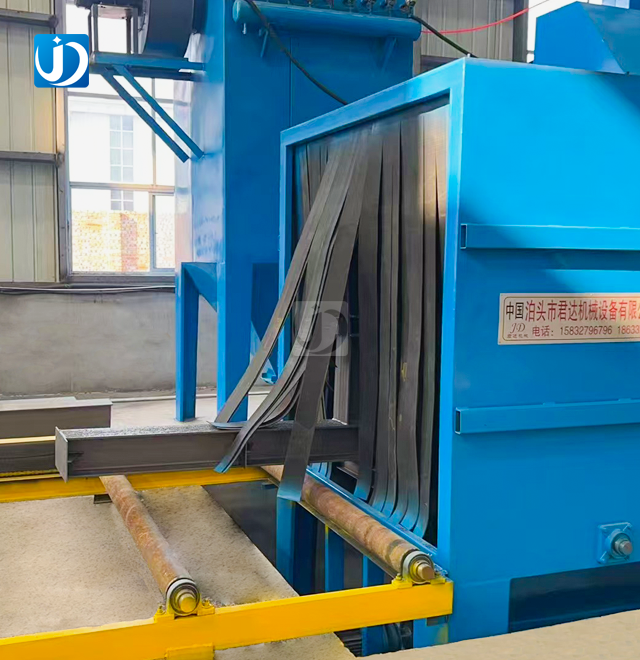
In a roller conveyor steel plate shot blasting treatment line, like the ones made by Junda Machinery, steel plates move automatically through a cabinet that is closed cabinet. Steel shot is sped up to 65–85 m/s by multiple centrifugal fans, usually 4–12 per machine based on the width of the plate. The abrasive hits the plate's surface at precise angles, breaking up and lifting oxide scale, rust, and surface contaminants all at the same time. The shot is then collected, sorted by a spiral separator, and used again. This cuts down on trash and running costs.
Abrasive Selection and Surface Profile
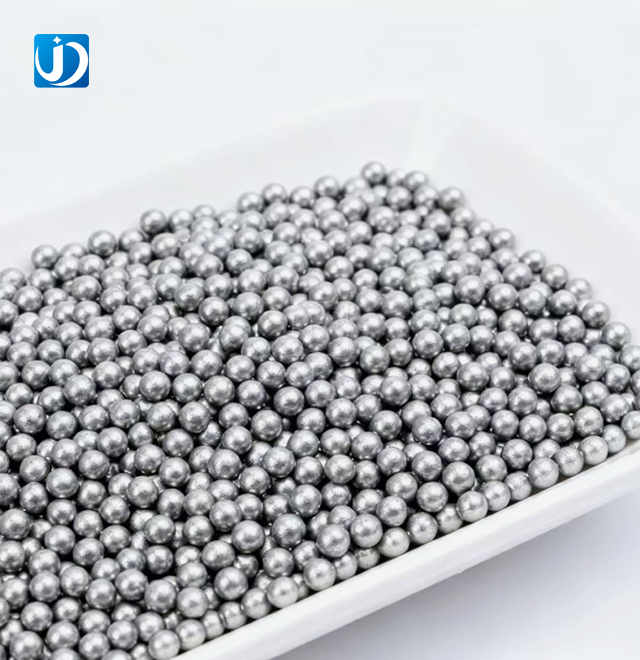
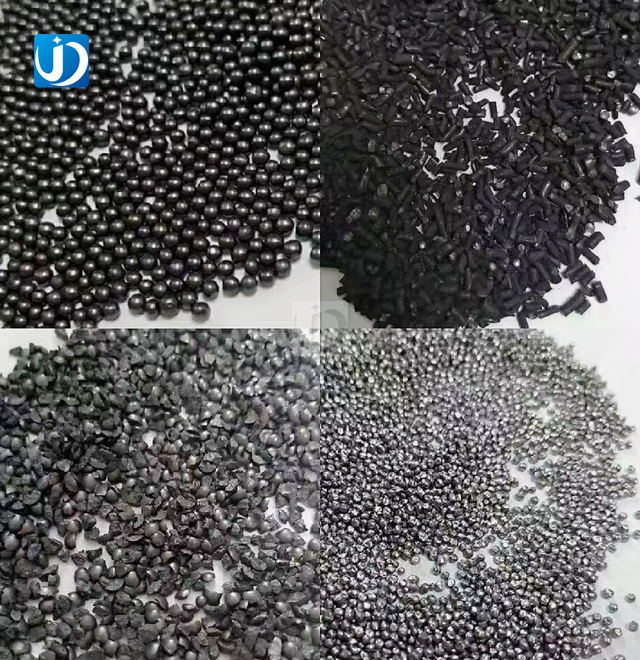
In order to change the anchor shape (Rz value), you must choose between steel shot (rounded) and steel grit (angular). For thin-film triggers, rounded shot is best because it creates a smooth surface with an Rz of 40–60 µm. With a depth of 60–80 µm Rz, angular grit is perfect for heavy anticorrosion coats on ship decks or bridge beams. Choosing the right type of grit for the coating is a technical choice that affects how well the coating sticks in the long run.
Why Shot Blasting Outperforms Sandblasting and Grinding
When you sandblast with silica sand, you release respirable crystalline silica (RCS) dust, which is a known carcinogen that is regulated by OSHA 29 CFR 1926.1153. Grinding takes a lot of work and doesn't always work the same way across large plate areas. Shot blasting with steel abrasives doesn't pose a silica risk, can handle 3–28 t/h, and consistently cleans all plates to Sa2.5 levels. These are all traits that sandblasting and manual grinding can't match on a large scale.
Benefits of Steel Plate Shot Blasting Treatment for B2B Clients
Facilities that move from semi-automatic blasting or grinding by hand to a continuous roller conveyor blasting line report improvements in speed, quality, and cost that can be seen. Here are the main benefits that make people decide to buy something:
- Sa2.5 cleanliness in a single pass: One continuous pass through the blasting cabinet achieves ISO 8501-1 Sa2.5 — the standard required by DNV, BV, LR ship classification societies and most infrastructure coating specifications. No secondary rework is needed.
- 400% longer coating lifespan: Research published by the SSPC and NACE confirms that coatings applied over a properly blasted Sa2.5 surface last approximately four times longer than coatings applied over hand-tooled or inadequately prepared surfaces.
- Seamless downstream integration: Junda Machinery's roller conveyor lines support PLC-controlled pacing, automatic loading and unloading, and direct interface with downstream painting and primer application lines — reducing labor touchpoints between surface prep and coating.
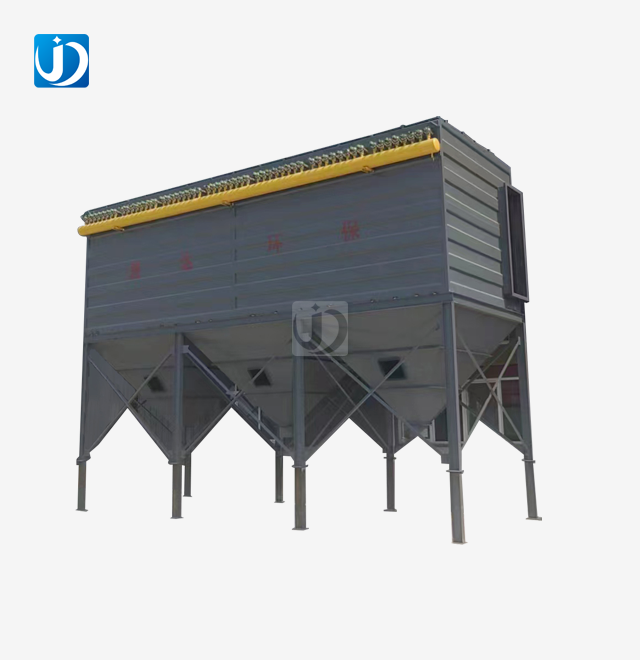
- Closed-loop dust and abrasive management: The integrated dust collection system captures particulates at source, maintaining a compliant working environment and protecting operators without interrupting production.
These benefits directly address the needs of medium to large fabricators in Southeast Asia, South Asia, and the shipbuilding industries: consistent quality output, less reliance on operators, and compliance documentation that can be checked for classification society audits.
Choosing the Right Steel Plate Shot Blasting Solution for Your Business
There are no two fabrication plants that have the same plate sizes, throughput goals, or downstream processes. The right set-up for tools rests on a number of factors that should be thought through before buying.
Roller Width and Plate Specification
Standard roller conveyor steel plate shot blasting treatment lines from Junda Machinery can handle plate widths of 1.5 m to 3.5 m, and custom configurations can go up to 5 m width. When builders work with wide hull plates or bridge makers work with thick flange plates, being clear about the right roller width from the start saves a lot of money in repairs later on.
Installed Power and Production Capacity
Installed power ranges from 45 kW to 220 kW across the product line, and throughput ranges from 3 t/h to 28 t/h. Between 150 and 200 tons of steel can be processed every day by a steel service center with two shifts. By matching installed power to peak production demand instead of just average demand, order surges don't cause bottlenecks in throughput.
Automation Level and MES Integration
Junda Machinery has PLC intelligent sorting, SCADA communication interfaces, and automatic loading/unloading units for facilities that want to do preprocessing without turning on the lights or connecting to a factory execution system (MES). This feature is especially useful for dock OEM tasks where the output of steel plate shot blasting treatment needs to be in sync with robotic painting cells.
Case Studies and Industry Applications
Shipbuilding: Permanent Anti-Fouling Bond
Under very high salt levels and water pressure, antifouling coatings must stick to the hull plates of ocean-going ships permanently. A shipyard in Southeast Asia that works with 50,000 tons of hull steel a year got rid of its manual blast rooms and put in a continuous roller conveyor blasting line instead. A BV-approved tester checked after the installation and confirmed that the Sa2.5 level was the same on all of the processed plates. This got rid of the need for coating repair, which used to take six weeks per vessel build.
Bridge Construction: 50-Year Lifecycle Compliance
Heavy-duty bridge beams need corrosion protection that is approved for 50 years of use in ISO 12944 C5-M (marine) or C5-I (industrial) settings. A lot of national bridge standards call for shot blasting to Sa2.5 with an anchor shape of 60–75 µm Rz. Fabricators who switched to automatic blasting lines say that independent pull-off tests according to ISO 4624 show that no coatings failed to stick to pre-blasted beams.
Pressure Vessel Manufacturing: Weld Integrity Assurance
When making pressure vessels, plates are blasted to get them ready for coating and to show any flaws on the surface so that ultrasonic testing (UT) can be done. UT probes can find laminations and inclusions that oxide scale would hide on a clean, scale-free surface. This keeps the material from failing under operating pressure.
Conclusion
Rough scaling, acid scale, and rust can all be fixed as long as the right method for preparing the surface is used regularly. Continuous roller conveyor steel plate shot blasting treatment gives consistent Sa2.5 cleanliness, controlled anchor profiles, and proof of meeting international classification society standards all in one automated pass. Fabricators, shipyards, and steel service centers that want to cut down on rework, make coatings last longer, and meet purchase requirements without sacrificing quality must have a properly designed blasting line. This point of view is clearly supported by statistics from SSPC, NACE, and ISO standards.
FAQ
Q1: What is the difference between shot blasting and sandblasting for steel plates?
Centrifugal wheels speed up steel abrasives that can be recycled in shot blasting. No compressed air is needed, and no silica dust is made. When you sandblast, you use compressed air to move silica sand around. This makes RCS dust, which OSHA says is a carcinogen. Shot blasting has a higher output, lower costs per ton for consumables, and is better for the environment.
Q2: How long can a shot-blasted plate remain uncoated?
A blasted plate can stay bare for 4 to 24 hours in a controlled setting with relative humidity below 50% before flash rust shows up. In tropical or coastal areas, like many Southeast Asian factories, shop primer is usually applied right away, within two to four hours of blasting.
Q3: Does shot blasting change the plate thickness?
The amount of material that is removed is very small (a few microns at most), and it has no effect on the structure of the plate thickness. The process changes the shape of the surface but not the size of the bulk.
Q4: What cleanliness grade do most industrial applications require?
About 90% of industrial finishing requirements can be met by Sa2.5 (Near-White Metal Clean per ISO 8501-1, the same as SSPC-SP10). Sa3.0 (White Metal) is only used in environments with high levels of chemicals or where it will be submerged.
Q5: What quality checks are performed after blasting?
As part of a standard post-blast inspection, the surface profile is measured using Testex replica tape (ISO 8503-5), the dust level is tested according to ISO 8502-3, and the Bresle method (ISO 8502-6) is used to check for salt contamination and make sure that soluble chlorides stay below 20 mg/m².
Get Your Steel Plate Surface Prep Right — Contact Junda Machinery
For twenty years, Junda Machinery has been designing roller conveyor blasting lines that can handle 3–28 t/h of material and achieve certified Sa2.5 results. As a company with ISO 9001, ISO 14001, and ISO 45001 certifications that specializes in steel plate shot blasting treatment, we offer full turnkey lines to producers in Southeast Asia, South Asia, and beyond. These lines include installation, commissioning, and long-term spare parts. To get a technical proposal, email junda001@jundablast.com with your plate specifications and production goals.
References
1. SSPC/NACE Joint Standard No. 2 — Near-White Metal Blast Cleaning (SSPC-SP10/NACE No. 2), SSPC: The Society for Protective Coatings, 2015.
2. ISO 8501-1 — Preparation of Steel Substrates Before Application of Paints and Related Products: Visual Assessment of Surface Cleanliness, International Organization for Standardization, 2007.
3. NACE International — Corrosion Cost and Preventive Strategies in the United States (NACE Publication 01103), 2016.
4. ISO 12944-4 — Paints and Varnishes — Corrosion Protection of Steel Structures by Protective Paint Systems: Types of Surface and Surface Preparation, International Organization for Standardization, 2017.
5. ISO 8502-3 — Tests for the Assessment of Surface Cleanliness: Assessment of Dust on Steel Surfaces Prepared for Painting, International Organization for Standardization, 2017.
6. Keane, J.D. — Good Painting Practice: SSPC Painting Manual, Volume 1, SSPC: The Society for Protective Coatings, 4th Edition, 2000.

USER EVALUATE
Real feedback and practical experience shared by worldwide partners who purchased our machinery and environmental treatment devices.