_1786959752558.webp)
Why Is a Pass-Through Shot Blasting Machine Used in Continuous Production?
By David Zhang, Senior Shot Blasting Equipment Engineer, Junda Machinery
A pass-through shot blasting machine is used in continuous production because it cleans steel without stopping the line. Parts ride on rollers through a sealed chamber, blast wheels hit every face, and the steel exits ready for primer. There is no batch loading and no hand grinding. This guide shows how the process works, which numbers matter, and how to size a line for your shop. Our team at Junda Machinery has built shot blasting equipment for 20 years, and every spec below comes from that work.
What Is a Pass-Through Shot Blasting Machine?
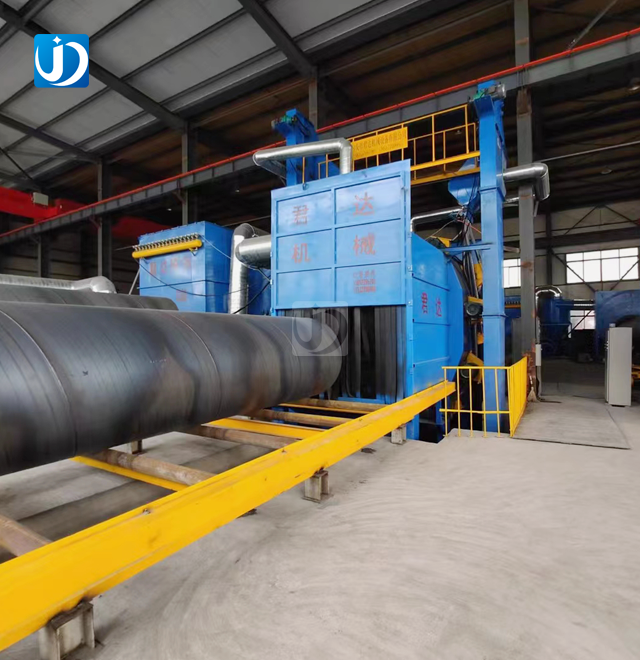
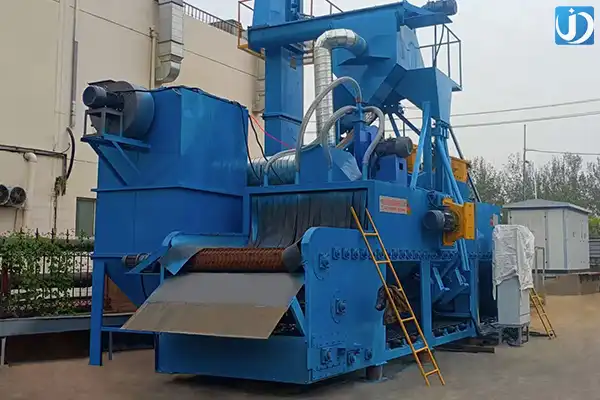
A pass-through shot blasting machine is a roller-conveyor blasting line that cleans steel while it travels straight through a sealed chamber. Centrifugal wheels throw steel shot at high speed. The impact strips rust, mill scale, and weld slag and leaves an even profile for paint. Buyers also search for terms such as roller conveyor shot blasting machine, through-type blasting line, and steel plate descaling machine. All of them describe one idea: the workpiece never waits for a batch cycle.
Our standard pass-through shot blasting machine carries four 15 kW blast wheels and about 90 kW of total installed power. It cleans plates, section steel, H-beams, and welded structures up to 2,000 mm wide and 1,000 mm high. Rollers carry up to 1.5 t per metre. One pass delivers 360° coverage and Sa 2.5 cleanliness.

Why Continuous Production Lines Rely on Pass-Through Shot Blasting
Continuous lines need every station to run at the same pace. Cutting, welding, and painting all move at line speed. A batch blaster breaks that rhythm because parts wait for loading, blasting, and unloading. A pass-through shot blasting machine closes the gap. Parts roll in on the same conveyor, blast for a set time, and roll out toward the paint booth. The blaster stops being the bottleneck.
How Do Continuous Flow Cut Coating-Line Delays?
Hand tools cannot keep up with a modern fabrication line. Steel Construction Info reports that hand and power tool cleaning reaches only about 30% to 50% effectiveness on mill scale and rust [1]. Results also vary from shift to shift. Our pass-through shot blasting machine treats 120–180 m² per hour, or about 8–12 t of structural steel. You set the conveyor speed between 0.5 and 2.5 m/min with a variable-frequency drive.
Why Does Sa 2.5 Matter for Coating Life?
Engineers widely accept surface preparation as the most important factor in coating success [1]. Bridge steelwork specifications usually call for Sa 2½ or Sa 3 [1]. The stakes are high. Corrosion costs the global economy more than $2.5 trillion each year, and early prevention could cut up to 35% of that cost [4]. A pass-through shot blasting machine exposes every part to the same blast time, so each piece gets the same result.
Timing matters too. Blasted steel can re-rust fast in damp air, so painting should follow quickly [1]. An inline blaster keeps that gap short.
How Does a Pass-Through Shot Blasting Machine Work Step by Step?
The process runs in five steps, and each step ties to a spec on your quote. Rollers carry the part into the chamber. Four blast wheels throw shots from the top, sides, and angled positions, so every face takes a hit in one pass. Spent abrasive drops to the bottom, where an air-wash separator splits reusable shot from dust and scale. Brushes and air blowers then clean loose dust off the part [1]. Finally, a pulse dust collector cleans the exhaust air.
Key Components of a Pass-Through Shot Blasting System
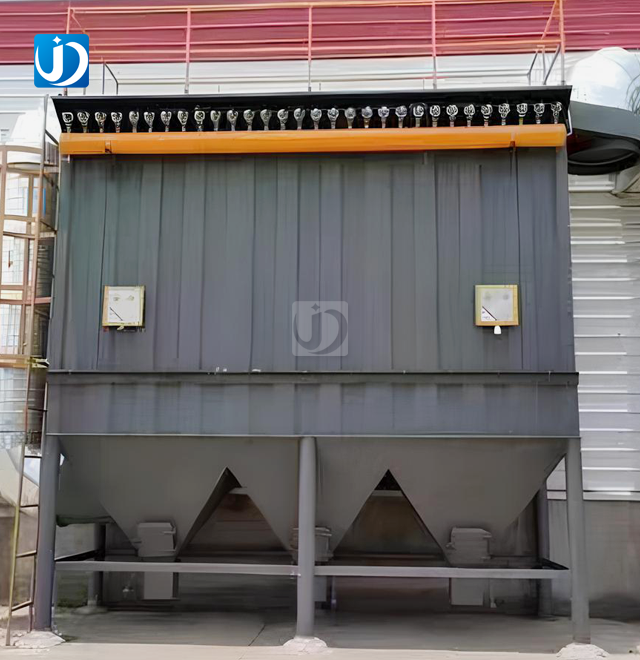
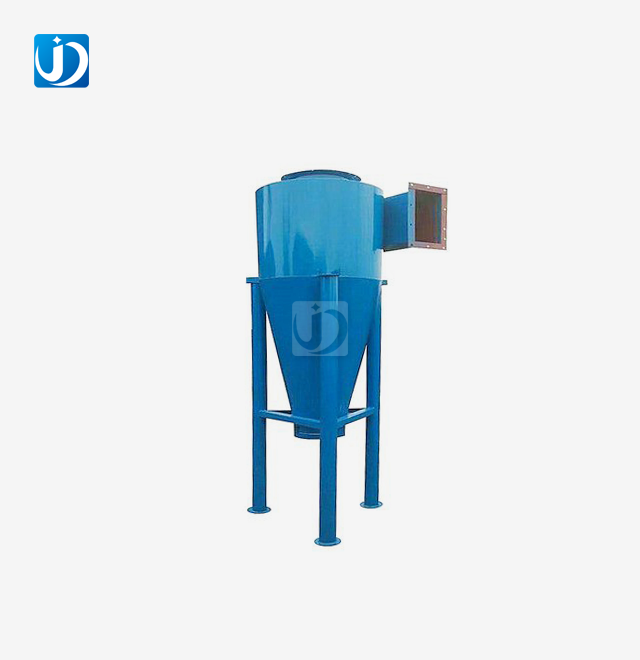
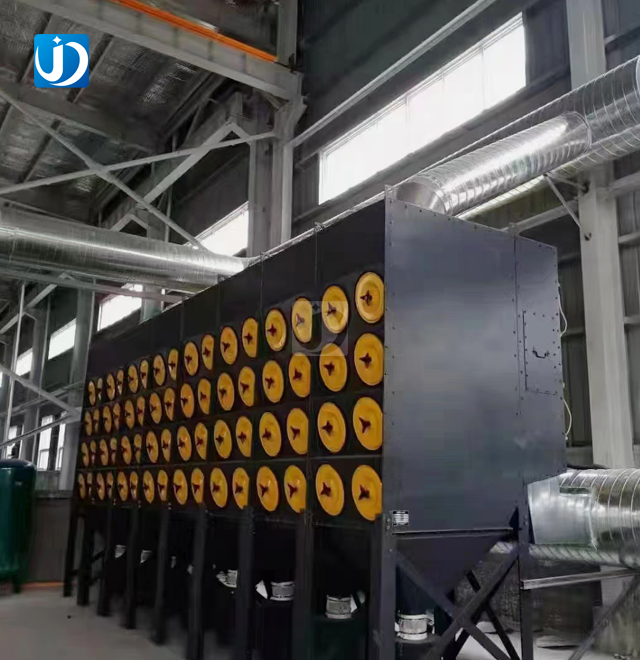
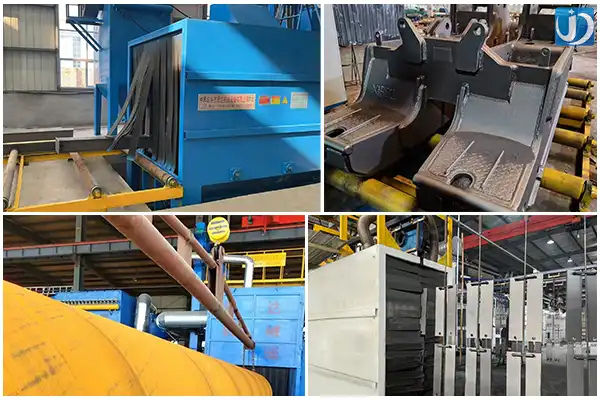
Six parts decide how well a pass-through shot blasting machine performs. The roller conveyor carries loads up to 1.5 t/m. High-manganese steel liners protect the chamber from abrasive wear. Four 15 kW wheel sets impact energy. The recycling loop cleans and returns the shot. The pulse collector holds emissions down. The control system sets speed and wheel start-up. Our self-developed monitoring software also tracks dust removal efficiency and maintenance schedules.
Pass-Through vs Batch-Type Shot Blasting: Which Fits Your Line?
Both machine types clean steel, but they serve different production patterns. This table compares them on the points buyers raise most often.
Factor | Pass-through (roller conveyor) | Batch-type (hanger or tumble) |
Part flow | Continuous, in line with cutting and painting | Load, blast, and unload in cycles |
Best parts | Plates, profiles, H-beams, long welded frames | Small castings, forgings, and loose parts in bulk |
Labor | Low, because rollers handle loading | Higher, because crews hang or load each batch |
Coverage | Every face in one pass | Depends on hanging position or tumble action |
Line fit | Matches line takt time | Adds a queue between stations |
When Does Batch Blasting Still Make Sense?
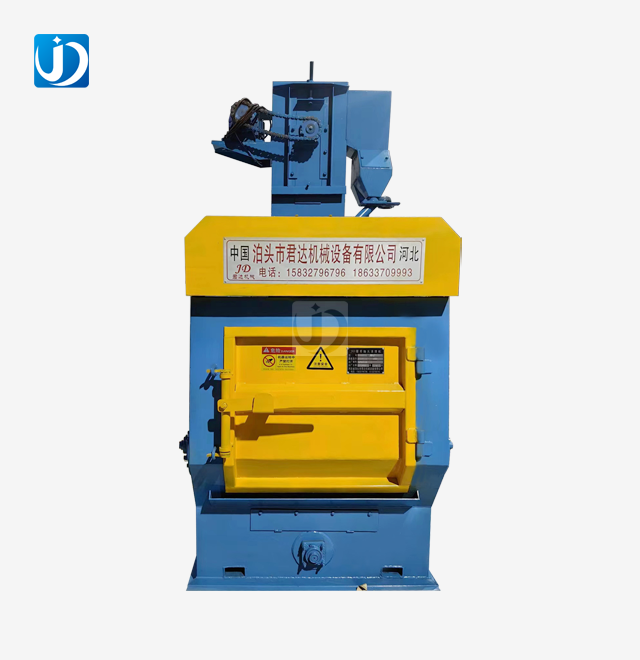
Batch machines suit small parts, mixed loads, and low daily volume. A tumble blaster handles bulk castings well. If your shop cleans a few dozen plates a week, a batch machine may cost less. Once your line feeds a paint booth every few minutes, a pass-through shot blasting machine wins on labor, floor flow, and consistency.
What Cycle Time Can a Pass-Through Machine Achieve in 2026?
A pass-through shot blasting machine has no batch cycle, so conveyor speed sets the pace. Our unit runs from 0.5 to 2.5 m/min. A 6 m beam at 2 m/min passes any fixed point in 3 minutes, and the next beam can follow right behind it. Area per hour depends on part shape. Our rated range is 120–180 m² per hour.
How Do Speed and Wheel Count Change Throughput?
Heavier rust needs more blast time, so you slow the conveyor. Clean plate with light mill scale can run faster. Modern wheel-blast plants typically use 4 to 8 wheels to cover every surface [1]. More wheels raise capacity for wider or heavier work, and we tune wheel count, chamber width, and dust collection to your line. The market is moving the same way. Analysts value the global shot blasting machine market at $1.39 billion in 2026, rising to $1.7 billion by 2030, with Asia-Pacific the largest region [3].
Which Industries Use Pass-Through Shot Blasting Machines Most?
Any shop that blasts long, flat, or heavy steel before paint gains from a pass-through shot blasting machine. Three use cases stand out.
Steel Structure and Bridge Fabrication
Fabricators cut, weld, blast, and paint H-beams, columns, and box girders. A pass-through shot blasting machine removes mill scale and weld slag in one pass, so painters start with clean steel. Weld spatter and slag must come off before coating [1]. Our 2,000 × 1,000 mm opening covers most standard sections.
Solar Supports and Container Parts
Solar mounting frames and container panels run in high volume on tight takt times. A pass-through shot blasting machine holds a steady conveyor speed, which keeps blasting quality even across thousands of similar parts. The sealed chamber and pulse dust collector keep shot and dust inside the machine.
Steel Plate and Profile Processing
Service centers and plate processors descale and derust steel with a pass-through shot blasting machine before cutting, welding, or coating. AGTOS notes that roller conveyor systems with cross conveyors can link blasting, preservation, sawing, and drilling on one line [6]. Demand supports these users. Worldsteel forecasts India’s steel demand to grow 7.4% in 2026 and 9.2% in 2027 [2]. More steel to fabricate means more surface to prepare.
Top 7 Design Factors That Decide Throughput and Cost
Seven design choices set how fast a pass-through shot blasting machine runs and what it costs to own. Match each one to your parts before you request a quote.
Design factor | What it controls | Junda standard spec |
1. Opening size | Largest part you can process | 2,000 mm wide × 1,000 mm high |
2. Wheel count and power | Cleaning speed and coverage | Four 15 kW wheels; count is customizable |
3. Conveyor speed range | Blast time per part | 0.5–2.5 m/min, variable frequency |
4. Roller load | Weight per meter of conveyor | 1.5 t/m |
5. Wear and sealing | Shot loss and floor cleanliness | High-manganese liners, sealed chamber |
6. Dust collection | Emissions and local compliance | Pulse dust collector and air-wash separator |
7. Controls and monitoring | Uptime and maintenance planning | Self-developed monitoring and management software |
Each factor also moves the price. More wheels and wider openings add cost and floor space. Our pass-through shot blasting machine measures about 8,500 × 3,200 mm and weighs about 12.5 t, so plan your foundation and crane access early.
Common Pass-Through Blasting Problems and How to Fix Them
Buyers usually worry about four issues with a pass-through shot blasting machine. Thin plate can warp under heavy blasting, so reduce wheel energy or use lighter shot. Long parts can drift on rollers, so align the rollers and add guides. Shot leakage makes a mess on the floor, so inspect seals and liners on a set schedule. Uneven cleaning points to worn blades or a clogged separator, so track blade hours and clean the air-wash. Our English maintenance videos and remote troubleshooting help your crew fix each one fast.
How to Choose the Right Pass-Through Shot Blasting Machine
Match Machine Configuration to Your Production Requirements
Start with your largest part and your line takt time. Add your target grade, such as Sa 2.5, and the rust condition of your steel. Then match the opening size, wheel count, and dust control of your pass-through shot blasting machine to those inputs. Distributors and OEM partners can also order private labeling, custom paint, and local voltage.
Export rules matter too. Regulation (EU) 2023/1230 applies from 20 January 2027 and replaces the Machinery Directive [5]. It sets mandatory health and safety requirements for machinery sold in the EU [5]. Junda helps customers apply for CE marking and supplies test reports, customs papers, and certificates of origin.
Botou Junda Machinery Equipment Co., Ltd. sits in Botou, Hebei, China’s base for foundry machinery and dust removal equipment. We hold ISO 9001, ISO 14001, and ISO 45001, plus two utility model patents and seven software copyrights.
Which Tests Should You Run Before You Buy?
Ask every pass-through shot blasting machine supplier for a test blast on your own plate or beam. Compare the result with the ISO 8501-1 reference photos, and check surface dust with the tape method in ISO 8502-3 [1]. Confirm delivery time, spare parts supply, and warranty terms in writing. We ship custom builds in about 15 days and supply original spare parts long term. We also offer remote installation guidance, operator training, and overseas engineer service when required. Distributors also get English manuals and FCL or LCL shipping support.
Conclusion
A pass-through shot blasting machine keeps steel moving from cutting to paint with one consistent surface result. It replaces slow hand work, removes the blasting queue, and reaches Sa 2.5 in one pass. Match opening size, wheel count, conveyor speed, dust control, and certification to your line. Then test your own parts before you sign.
FAQ
What is a pass-through shot blasting machine used for?
A pass-through shot blasting machine cleans plates, profiles, H-beams, and welded steel before painting or coating. It removes rust, mill scale, and weld slag while parts travel on a roller conveyor.
How fast is a pass-through shot blasting machine?
Our pass-through shot blasting machine runs at 0.5–2.5 m/min and treats 120–180 m² per hour, or about 8–12 t of structural steel per hour.
Can it reach Sa 2.5 in a single pass?
Yes. Our pass-through shot blasting machine uses four 15 kW wheels to cover every face, and one pass reaches Sa 2.5. Request a test blast on your own parts to confirm.
What is the largest workpiece it can handle?
The standard opening is 2,000 mm wide and 1,000 mm high, with a roller load of 1.5 t/m. We can customize the opening for wider lines.
How long does delivery take, and does Junda help with CE?
Custom builds ship in about 15 days. We answer inquiries within 6–8 hours and help you apply for CE marking with test reports and customs documents.
Ready to Test Your Steel on a Pass-Through Line?
Looking for a pass-through shot blasting machine for sale with a 15-day build time? Junda Machinery will test your plate or beam and quote a line that fits your takt time. Email junda001@jundablast.com with your part sizes, target grade, and voltage. Our engineers respond within 6–8 hours. You can also review our full range at jundablast.com.
References
[1] Steel Construction Info (2026). Surface preparation.
[2] worldsteel (2026). worldsteel Short Range Outlook April 2026.
[3] The Business Research Company (2026). Shot Blasting Machine Global Market Report 2026.
[4] AMPP, Materials Performance (2025). Understanding the Impact of Corrosion: A Global Call to Action.
[5] EU-OSHA (2023). Regulation (EU) 2023/1230 on machinery.
[6] AGTOS (2026). Roller conveyor shot blast machines.

USER EVALUATE
Real feedback and practical experience shared by worldwide partners who purchased our machinery and environmental treatment devices.