_1786959752558.webp)
What Is a Pass-through Shot Blasting Machine?
By David Zhang, Senior Shot Blasting Equipment Engineer, Junda Machinery
A pass-through shot blasting machine is a roller-conveyor blasting line that cleans steel while the steel moves straight through a sealed chamber. Blast wheels throw steel shot at every face, so rust, mill scale, and weld slag come off in one pass. This guide gives you a plain definition, the parts list, real speed and capacity figures, and a cost comparison with manual sandblasting. Junda Machinery has built shot blasting equipment for 20 years, and every spec below comes from our own machine.
What Is a Pass-Through Shot Blasting Machine? Simple Definition
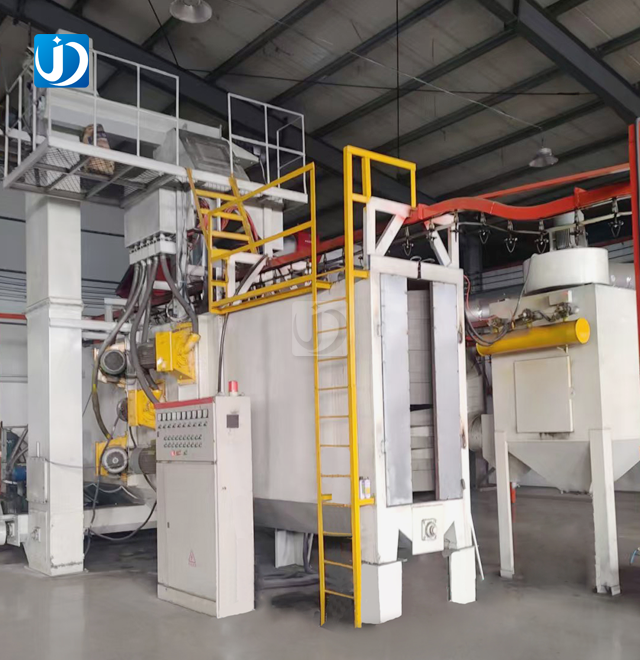
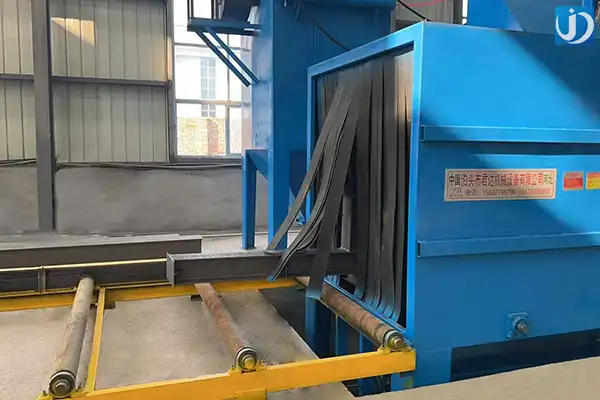
In simple terms, a pass-through shot blasting machine is an automatic wheel-blast system. Workpieces ride on a roller conveyor through a closed blast chamber. Centrifugal wheels throw metal shot at high speed. The shot strips rust, scale, and slag and leaves an even profile for coating. Buyers also call it a roller conveyor shot blasting machine, a through-type blaster, or a steel plate descaling line.
Our standard pass-through shot blasting machine uses four 15 kW wheels and about 90 kW of total installed power. Its opening measures 2,000 mm × 1,000 mm. Rollers carry 1.5 t per meter. One pass gives 360° coverage and Sa 2.5 cleanliness. Sa 2½ is the ISO 8501-1 grade for very thorough blast cleaning, and bridge steelwork specs usually call for Sa 2½ or Sa 3 [1].
How Does a Pass-Through Shot Blasting Machine Work?
The process runs in five steps. Rollers carry the workpiece through the entry seal. Four wheels throw shot from above, the sides, and angled positions, so every face takes impact in one pass. Spent abrasive drops into a hopper, and an air-wash separator splits reusable shot from dust and scale. Brushes and air blowers then clear loose dust off the part [1]. Every pass-through shot blasting machine ends with a pulse dust collector that cleans the exhaust air before release.
Main Components of a Pass-Through Blasting Machine
Six components decide how a pass-through shot blasting machine performs. The table lists each job and our standard spec.
Component | Job | Junda standard spec |
Roller conveyor | Carries parts through the chamber | Loads up to 1.5 t/m |
Chamber liners | Resist abrasive wear | High-manganese steel plates |
Blast wheels | Throw shot at every face | Four 15 kW wheels, 360° coverage |
Recycling and separator | Return clean shot, remove dust and scale | Air-wash separation |
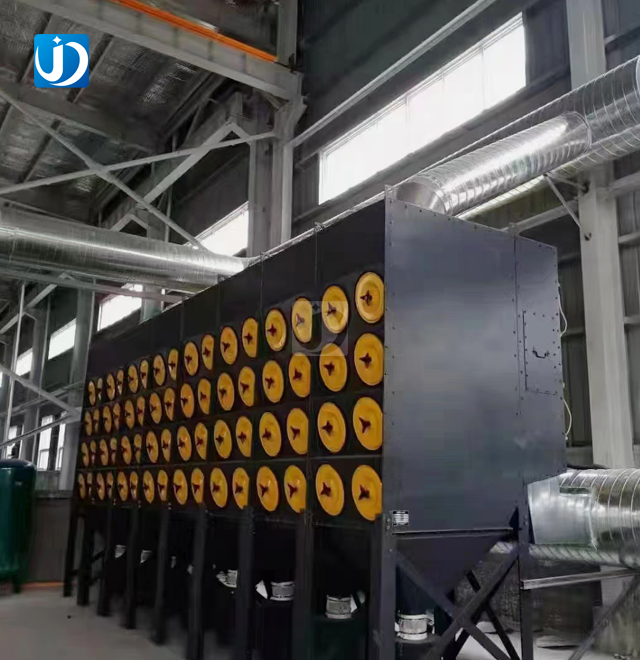
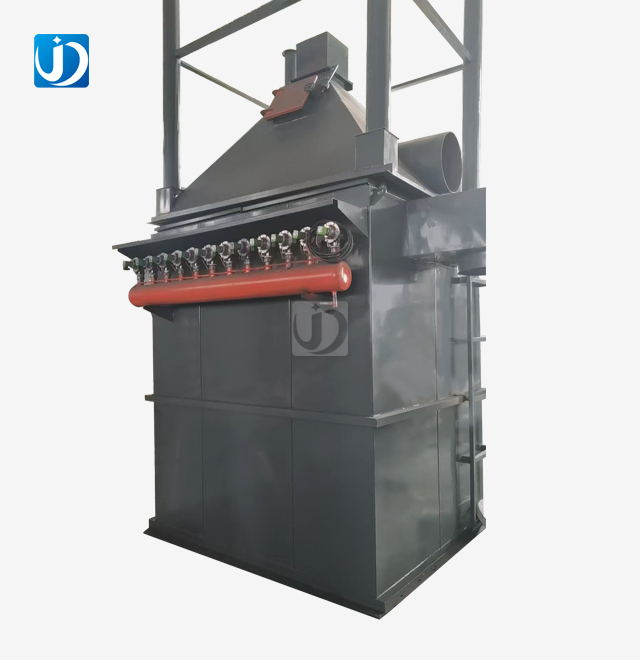
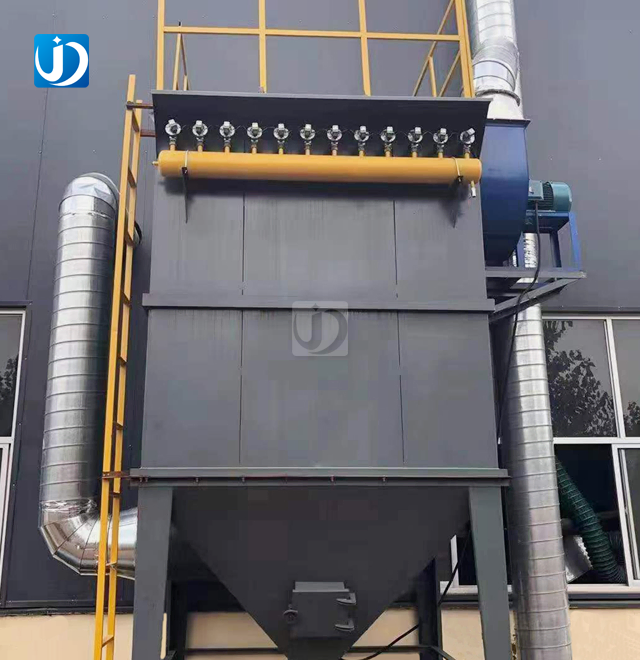
Dust collector | Clean the exhaust air | Pulse dust removal |
Controls | Set speed and track wear | Variable-frequency drive, self-developed monitoring software |
Pass-Through vs Tumble Belt vs Hook Type: Key Differences
Rösler lists tumble belt machines and multi-tumblers as typical batch systems, hanger machines as a fit for larger single pieces, and roller conveyor machines as the choice for long workpieces in continuous flow [3]. The table turns that split into a buyer view. A pass-through shot blasting machine differs from batch and hook systems in flow, labor, and coverage.
Factor | Pass-through | Tumble belt | Hook type |
Part flow | Continuous, in line with cutting and painting | Batch cycles | Single piece or batch |
Best parts | Plates, profiles, H-beams, welded frames | Small robust parts that can tumble | Large, heavy, or delicate parts |
Labor | Low, because rollers load the parts | Moderate, for bulk loading | Higher, because crews hang each piece |
Coverage | Every face in one pass | Parts turn over in the drum | Rotating hook exposes all sides |
Main limit | Part must ride on rollers | Part must tolerate impact | Slower loading and hook capacity |
Which Type Should You Pick for Your Parts?
Pick tumble belt for bulk castings and forgings. Pick hook type for heavy or collision-sensitive parts with complex shapes. Pick a pass-through shot blasting machine when your steel is long, flat, or welded and feeds a paint line. Mixed shops sometimes run two types. Match the machine to the part, not the other way around.
What Workpieces Suit Pass-Through Shot Blasting Best?
Steel that rides on rollers without tumbling suits this design. Three use cases stand out for buyers in Vietnam, Malaysia, Indonesia, India, and South Korea.
Structural Steel and Bridge Girders
Fabricators cut, weld, blast, and paint H-beams, columns, and box girders. A pass-through shot blasting machine removes mill scale and weld slag in one pass, and weld spatter must come off before coating [1]. Our 2,000 × 1,000 mm opening and 1.5 t/m roller load cover most standard sections.
Solar Supports and Container Parts
Solar mounting frames and container panels run in high volume on tight takt times. A steady conveyor speed keeps blast quality even across thousands of similar parts. The sealed chamber of a pass-through shot blasting machine keeps shot and dust inside.
Plate and Profile Processing
Service centers descale plates, angles, and channels with a pass-through shot blasting machine before cutting, welding, or coating. Demand supports them. Worldsteel forecasts India’s steel demand to grow 7.4% in 2026 and 9.2% in 2027, and developing economies outside China to grow 5.1% in 2027 [2]. More steel to fabricate means more surface to prepare.
Typical Throughput and Conveyor Speed Data for 2026
Conveyor speed sets throughput. Our pass-through shot blasting machine runs at 0.5–2.5 m/min with variable-frequency control. It treats 120–180 m² per hour, or about 8–12 t of structural steel per hour. A 6 m beam at 2 m/min passes any fixed point in 3 minutes, and the next beam can follow right behind it.
What Changes Speed in Practice?
Heavy rust needs more blast time, so you slow the conveyor. Clean plate with light mill scale can run faster. Modern plants typically use 4 to 8 wheels to cover every surface [1]. Rösler lists roller conveyor machines with up to eight turbines for large steel [3]. More wheels raise the capacity of a pass-through shot blasting machine. We tune wheel count and chamber width to your takt time.
Advantages and Limitations of Pass-Through Blasting
What Are the Advantages?
A pass-through shot blasting machine gives every part the same blast time, so cleanliness stays even from shift to shift. It keeps steel moving between cutting and painting. It cuts hand labor and holds dust inside a closed chamber. Blasted steel re-rusts fast in damp air, so an inline machine shortens the wait before paint [1]. Our monitoring software tracks dust removal efficiency and maintenance needs.
What Are the Limitations?
This design does not suit small bulk parts, and every part must ride on rollers. Thin plate can warp under heavy blasting, so lighter shot or lower wheel energy helps. A pass-through shot blasting machine also needs floor space of about 8,500 × 3,200 mm and costs more up front than a batch unit. A test blast on your own steel settles these doubts early.
Pass-Through Blasting vs Manual Sandblasting: Cost Compared
Manual sandblasting looks cheap until you count labor, containment, and health risk. A Graco bidding guide uses 13.9 m² per hour as an illustrative rate for one nozzle and warns that real rates vary [5]. Against that example, our pass-through shot blasting machine at 120–180 m² per hour equals roughly nine to thirteen nozzles working at once.
Safety adds cost too. OSHA lists abrasive blasting with sand among the activities that expose workers to respirable crystalline silica dust [4]. A closed chamber keeps operators away from the blast zone, and our machine blasts with steel shot. Rework also drops, because each piece gets the same treatment.
How Much Does a Pass-Through Shot Blasting Machine Cost?
No single honest price exists. Strong Makine’s 2026 price guide names turbine count, cabin material, and automation level as key drivers and advises buyers to request a factory quote [6]. The same holds for us. The price of a pass-through shot blasting machine moves with wheel count, opening size, dust system, voltage, and controls. Send drawings and we quote within 6–8 hours. Compare offers on total cost, including installation, training, spare parts, and warranty.
How to Select and Install the Right Pass-Through Machine
Start with your largest part, your takt time, and your target grade. Then match opening size, wheel count, and dust control. Ask each pass-through shot blasting machine supplier for a test blast on your own steel and compare it with the ISO 8501-1 photos [1]. Buyers in Vietnam, Malaysia, Indonesia, India, and South Korea also raise local voltage and dust rules. We configure voltage, dust collection, painting, and private labeling to your site.
What Does Installation Involve?
Plan floor space for about 8,500 × 3,200 mm and a machine weight near 12.5 t. Prepare the foundation, crane access, power, and dust duct route. We guide installation remotely, commission the machine, train your operators, and send an overseas engineer when required. English manuals and maintenance videos come with every pass-through shot blasting machine. Distributors get FCL, LCL, and oversized shipping support, plus CE documents, test reports, and certificates of origin.
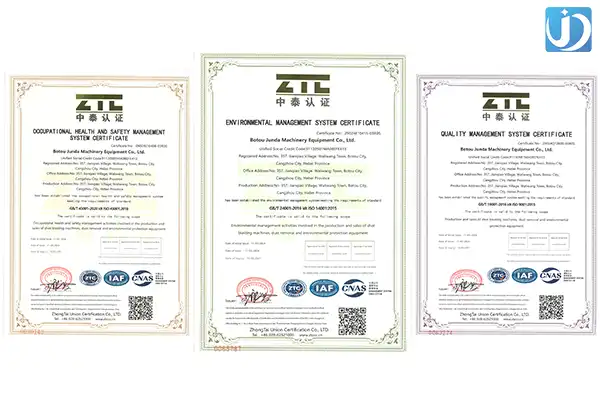
Botou Junda Machinery Equipment Co., Ltd. sits in Botou, Hebei, China’s base for foundry machinery and dust removal equipment. We hold ISO 9001, ISO 14001, and ISO 45001, plus two utility model patents and seven software copyrights. We also keep inventory for fast orders.
Conclusion
A pass-through shot blasting machine replaces slow hand blasting with one continuous, repeatable process. It suits long, flat, and welded steel, reaches Sa 2.5 in one pass, and keeps your paint line supplied. Weigh opening size, wheel count, speed, dust control, and local voltage against your parts. Then ask for a test blast before you commit.
FAQ
What is a pass-through shot blasting machine?
A pass-through shot blasting machine is a roller-conveyor blasting line. Workpieces travel through a sealed chamber where wheels throw steel shot at every face. It removes rust, mill scale, and weld slag in one pass.
How does a pass-through machine differ from a hook type machine?
A pass-through shot blasting machine moves long, flat, or welded steel continuously on rollers. A hook type machine hangs heavy or delicate parts one at a time or in batches. Pass-through suits paint-line feeding, while hooks suit complex shapes.
What conveyor speed and capacity does it offer?
Our pass-through shot blasting machine runs at 0.5–2.5 m/min and treats 120–180 m² per hour, or about 8–12 t of structural steel per hour.
Is it cheaper than manual sandblasting?
It costs more up front. It cuts labor, containment, and rework, and one machine matches roughly nine to thirteen illustrative nozzle rates [5]. Send your daily volume for a quote.
How long does delivery take, and does Junda help with CE?
Custom builds ship in about 15 days. We answer inquiries within 6–8 hours and help you apply for CE marking with test reports and customs documents.
Ready to Send Your Drawings for a Test Blast Quote?
Searching for a pass-through shot blasting machine for sale that fits your line speed and local voltage? Junda Machinery will review your parts and quote a configuration with dust control and delivery terms. Email junda001@jundablast.com with sizes, target grade, and site details. Our engineers respond within 6–8 hours. You can also review our full range at jundablast.com.
References
[1] Steel Construction Info (2026). Surface preparation.
[2] worldsteel (2026). worldsteel Short Range Outlook April 2026.
[3] Rösler Group (accessed 2026). Shot blasting technology overview.
[4] OSHA (accessed 2026). Silica, Crystalline: Overview.
[5] Graco (accessed 2026). How to Bid on an Abrasive Blasting Project and Profit.
[6] Strong Makine (2026). 2026 Shot Blasting Machine Prices.

USER EVALUATE
Real feedback and practical experience shared by worldwide partners who purchased our machinery and environmental treatment devices.