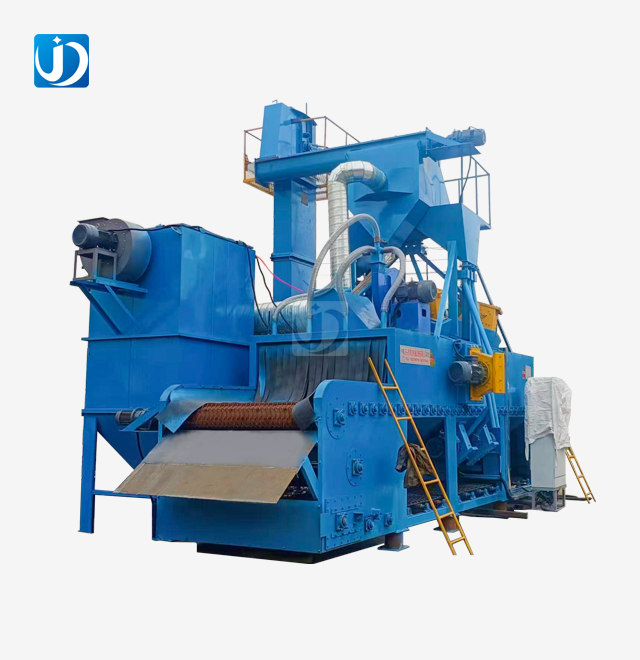
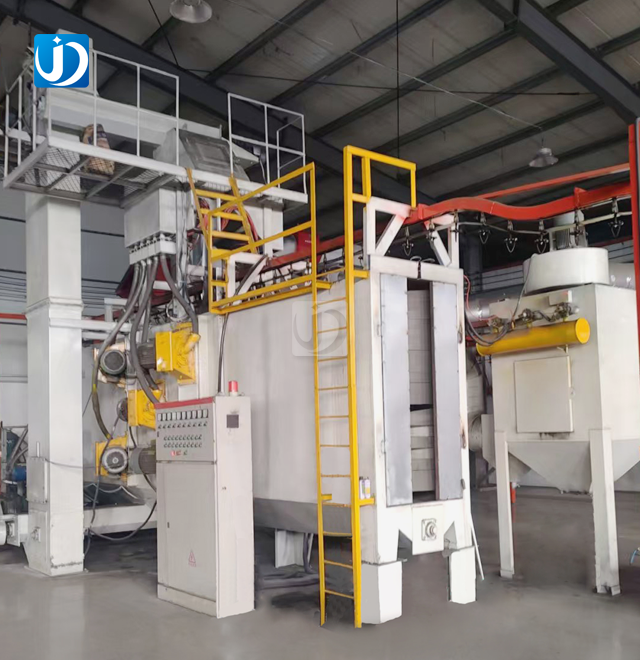
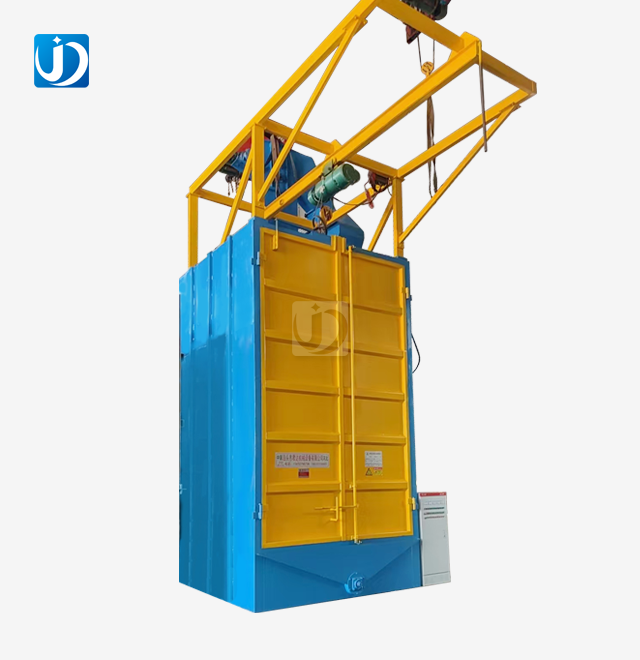
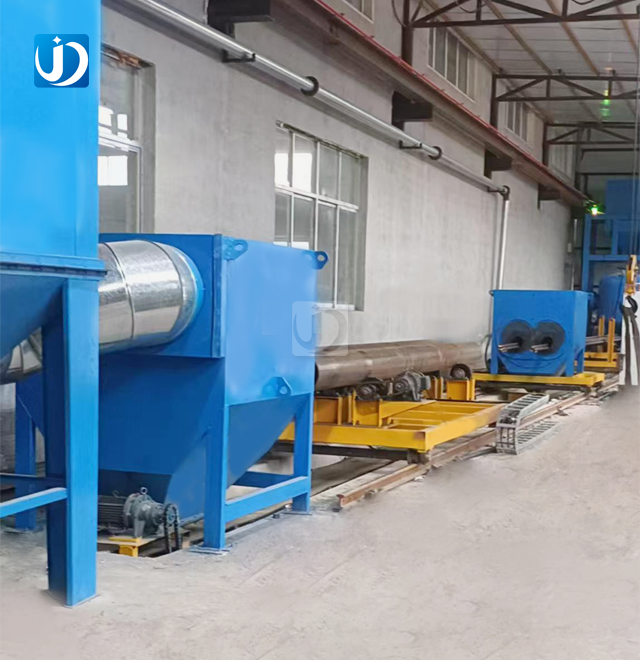
What Is a Hook Pass-Through Shot Blaster and How Does It Work?
What Is a Hook Pass-Through Shot Blaster Used For?
Definition and Scope
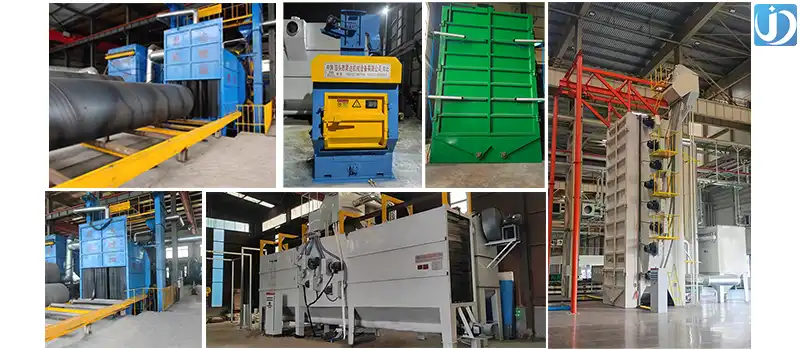
A single-rail overhead track runs through one or more blast chambers on a "hook pass-through shot blaster." Parts go in, get cleaned, and come out without having to be unhooked or moved during the cycle. A fixed conveyor path moves the process along instead of a person moving a nozzle by hand, so it's not a manual blast cabinet. Not a tumble belt machine, which drops small, loose pieces into a drum that turns. It's also not the same as a single-station hanger blaster, which stops the hoist to clean one part, or a paint booth, which coats things instead of cleaning them.
Typical Applications
The Q37, Q38, and Q48 series from Junda are used for parts of construction equipment, truck frames and chassis, large castings, and awkwardly shaped building parts that a flat conveyor cannot hold. The single-hook can hold between 500 kg and 10,000 kg, which is enough for small brackets to full backhoe counterweights. Because the hoist height can be changed by a variable frequency drive and the hook can spin, operators can slow the cycle down for castings that are heavily rusted or speed it up for fabrications that are only lightly scaled. Because of this, fabrication shops that make a variety of goods choose hook-style systems over fixed roller lines.
Three Use-Case Scenarios
The same hook pass-through shot blaster is bought by different people who have different questions. The following table lists common needs based on the type of buyer.
| Buyer or user | Typical requirement | Suitable configuration |
|---|---|---|
| Structural steel plant owner | Faster turnaround on heavy welded frames | Larger single-hook capacity, longer rail, alternating load/unload stations |
| Equipment distributor | One machine that fits many customer part types | Standard Q37/Q38 model with modular wheel count |
| Fabrication line manager | Fitting the blaster into an existing paint line | Hook conveyor synced to painting conveyor speed |
That's why power alone isn't enough to choose the right machine. Rail length, hook spacing, and how the blaster connects to stations upstream and downstream are just as important as the amount of work it does.
How a Hook Pass-Through Blaster Works Step by Step?
Once buyers understand the purpose, they want to know how the process works from hanging a part to cleaning it up.
Loading and Conveyor Movement
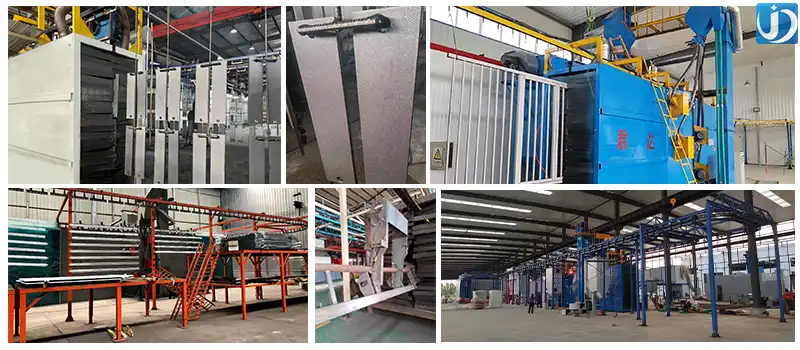
The parts are put on the single rail by hooks that are spaced out along it. They are then loaded by a crane, an overhead hoist, or an automatic loading station. The hook spins between 2 and 4 times per minute, which means that the abrasive gets to all sides of the part, not just the ones that face the wheels. The frequency of both the hoist and the rotation speed can be changed, so the cycle time can be adjusted to fit the size, weight, and level of rust on the part. The main difference from single-station machines is that while one part blasts, the next part is already being put at the place where it comes in.
Abrasive Blasting Process
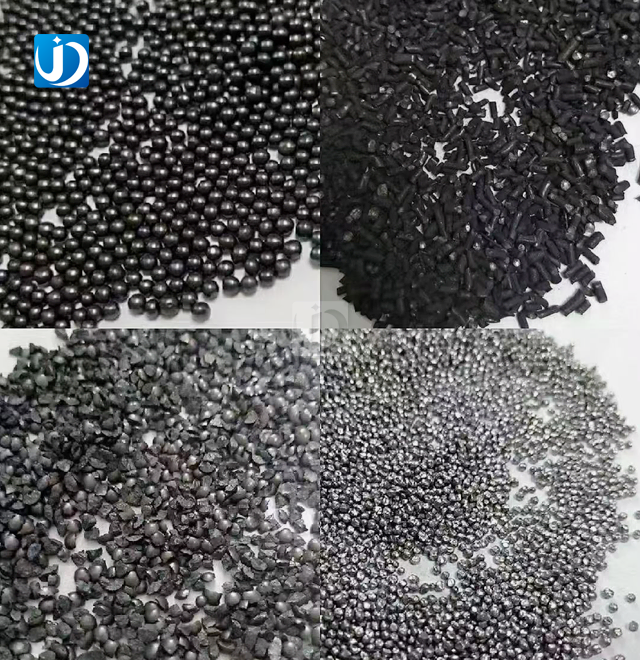
The part first goes into the sealed chamber through a door or rubber curtain that keeps the abrasive inside. Then, as the hook turns and moves forward, high-alloy blast wheels speed up the steel shot that hits the surface from different directions. The shot that bounces back and the trash that is taken away fall through a grated floor and into a collection bin below the chamber. The mix is taken to an air-wash separator by a bucket lifter. This separates the reused shot from the dust and broken abrasive. The clean shot goes back to the wheels on its own, and the part comes out of the other end ready to be inspected, painted, or welded.
Abrasive Recovery and Dust Collection
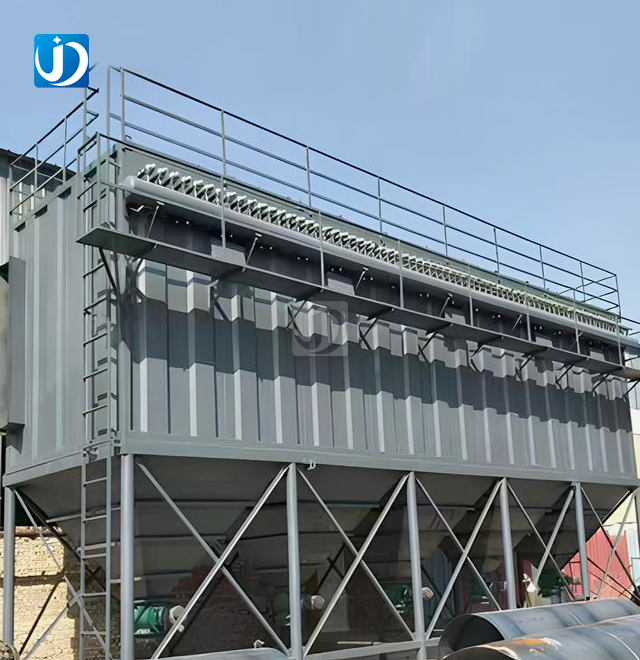
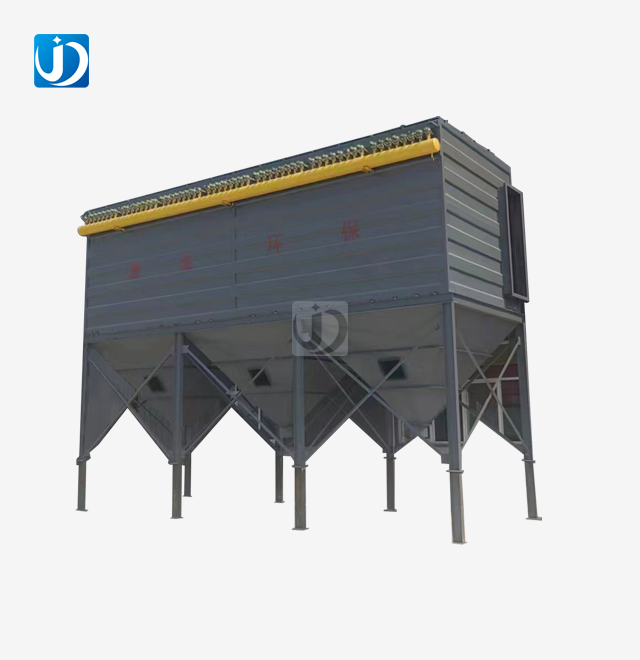
A screw conveyor and a bucket lift work together in Junda's recycling system to move used abrasive without having to be scooped by hand. This saves both time and abrasive. The air-wash separator then uses a controlled air stream to separate the fines from the usable shot. This keeps the shot size the same from cycle to cycle. A cartridge-style dust collector pulls particles out of the chamber before they reach the floor of the plant, and differential-pressure sensors let you know when filters get clogged before the flow of air stops. Reference: ISO 8502 series (2003), which talks about checking for dirt on the surface after cleaning.
The steps in the process are as follows: loading, hook conveyor, blast chamber, abrasive recovery, dust collection, unloading, and inspection.
Hook Pass-Through vs Single-Station Hook Blasting
A lot of people who are upgrading from an older machine already have a single-station hanger blaster. Here's how the hook pass-through shot blaster and the single-station hanger blaster stack up when it comes to the things that affect daily output.
Core Comparison
| Criterion | Hook pass-through shot blaster | Single-station hook blaster |
|---|---|---|
| Operating mode | Continuous or semi-continuous | Batch, one load at a time |
| Loading method | Multiple hooks moving in sequence | One hook, one load position |
| Throughput | Higher for repeat production | Lower, but flexible |
| Labor after setup | Lower | Higher, constant loading and unloading |
| Floor layout | Needs infeed and outfeed space | More compact |
| Typical investment | Higher | Lower |
When to Choose Each Machine?
When production stays steady and parts hang from the same points, a pass-through system makes its money back because the machine keeps going while the next batch is loaded. Plants that make truck chassis, excavator arms, or families of parts that are cast over and over again fit this pattern well. There are still times when a single-station hook blaster makes sense. This is when the freedom of manually loading parts beats the speed loss from stopping between parts, the floor space is limited, or the daily volume is low.
Decision Checklist
A plant manager should check a short list of facts about the real production line, not just the stock numbers, before deciding between the two. The following items cover the checks that are most often skipped when quotes are given.
- Confirm the maximum single part weight and how that compares to the heaviest job on your order book for the next two years, since undersizing the hook capacity is the most common reason buyers request a second machine within 18 months.
- Check the center of gravity on irregular parts like frames or arms, because an unbalanced hang can swing into chamber walls or neighboring hooks, causing dents that lead to rework or customer rejection.
- Match required cleanliness grade, such as Sa2.5 under ISO 8501-1 (2007), against your coating supplier's specification, since over-blasting wastes abrasive and under-blasting causes coating failure and warranty claims.
- Walk the shop floor to confirm ceiling height, rail run length, and clearance around existing cranes, because retrofitting a pass-through rail into a tight bay often costs more than the machine itself.
These checks fix the two things that buyers complain about most after installation: a rail path that doesn't fit the building and a capacity that is too small.
Roller Conveyor vs Hook Conveyor: Which to Choose?
Some shops that make things are picking between a roller line and a hook line instead of two different kinds of hooks. The shape of the part is more important than the price when choosing.
Roller Conveyor Shot Blasting
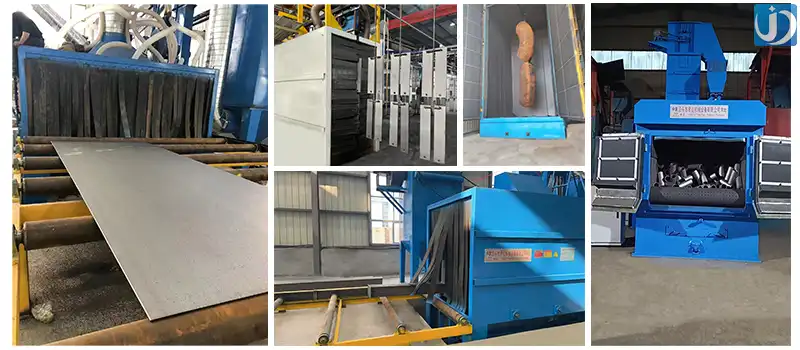
A roller conveyor is good for moving steel plates, beams, profiles, and long flat pieces that can stay in place on driven wheels as they move through the chamber. Plate-processing lines can go through it quickly, and it's easy to connect to cutting and painting units upstream and downstream. There is a dark area where the part hits the rollers, so the shot can't reach that surface directly. This leaves a strip that needs to be cleaned again if the whole surface needs to be cleaned.
Hook Conveyor Shot Blasting
For parts that need to be blasted from all sides, like metal frames, molds, housings, and more, a hook conveyor is the best choice for a hook pass-through shot blaster. Junda's single-rail design keeps hooks far apart so there are no dead spots. This way, one part doesn't block the light from the next, and turning it over shows surfaces that a roller line would miss. There must be a clear, safe lifting point on the part itself, and there must be enough space above for the rail and the spinning load.
Selection Table
| Requirement | Preferred option |
|---|---|
| Steel plates and beams | Roller conveyor |
| Complex welded frames | Hook conveyor |
| High-speed plate processing | Roller conveyor |
| Castings with irregular geometry | Hook conveyor |
| Existing overhead crane workflow | Hook conveyor |
Workpiece Weight and Dimension Limits
Mistakes in size lead to more downtime than any other problem. If you check the numbers before you buy, you can avoid the two most common fitting problems: a chamber that is too small for the part and a hook that is rated for less than the real load.
Key Design Parameters
The buyer should know the largest weight of a single part, the largest load that can be put on a hook at once, the length, width, and height of the part, as well as the diagonal size for parts that spin inside the chamber, before they choose a machine. Junda's Q37/Q38/Q48 range can handle 500 kg to 10,000 kg per hook. The chamber size and rail length are customized to fit the biggest part of the user, not a standard size from the catalog. On the selection call, the actual part drawing is used to check the hook pitch, throat clearance, and rotation angle. These things are not just guesses based on a brochure.
Loading and Suspension Risks
An unbalanced part swinging during rotation is the most common problem we see in the field. This part can hit the chamber wall or a nearby hook. In 2023, a Vietnamese company that made truck frames had an early test run where a 1.8-ton frame touched the side liner because the lifting point wasn't in the middle. Adding a second suspension point fixed the problem before full production began. This kind of problem can be found quickly with a center-of-gravity and size check on a real sample part, before it turns into a guarantee argument.
Output Data: Units per Hour and Cycle Times
Once the shape and size are set, the next question that is almost always asked is: how many parts will this actually make on our floor every hour?
Throughput Calculation
Units per hour for a hook pass-through shot blaster are found by multiplying the number of loaded hooks by the number of conveyor cycles per hour and then multiplying that number by a realistic utilization rate. The method only gives you a starting point; it doesn't give you a final answer. The hook pitch, effective blast length, loading time, and product mix can all change that number.
Example Capacity Model
| Variable | Example |
|---|---|
| Hook pitch | 1,200 mm |
| Conveyor speed | 1.5 m/min |
| Theoretical hook positions per hour | 75 |
| Utilization rate | 80% |
| Estimated output | About 60 parts/hour |
A client story shows that this is true. Along with a single-station hook blaster, a mid-sized structural steel fabricator in northern Vietnam got a Junda Q38 in early 2024. In their old setup, they could make 22 frames per shift because loading always stopped the blast cycle. Without adding staff, output went up by 42% to 38 frames per shift after the structure was changed to a pass-through with two loading stations. The amount of abrasive used on each part went down by about 15% because the variable-speed rotation matched the blast time to the level of rust instead of running the same cycle over and over for each part.
Performance Verification
A factory or site acceptance test should be done before the final payment is made to make sure that the real units per hour, the cleanliness of the surface compared to the agreed grade, the amount of grit used per cycle, and the performance of the dust collector under load are all met. The only way to be sure that the numbers will work in real production is to test with the customer's own parts, not a demo sample.
Blast Wheel Configuration and Coverage
This is only important if the surface finish always meets the requirements. That outcome depends on how the wheels are set up and how the chambers are lined.
Blast Wheel Arrangement
Performance of a hook pass-through shot blaster depends on how many wheels are there, where they are placed, how big they are, how fast the turbine is turning, how wide the cylinder is, and how much grit flows through each wheel. The side wheels are for vertical surfaces, the upper wheels are for top faces, and the curved wheels are for getting to places on the bottom that you would miss otherwise. Junda lines the inside of the chamber with high-manganese steel plate and puts high-alloy, wear-resistant blades on the wheels. This is because these two parts take the most wear and tear and directly affect how long the machine goes before parts need to be replaced.
Surface Preparation Requirements
A visual cleanliness grade and a surface roughness number are often used in coating standards. The most common visible standard for grades like Sa2.5 is set by ISO 8501-1 (2007). ISO 8503 (2012) talks about the roughness profile that affects how well coatings stick to surfaces. Customers in North America may also use SSPC terms along with these ISO standards, so it's a good idea to find out which standard the coating seller wants before the final test.
Quality Verification and Test Reports
The first step in verification is to look at a sample part before it is blasted. Once the cleaning is done, the agreed upon visible standard is used to measure how clean the part is. Direct checks are needed in tough spots like welds, corners, and contact points from fixtures, since these areas often show gaps in coverage even after the rest of the surface goes by. Keeping track of the type of grit, wheel settings, and conveyor speed along with the test result creates a file that can be used in case of a quality disagreement in the future.
Installation Requirements and Floor Space
Even if a machine works well on paper, it still needs a place to be built. When you plan your site, you can avoid the expensive surprise of a rail that doesn't fit.
Site and Utility Requirements
Plants need to make sure the foundation can handle the weight, the general size of the machine, and there is enough room for a crane or hoist to get to it before the train line is set in stone. Electrical supply voltage, where to put the control box, where to put the dust collection, and how to route the ducts should all be checked against the real building plan instead of a general drawing. This is because building structures and voltage standards vary from country to country.
Layout and Integration
A good layout makes it clear enough between the staging area for raw parts, the loading and unloading zones, the hook return path, and the operator access that crews don't cross paths during a shift. For maintenance workers to get to the blast wheels, filters, and bucket lift, this needs to be planned into the structure from the start, not added later.
> "Suggested layout": "Raw Material Area" → "Loading Station" → "Hook pass-through shot blaster" → "Inspection" → "Painting or Coating Line" → "Finished Goods Area"
Compliance and Documentation
For projects going to the EU, the CE paperwork should follow the rules for machinery safety in ISO 12100 (2010) and, if needed, the rules for control systems in ISO 13849-1 (2015). For projects going to the US, OSHA's 29 CFR 1910.94 abrasive blasting standard should be used to compare air and safety requirements. Junda works with both routes, and the delivery package comes with wire plans, lists of parts, and test records.
Common Faults and Maintenance Schedule
Even if a machine is well made, it needs to be maintained. Unplanned downtime is the biggest cost driver plant managers say they see after installation. Knowing the usual problems ahead of time cuts down on that.
Common Faults and Likely Causes
| Symptom | Possible cause | Recommended check |
|---|---|---|
| Uneven blast coverage | Wrong loading pattern or worn blades | Check part orientation and wheel blades |
| Low cleaning performance | Low wheel speed or dirty abrasive | Check motor, turbine, and separator |
| High abrasive use | Damaged seals or bad separator setting | Inspect chamber seals and air-wash unit |
| High dust emissions | Blocked filters or leaking ducts | Check filter pressure and duct seals |
| Parts collide | Hook spacing error or bad balance | Review loading pattern and center of gravity |
Preventive Maintenance Schedule
| Frequency | Key tasks |
|---|---|
| Daily / per shift | Check hooks, seals, doors, emergency stops, abrasive level |
| Weekly / monthly | Inspect wheel blades, liners, elevator belts, dust collector pressure |
| Quarterly / annual | Check motor, gearbox, bearings, chamber lining, safety circuits |
Spare Parts and Service Planning
The filters, door seals, blast wheel blades, and covers should be kept in stock on-site because they wear out the fastest. Junda offers long-term deliveries of original spare parts along with English operation manuals and maintenance videos. This way, plant maintenance teams don't have to wait for an overseas engineer to do every part swap.
How to Select a Hook Pass-Through Shot Blaster?
Once you understand the technical side of things, the last step is to compare hook pass-through shot blaster providers based on real evidence, not just what they say in their brochures.
Technical Selection Checklist
Check the machine's estimated hook capacity and chamber size against the weight, shape, and hanging method of the piece. Check that the number of blast wheels and their covering meet the minimum level of cleanliness. Also, make sure that the conveyor speed and hook pitch can reach your desired units per hour without putting too much stress on the abrasive system.
Procurement and Total Cost Factors
When you get a quote, make sure that the base machine, blast wheels and motors, dust collection, automation, installation, training, and spare parts are all broken down into separate line items instead of one big sum. This helps you compare two sellers more evenly and see where one quote is lacking something that the other one had.
Supplier Capability and Evaluation
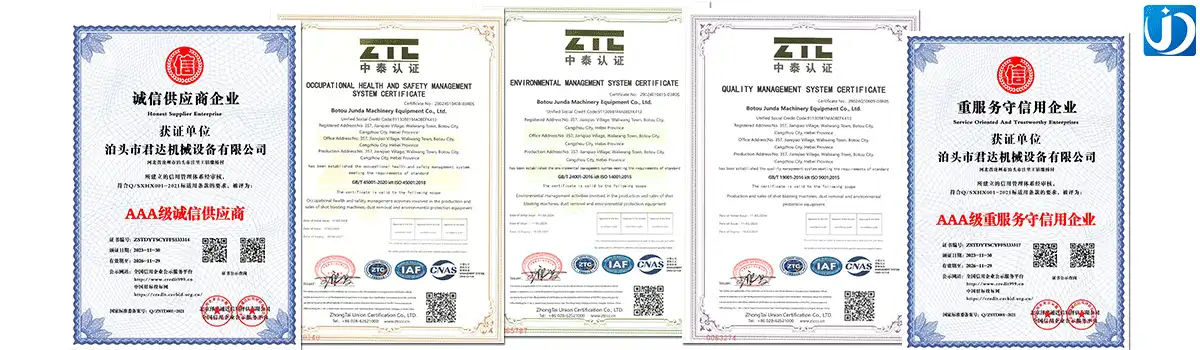
If you want to get a good idea of a maker, look at more than just their specification sheets. Check out their reference installs, test processes, and response time after the sale. Based in Botou, Hebei Province, Junda Machinery has been making shot blasting and dust removal equipment for 20 years. The company is certified by ISO 9001, ISO 14001, and ISO 45001, and it has 2 utility model patents and 7 software copyrights for systems that monitor dust and control production. We ship standard personalized machines in about 15 days, and we answer customer questions within 6 to 8 hours. This is especially helpful for plant managers who need to schedule a shutdown around delivery.
Case Study: Vietnam Structural Steel Plant
The Vietnam company that was talked about earlier in this guide had been using a single-station hanger blaster for six years before they got in touch with Junda. Every frame would sit still while it was being loaded because the hoist couldn't move while a part was clamped in. Junda asked for a Q38 model with a two-station loading layout and a single-hook capacity of 3.5 tons after looking at part drawings and running a video test on a sample frame. From start to finish, installation and remote testing took 19 days. The plant saw a 42% rise in output and a 15% drop in abrasive use in the first full month, as shown by the plant's own production log compared to the same time last year.
Conclusion
A hook pass-through shot blaster works best when the amount of work being done stays the same and parts can be safely hung from a set point. For complicated welded or cast parts, pick a hook conveyor. For plates, beams, and long flat steel, pick a roller conveyor. Before you sign off on a price, compare the capacity, coverage, dust control, and safety paperwork to your biggest part, not an average from a catalog. When you compare sources, use test results and the total cost of installation to make your choice. The cheapest machine on paper isn't always the cheapest one to run for three years.
FAQ
What is a hook pass-through shot blaster?
A continuous machine called a hook pass-through shot blaster hangs parts from hooks above and moves them through a rough blasting chamber. Whilst the part moves and spins, the turbine wheels throw steel shot or grit at it to remove rust, scale, paint, and weld leftovers.
What is the difference between a hook pass-through and a tumble shot blaster?
Each part is suspended separately by a hook pass-through blaster, which works well for parts that are too big or too fragile to touch each other. A tumble blaster works on small, loose parts in a spinning box. When parts touch each other in this way, marks are made that a hung part wouldn't get.
Is a hook pass-through shot blaster suitable for high-volume production?
Yes. Since loading and blasting happen at the same time on separate hooks, the machine can make more things at once than a single-station machine could. There are still things like hook pitch, transport speed, part size, and the cleaning grade that affect how many units are made per hour.
What standards apply to shot-blasted metal surfaces?
The 2007 standard ISO 8501-1 talks about how clean something looks, the 2003 standard ISO 8502 talks about tests for dust and liquid contaminants, and the 2012 standard ISO 8503 talks about surface roughness. When the coating supplier is based in North America, the project specifications may also use SSPC language.
Ready to Size Your Own Hook Pass-Through Shot Blaster
If your current setup stops every time a part is loaded, a hook pass-through shot blaster will help you get back the time you lost. We have sent Q37, Q38, and Q48 models to fabricators and wholesalers in Vietnam, India, Indonesia, South Korea, and Malaysia. We offer online commissioning and original spare parts for all of our machines. Send junda001@jundablast.com your workpiece plans and the output you want. Within a few business days, we'll send you a hook pass-through shot blaster maker price based on your biggest part.
References
1. International Organization for Standardization. ISO 8501-1:2007 — Preparation of steel substrates before application of paints and related products: Visual assessment of surface cleanliness. Cited in the sections on surface preparation requirements and the decision checklist.
2. International Organization for Standardization. ISO 8502 Series — Tests for the assessment of surface cleanliness. Cited in the abrasive recovery and FAQ sections.
3. International Organization for Standardization. ISO 8503-1:2012 — Surface roughness characteristics of blast-cleaned steel substrates. Cited in the blast wheel configuration section.
4. International Organization for Standardization. ISO 12100:2010 — Safety of machinery: General principles for design, risk assessment, and risk reduction. Cited in the compliance and documentation section.
5. International Organization for Standardization. ISO 13849-1:2015 — Safety of machinery: Safety-related parts of control systems. Cited in the compliance and documentation section.
6. Occupational Safety and Health Administration, U.S. Department of Labor. 29 CFR 1910.94 — Ventilation, abrasive blasting. Cited in the installation and compliance section.
About the Author
James Li is a Surface Preparation Equipment Engineer who has worked on shot blasting and abrasive recovery system design for over a decade, including installations across Southeast Asia and South Asia. He specializes in hook conveyor sizing, dust collection design, and factory acceptance testing for heavy fabrication and casting plants. James works with plant engineers to match machine specifications to real workpiece data rather than catalog defaults.

USER EVALUATE
Real feedback and practical experience shared by worldwide partners who purchased our machinery and environmental treatment devices.