


_1786959752558.webp)
Shot Blasting Unit: Complete Guide to Types, Applications, and Benefits
If you work in automotive manufacturing, foundry operations, or any metal fabrication environment, you have likely heard about shot blasting units. A shot blasting unit is a modular industrial machine that propels abrasive media — steel shot, grit, or cut wire — at high velocity against a workpiece to remove rust, scale, and surface contaminants. Modern units deliver controlled, repeatable surface profiles essential for coating adhesion and fatigue resistance. This guide covers every stage of the decision process: what these machines do, which type fits your production line, how to maintain them, and what to look for when buying.
Understanding Shot Blasting Units: Definition, Function & BenefitsWhat Is a Shot Blasting Unit?
A spinning wheel rotor in a shot blasting unit throws abrasive media at metal surfaces at speeds of about 50 to 80 m/s. It only takes seconds for the impact to remove mill scale, rust, and old coatings, leaving a clean anchor profile. ISO 8501-1 says that surfaces can reach Sa 2.5 or Sa 3.0 cleanliness grades if they are properly prepared. This is the level of cleanliness needed before applying industrial-grade coatings.
Core Components
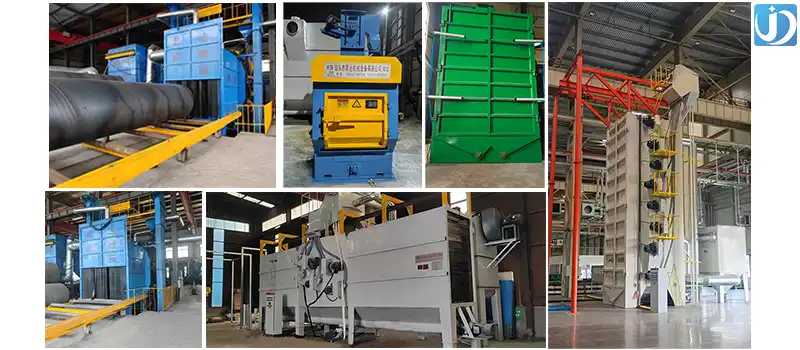
They are all made up of the same parts: a blast chamber, one or more turbine wheels, an abrasive recovery conveyor, a magnetic separator, and a cartridge dust collector. Operators can precisely control the direction of the blast with enclosed designs that have wheel layouts that can be set to top, side, or bottom positions. This is especially important when cleaning car parts because only certain areas need to be treated on the surface.
Key Benefits Over Alternative Methods
Open-air sandblasting can't match the uniform surface roughness of a shot blasting unit. It recycles abrasive media all the time, which means it uses up to 90% less media than single-pass methods. Dust is collected at its source instead of being spread out. For production lines that have to go through IATF 16949 or ISO 9001 audits, a closed blasting module's repeatable, recorded output is a big practical benefit over doing things by hand or hiring someone else to do them.
Types of Shot Blasting Units and Their Applications
Wheel Blasters vs. Air Blasters
Wheel-type units work best for steady, high-volume production because they use high-speed impeller engines. Air-powered blast cabinets can target specific areas better and are good for sensitive parts or shapes with a lot of angles. In Tier-1 automotive plants, wheel blasters work on between 80 and 600 transmission housings and brake rotors per hour, while air blasters finish precision fasteners.
Manual, Semi-Automatic, and Fully Automatic Systems
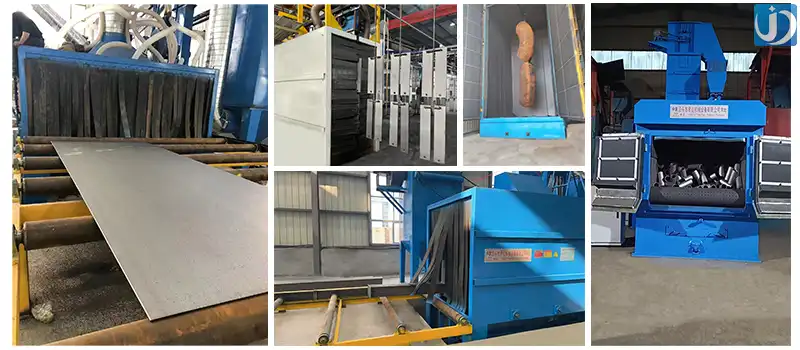
Manual cabinets work best in low-volume job shops because they need an operator to be present during the whole cycle. Semi-automatic systems use conveyors to load and unload, but they still need some human supervision. Line-embedded, fully automatic shot blasting modules work directly with robotic arms, vision inspection cameras, and PLC networks that use Profinet, EtherCAT, or Modbus protocols. This makes them the best choice for modern auto assembly lines that want to have no manual touchpoints.
Real-World Application Sectors
The variety of industries that use this technology shows how far it has spread. These are the main fields that use abrasive blasting equipment every day:
- Automotive parts manufacturing: Engine blocks, transmission casings, bearing races, and suspension components all receive directional shot peening or surface cleaning before coating or assembly.
- Foundry and casting: Tumble-belt and hanger-type systems remove core sand, burrs, and scale from small and medium castings under continuous-duty cycles.
- Structural steel and construction: Roller conveyor lines descale H-beams and plates before anti-corrosion coating, meeting bridge and building codes in salt-exposure environments.
- Fastener and bearing production: Inline blasting modules handle high-frequency part flows — thousands of identical small parts per shift — delivering consistent surface quality without slowing line throughput.
All of these uses need the same thing: a surface quality that can be checked and repeated. That's exactly what a properly designed blasting unit does when it's part of the production process.
Maintenance and Safety: Ensuring Longevity and ComplianceRoutine Maintenance Practices
Wear on the turbine blades is the main reason why machines aren't working as well as they used to. Depending on how hard the grit is, blades usually last between 200 and 1,000 hours of use. It is necessary to inspect blade sets once a week, replace them with a full set that matches, and check the position of the control cage to keep the right blast pattern. A weekly list should include things like the tension of the conveyor belt, the strength of the separator magnet, and the differential pressure of the dust filter.
Operator Safety Requirements
Full-face masks, leather gloves, and hearing protection rated for settings above 85 dB are required for operators who work near abrasive blasting equipment. When units are enclosed, the amount of dust in the air is kept well below OSHA's 5 mg/m³ standard for harmless dust. Another way to protect maintenance workers is to have access doors that are locked and to turn off the turbine power before they open.
Environmental Compliance and Media Recycling
There are many ways to recycle steel shot blasting unit media. Recovery and separation systems that are well maintained can extend the life of the media by 30 to 40 rounds before the particles get too small to give enough impact energy. In most places in the U.S., non-hazardous spent media can be thrown away as regular industrial waste as long as no toxic coatings are being removed. EPA 40 CFR Part 261 rules say that places that get rid of lead-based paints must follow them.
How to Choose the Right Shot Blasting Unit for Your Business
Production Throughput and Part Geometry
Make sure that the unit's estimated throughput, which is given in pieces per hour, fits with your production plan while leaving at least 20% extra space. A unit that can make 120 pieces per hour will wear out faster and won't have any extra space for when demand is high. Wheel layout is based on the shape of the part; parts that are complex or hollow need to be covered from the top, side, and bottom turbine positions at the same time.
Communication Protocol and Line Integration
Protocol compatibility is required for settings that work with cars and precision manufacturing. If you make sure that a unit already supports Profinet or EtherCAT before you buy it, you won't have to pay extra for interface work that can cost as much as the machine itself. Junda Machinery units can be set up to work with Profinet, EtherCAT, and Modbus as normal. Open electrical and mechanical interface documentation is given during the technical review stage.
Total Cost of Ownership
The purchase price is only the first number. Over a five-year period, the true ROI is based on the following cost factors:
- Energy consumption: Single-module power ratings of 7.5–55 kW mean that selecting an appropriately sized unit rather than oversizing saves thousands in annual electricity costs.
- Abrasive media consumption: Closed-loop recovery systems reduce media spend compared with open systems.
- Spare parts availability: Standardized turbine blade geometry and local parts stock directly affect downtime duration and cost.
- Labor savings: Converting from 30 pieces per hour manual processing to 120 pieces per hour automated blasting reduces per-unit labor cost by approximately 70% at constant labor rates.
When you add these numbers up, you can see that most automated inline blasting units pay for themselves in 18 to 30 months in a two-shift auto production setting.
Procurement and Installation: From Inquiry to Operation
Sourcing and Vendor Qualification
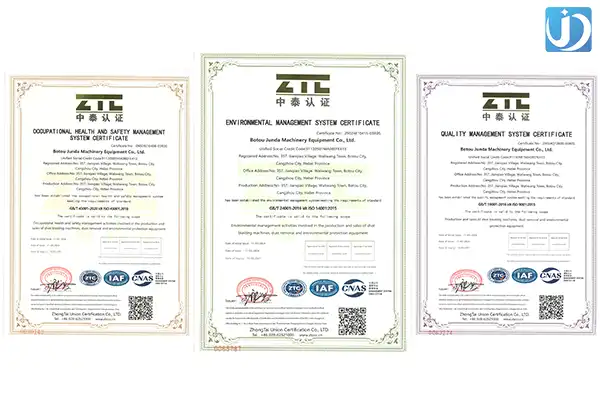
The safest places to buy capital equipment are still verified industrial equipment lists, trade shows like FABTECH and IMTS, and websites directly from manufacturers. As a starting point, when looking at shot blasting unit suppliers, you should ask to see proof of ISO 9001 certification, quality records that are compatible with IATF 16949, and First Article Inspection reports. Junda Machinery is certified by ISO 9001, ISO 14001, and ISO 45001, and they offer full FAI documentation.
Installation Readiness and Commissioning
Before the equipment arrives, the facility should be ready by figuring out the floor load rates, the compressed air supply (for pneumatic parts), the voltage matching for the electrical supply, and the route of the dust exhaust ducts. Standard tailored units from Junda Machinery ship in about 15 days and come with instructions for remote activation. When project scope or protocol integration calls for physical presence, on-site engineer support can be set up.
After-Sales Support Structure
The long-term performance of equipment depends on how quickly parts can be found and fixed. Junda Machinery keeps original extra parts in stock and answers technical questions within 6 to 8 hours. Every unit comes with English-language repair guides, maintenance videos, and operation instructions. This makes it easier for in-house maintenance teams to do their jobs without having to wait for translations.
Conclusion
When a company makes enough products to justify automation, a shot blasting unit is one of the best purchases they can make. The right machine cleans more quickly, keeps records of its work, works with digital production systems, and cuts the cost of processing each part by a large amount. Three choices—picking the right type, taking good care of it, and buying it from a company with proven quality records—make the difference between successful setups and mistakes that cost a lot of money. This guide's structure should help you get started. Get in touch with us when you're ready to make changes to fit your unique line.
FAQ
1. What is the difference between shot blasting and shot peening?
Shot blasting removes surface contaminants and creates a clean anchor profile for coatings. Shot peening uses controlled media impact to introduce compressive stress into a metal surface, improving fatigue resistance. Both processes use similar equipment but differ in media size, velocity, coverage pattern, and the outcome being measured.
2. How often should turbine blades be replaced?
Blade replacement frequency depends on abrasive hardness and hourly throughput. Steel shot typically allows 600–1,000 blade hours; angular grit cuts that figure to 200–400 hours. Always replace the full blade set together to maintain rotational balance and avoid excessive vibration.
3. Can a shot blasting unit be customized for an existing production line?
Yes. Modular units designed for inline installation can be specified with custom mechanical mounting interfaces, electrical cabinet configurations, and PLC protocol settings to match existing line architectures. Junda Machinery provides ODM engineering with NDA protection and supports small-batch trial production before full-volume commitment.
4. What surface finish standard does shot blasting achieve?
Properly configured wheel blasting equipment consistently achieves Sa 2.5 (near-white metal) and Sa 3.0 (white metal) per ISO 8501-1, or SSPC-SP 10 and SSPC-SP 5 equivalents widely referenced in U.S. coating specifications.
Get a Shot Blasting Unit Quote from Junda Machinery
For car, foundry, and precision production lines, Junda Machinery designs modular shot blasting units that work with both Profinet and EtherCAT protocols, come with paperwork that is in line with IATF 16949, and can be branded by the OEM. Within 6–8 hours, our team gets back to you. You can email us at junda001@jundablast.com to get a technical consultation or a sample proposal for your specific production needs.
References
1. Surface Preparation Standards for Painting Steel Surfaces — SSPC (Society for Protective Coatings), 2020.
2. ISO 8501-1: Preparation of Steel Substrates Before Application of Paints and Related Products — International Organization for Standardization, 2007.
3. Shot Peening: A Dynamic Application and Its Future — Jack Champagne, Metal Finishing, 2002.
4. Abrasive Blasting Operations: Engineering and Administrative Controls — NIOSH (National Institute for Occupational Safety and Health), 1975 (revised 2021).
5. Automotive Manufacturing Technology: Surface Preparation and Coating Adhesion — Society of Manufacturing Engineers (SME), 2018.
6. Wheel Blast Machine Design and Turbine Performance Optimization — Wheelabrator Group Technical Report, 2019.

USER EVALUATE
Real feedback and practical experience shared by worldwide partners who purchased our machinery and environmental treatment devices.