


_1786959752558.webp)
Struggling to meet high-standard pretreatment requirements? Shot cleaning machine optimizes workpiece surface quality
If your production line is still relying on manual grinding or open-air sandblasting to prepare metal surfaces, you already know the problem. Results vary shift to shift, dust complaints pile up, and export orders demanding Sa2.5 cleanliness keep getting delayed. A modern shot blaster addresses all of these issues at once — delivering consistent surface profiles, automated abrasive recycling, and PLC-controlled operation that removes the guesswork from your pretreatment process entirely.
Why Traditional Surface Preparation Falls ShortThe Hidden Cost of Manual Blasting
It may seem cheap on paper to prepare the area by hand, but the real cost adds up quickly. Surface profiles aren't always the same because operators work at different speeds, put uneven pressure on the surface, and get tired over the course of an 8-hour shift. When a coating inspector further downstream rejects a batch because the steel still has mill scale on it or anchor depths aren't even, the whole production process stops. It takes time, work, and materials to do rework.
Environmental and Compliance Pressure
Sandblasting outside creates silica dust that is dangerous according to OSHA rules and is being limited more and more by environmental groups in Southeast Asia and other places. Environmental complaints and fines are often given to factories that use manual or compressed-air blasting systems. Using a closed-loop surface cleaning system with a built-in dust collector stops the dust problem before it starts, instead of having to deal with it after the fact.
Equipment Limitations Cause Quality Gaps
Equipment that is too old, like blast nozzles that are too worn out to work properly, separators that can't easily sort abrasive, and lines that leak pressure, directly lowers the quality of the output. A lot of mid-sized fabrication shops still use machines that are 10 years old or more and have no paperwork to back them up. It's not possible to hit Sa2.5 on every pass without a calibrated blast wheel and new liners.
How Shot Cleaning Machines Deliver Consistent Surface Quality
The Mechanics Behind Centrifugal Blasting
A shot cleaning machine moves steel shot or grit at speeds of 60 to 85 meters per second with the help of a high-speed spinning blast wheel instead of compressed air. When the abrasive media move at those speeds, they remove layers of rust, mill scale, and oxide evenly across the part's surface. The variable frequency drives control both the wheel speed and the shot blaster flow rate. This means that the operator can fine-tune the surface profile to meet coating requirements without having to change the type of abrasive.
3D Blast Wheel Layout for Full Coverage
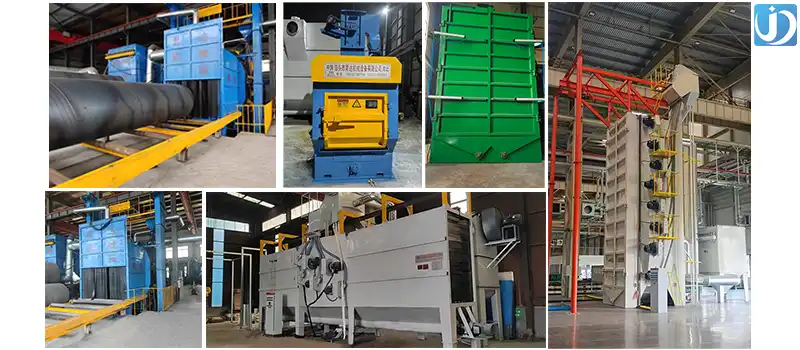
The shot blasting equipment made by Junda Machinery has a multi-wheel 3D plan that puts blast engines above, below, and on both sides of the path the workpiece takes. As a result, the top flanges, web faces, and bottom flanges of an H-beam can all be treated in a single pass through the machine, without having to be repositioned by hand. It is common for one-pass processing at Sa2.0 to Sa2.5, which is exactly what American and European general contractors need before painting.
PLC Control and Automated Abrasive Recycling
The built-in PLC system keeps an eye on the load on the wheel motors, the speed of the conveyor, and the pressure in the dust collection all the time. When the abrasive loses too much sharpness or size, the separator takes out the fines and puts the useful shot back into the storage bin. This closed-cycle design keeps the amount of abrasive used low, cuts down on the time needed for cleaning by hand, and keeps the surface roughness (Rz/Ry) value stable. These are all things that affect how well a primer sticks to the base metal.
Shot Blasting vs. Alternative Surface Treatment Methods
What kind of item you have, how much you want to make, and how clean you want the surface to be will all affect which surface treatment method you choose. This is how a wheel-blast system stacks up against the other options:
- Wheel-blast shot blaster cleaning machine: Handles structural steel, castings, hardware parts, and fabricated assemblies at 0.5–20 t/h throughput. Achieves Sa2.0–Sa2.5 in a single pass. Closed-loop dust collection eliminates airborne silica. Best for continuous production environments.
- Compressed-air sandblasting cabinet: Suitable for small, complex parts where a tight blast pattern is needed. Slower throughput, higher abrasive consumption, and operator-dependent quality. Works for batch sizes too small to justify a conveyor system.
- Chemical pickling: Removes rust and scale through acid immersion. Effective on thin-gauge steel but generates hazardous liquid waste, requires neutralization tanks, and adds process steps before coating.
The practical lesson is easy to understand. A wheel-blast system gives the best speed, cleanliness level, and cost per ton for medium to large manufacturing shops that make a lot of steel plate, structural sections, molds, or axle parts.
Procurement and Integration: What B2B Buyers Should KnowDefining Your Technical Specifications
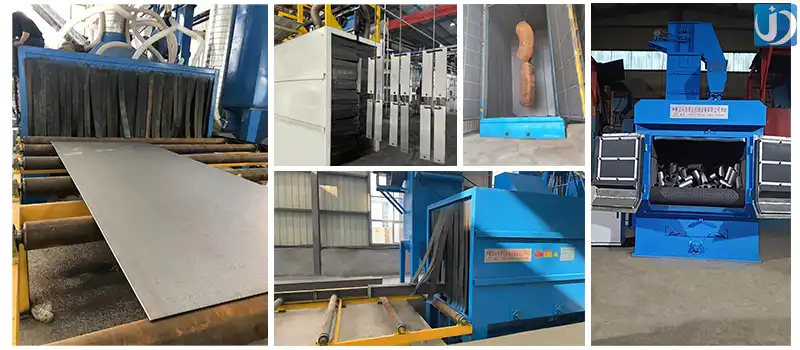
Before asking for a quote, write down the maximum width, height, and length of your item, as well as your hourly output goal, the grade of rust that needs to be removed, and the level of cleanliness that you need after blasting (Sa2.0 or Sa2.5). Also, make sure you know what kind of power source you have in your area. Vietnam and Indonesia usually use 380V/50Hz three-phase, and Junda Machinery sets up electrical panels to work with your grid standard as part of every order.
Delivery Timeline and Spare Parts Package
Standard types are kept in stock and can get to a port in 30 days. Custom designs, such as different conveyor lengths, specific dust collector capacities, or changed blast wheel numbers, can be made in about 15 days after the order is confirmed. Junda Machinery includes a set of extra parts (blast wheels, liners, impellers, separators, and filter cartridges) with every machine they sell. This way, your repair team will always have the most important wear parts on hand.
Installation, Commissioning, and After-Sales Support
You can do remote video commissioning in English, and every unit comes with a full English-language operation manual. If a buyer needs help on-site, an overseas engineer can be sent to help. The Botou, Hebei production base provides long-term spare parts. This is the same industrial region that most of China's shot blasting manufacturers get their parts from, so Junda Machinery has direct access to component suppliers and short lead times for restocking.
Real Results: How Fabricators Have Improved Output Quality
A medium-sized steel structure builder in Southeast Asia got rid of a line of sandblasting guns and replaced them with a Junda roller conveyor shot blasting machine. After the installation, the shop got Sa2.5 on H-beam sections in a single pass, which cut the work needed to prepare the surface by 60% and stopped nearby facilities from complaining about dust. Their European customer took the first batch after the upgrade without asking for any changes, which had not happened in three years of working together.
An engine housing foundry said that the automated blast cycle cut cycle time per part by 40% compared to tumble-blasting and manual spot blasting in casting finishing applications. Consistently roughening the surface also helped the primer stick, which cut in half the number of guarantee claims for paint delamination over the next production year.
Conclusion
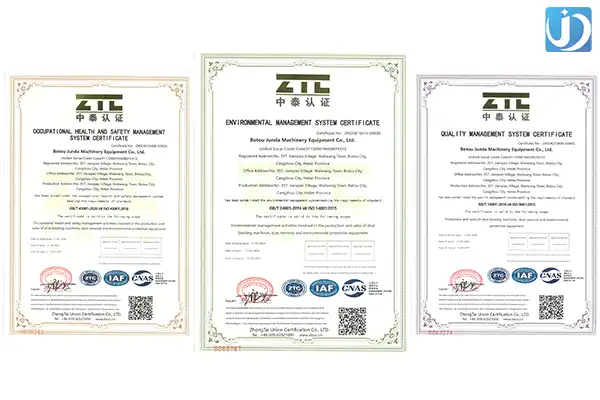
When your orders need to be signed off by someone with Sa2.5 credentials, you can't mess up the surface prep step. Manual methods bring variation that leads to higher costs for redoing, higher risks of not following the rules, and strained relationships with clients. If you set up your shot blaster cleaning system correctly, with the right layout for the blast wheels, management of the abrasive, and PLC controls, that variation goes away, and your production team can focus on making things instead of inspecting them again. Junda Machinery has been making things for 20 years, is certified by ISO 9001, 14001, and 45001, and has a history of exporting to Southeast Asia and other places.
FAQ1. What cleanliness grade can a shot blasting machine achieve in one pass?
Junda Machinery's equipment achieves Sa2.0 to Sa2.5 per ISO 8501-1 in a single conveyor pass, which satisfies the majority of structural steel coating specifications required by European and American project owners.
2. What abrasive media works best for steel fabrication?
S280–S330 steel shot is standard for rust and mill scale removal. Steel grit (GL or GH grade) produces a deeper anchor profile when thick epoxy or zinc-rich coatings are specified.
3. Can the machine run on local Southeast Asian power supply?
Yes. Junda Machinery configures all electrical panels to the customer's local voltage and frequency — including 380V/50Hz for Vietnam and Indonesia — before shipment.
4. How long do blast wheel blades typically last?
High-chrome alloy blades typically run 80–120 hours before requiring replacement, depending on abrasive hardness and throughput rate. The closed-cycle separator extends blade life by removing degraded fines before they recirculate.
5. Is remote commissioning available?
Yes. Junda Machinery provides remote video commissioning in English and supplies a full English-language operation manual. On-site engineer dispatch is available upon request.
Get a Customized Shot Blaster Quote from Junda Machinery
Junda Machinery has been making professional shot blasters for 20 years and works with steel fabricators, foundries, and hardware factories all over the world. Standard models are sent out within 30 days, and special versions are sent out in about 15 days. Voltage adaptation, CE paperwork support, a spare parts package, and technical instructions written in English are all included with every machine. For a quote that is tailored to your project, please contact our team right away at junda001@jundablast.com.
References
1. ISO 8501-1:2007 — Preparation of Steel Substrates Before Application of Paints and Related Products. International Organization for Standardization, 2007.
2. SSPC-SP 10/NACE No. 2 — Near-White Blast Cleaning Standard. Society for Protective Coatings, 2007.
3. Goff, A.H. — Surface Preparation and Coating Application. Journal of Protective Coatings & Linings, 2018.
4. Trethewey, K.R. & Chamberlain, J. — Corrosion for Science and Engineering. Longman Scientific & Technical, 1995.
5. Sancaktar, E. — Surface Preparation Effects on Adhesion Strength in Metal Coating Systems. Journal of Adhesion Science and Technology, 2015.
6. Shipbuilding Research Association of Japan — Surface Treatment and Coating Technology for Steel Structures. SRAJ Technical Report, 2019.

USER EVALUATE
Real feedback and practical experience shared by worldwide partners who purchased our machinery and environmental treatment devices.