Cast Stainless Steel Shot Sizes: How to Choose the Right Grade
Your parts might not pass inspection if you don't pick the right size of cast stainless steel shot. The customer will then send them back. When factory managers switch from carbon steel media to stainless shot, the first thing they usually do is figure out what diameter and hardness grade will work best for their part. This guide has SAE size references, hardness tables, and a real case from a Foshan aluminum anodizing line that answer that question. Before you order a full ton, you will learn how particle size, alloy chemistry, and part geometry all affect the surface finish, how fast it cleans, and the germ-risk.
What Sizes and Grades Does Cast Stainless Steel Shot Come In?
Defining Cast Stainless Steel Shot and What It Is Not
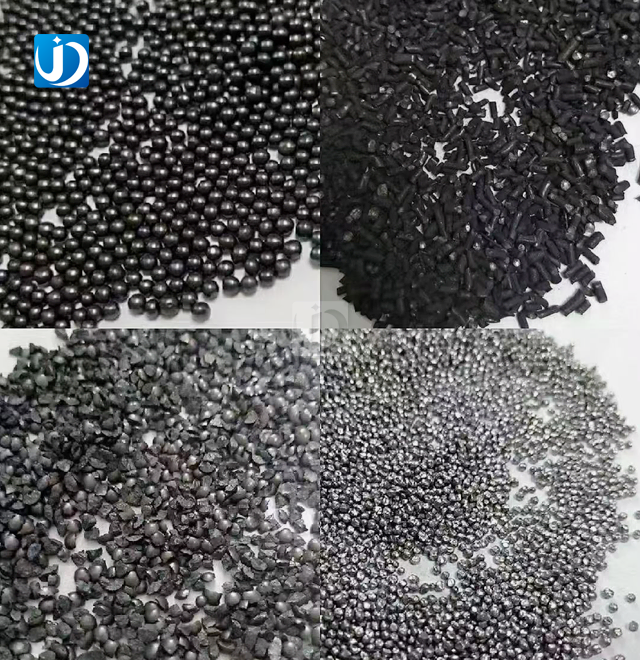
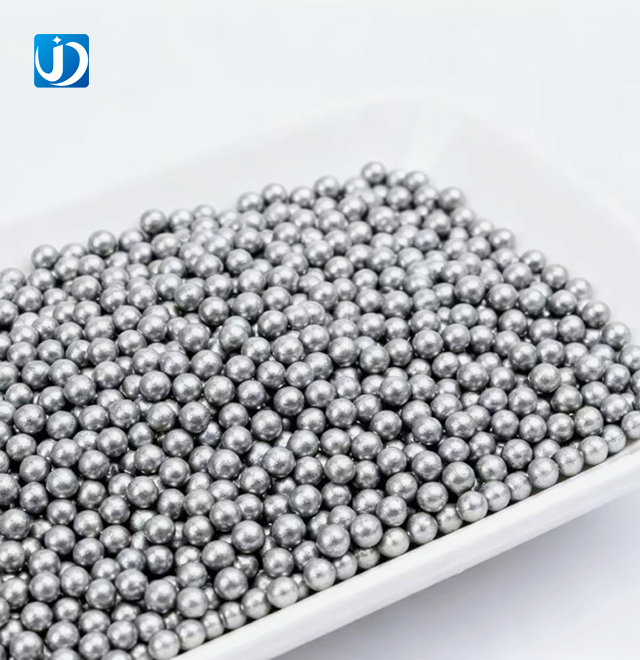
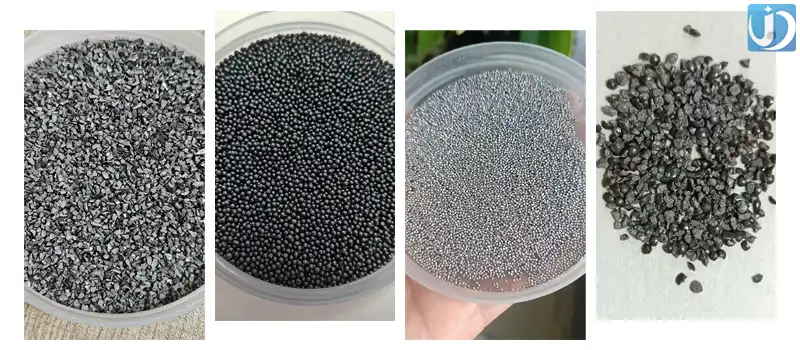
Cast stainless steel shot is a round metal abrasive made by melting a stainless alloy, atomizing it into droplets, cooling the droplets into round particles, and then screening and conditioning them to a particular size band. This is not the same as cut wire shot, which is made from drawn stainless steel and usually needs a conditioning pass to smooth out the edges. It's also not the same as stainless steel grit, which is broken up and square instead of round. At first glance, carbon steel shot looks the same on a shelf. But when it touches something else, it leaves behind iron. Stainless grades were made to fix this issue.
Providers may mean one of four things when they say "grade." It will save weeks of back and forth if you make it clear which one is important for your order. When you look at the grade, it can tell you what kind of alloy it is (202, 304, 316, or 430), how hard it is (as-cast or work-hardened), and how round and hard to break it is. It doesn't matter what size or hardness of shot you order as long as you just write "304 shot" on the order.
Common Stainless Steel Shot Size Designations
| SAE designation | Approximate particle range | Typical use |
|---|---|---|
| S70–S110 | Fine | Delicate cleaning, light finishing, small cavities |
| S110–S170 | Fine to medium | Aluminum castings, general cleaning |
| S230 | Medium | General-purpose blasting and surface finishing |
| S330–S390 | Coarse | Heavy cleaning on robust castings |
| S460 and larger | Very coarse | High-impact cleaning where part thickness allows |
SAE J444 for cast shot sizing says that these bands follow the same rules for grouping things. You can compare the latest edition to the sieve report from your supplier to find out the exact diameter limits. Because different mills round off the edges of each band in different ways.
Chemistry and Hardness Options That Define Each Grade
SUS202, 304, 316, and 430 are the four main groups of stainless steel grades used to produce cast stainless steel shot. You can further divide these groups into austenitic grades (202, 304, and 316) and a martensitic-adjacent ferritic grade (430). It is made up of about 17–20% chromium and 8–10% nickel, which keeps the structure from magnetically shifting and makes it resistant to corrosion. Most of the time, hardness is given in bands from 380HV to 700HV so that the buyer can find the right energy for the part's sensitivity. Before confirming an order, the buyer should make sure that the product has a bulk density of at least 7.7g/cm³, is round, has low satellite content, and won't break after many cycles.

How Do SAE Size Numbers Map to Stainless Shot Diameter?Reading S110, S230, and S330 Correctly
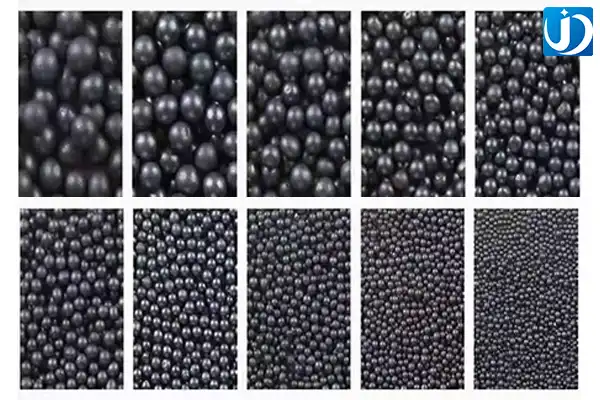
There isn't just one diameter shown by an SAE number; there are several. Things get lighter and more detailed when S110 particles hit them. The S230 is in the middle. You can clean it quickly and be in charge of the surface for general work. It gets rid of scales faster, but the finish is rougher, and each hit has more impact energy. The S330 is pretty rough. A workshop might order a size that matches the label but doesn't work the same way on the line if they only read the number and don't look at the actual sieve curve.
Verifying Size Through Sieve Analysis
A sieve analysis, which follows ASTM B214 for sizing metal powders (ASTM International, 2016), helps verify whether a batch of cast stainless steel shot meets the specified particle size distribution and what percentage of the lot actually falls within the required range. An example of the delivered lot is chosen and put through calibrated sieves or an agreed-upon laser method. This is done in five easy steps. After that, the percentage of the screen that was kept is written down, and the curve is compared to the purchase specification. Last but not least, any batch that has too many fines, too many particles that are too big, or a mixed-grade signature is marked. A "same size" reorder doesn't always work the same way on the shop floor because this step isn't taken.
What to State on Your Purchase Order
There should be an SAE size, a range of diameters that are okay, a sieve method, a maximum fines and oversize percentage, the expected roundness, a lot number, and a certificate of conformity on the purchase order. The size and weight of the label are also important, especially for people who are exporting and need English labels to get their goods through customs. Everyone I've worked with in both Foshan and Dongguan agrees on one thing: verbal agreements about sizes are forgotten after the second reorder, but written specifications are kept even when staff changes happen on both sides.
How Does Shot Size Affect Surface Finish and Cleaning Speed?
Fine Shot Versus Coarse Shot
| Factor | Fine stainless steel shot | Coarse stainless steel shot |
|---|---|---|
| Surface finish | Smoother, more even satin | More textured, visible peaks |
| Cleaning speed | Lower removal per impact | Higher removal per impact |
| Cavity access | Better for narrow sections | More limited |
| Impact energy | Lower | Higher |
| Media consumption | Can rise through carryout loss | Often lower per treated area |
| Part risk | Lower deformation risk | Higher risk of edge rounding |
What Controls Surface Roughness Besides Size
Although the diameter of cast stainless steel shot influences surface roughness, five other factors can also affect the actual Ra reading. The blast pressure or wheel speed can change how hard something hits. How many hits a surface gets is based on how long it is out in the weather. The flow rate of the media changes the coverage density. It depends on how the metal is made on the outside and how hard the alloy is. How the energy lands depends on how far apart the nozzles are or what shape the wheels are. Take a reading from a calibrated profilometer and compare it to a known Ra or Rz target. This is the only way to be sure that these variables always give the same result.
Cleaning Productivity and Cost Per Cleaned Part
People who only look at the price per kilogram miss the real picture of the economy. How much it costs to clean a part depends on how fast it can be cleaned every hour, how fast the media breaks down, how much dust is made, how well the separator works, and how many times it can be broken before it breaks. On an Ervin-type machine used to test fatigue life, round cast stainless steel shot with few holes usually lasts a lot longer before breaking than shot that has clear signs of shrinkage. This changes how much it really costs, even though the price seems higher on paper.
Which Shot Grade Suits Stainless Steel Surface Finishing?Why Stainless Media Protects Stainless Parts
Cast stainless steel shot stops the specific failure pattern brought on by carbon steel media, in which minute iron particles stick to the surface and then rust off as the part leaves the blast booth. After weeks, and often after the shipment has already been sent to a customer, that oxidation shows up as small rust spots. This risk goes down if you change the media, but that doesn't mean the corrosion resistance is fixed. There are more steps to finishing than just a clean blast. The other steps are passivation, rinsing, and post-treatment, which need to be checked separately.
Matching Shot to Stainless Workpiece Requirements
When making a choice, one should think about the type of stainless steel used, how hard the piece is, the finish that is wanted (roughest that can be used), how clean the customer wants it to be, and the type of machine that is on the floor. For example, lines that make food-grade hardware and lines that make decorative hardware will both need 304 shot, but they will need different hardness bands and size distributions because their inspection standards and finish goals are different.
How We Verify the Finish Actually Holds Up
There are several things that should be done as part of the verification process. These include a visual inspection under controlled lighting, written measurements of Ra, tests for cleanliness or residue if the contract calls for them, a microscopic look for embedded particles, and a salt-spray or staining check if corrosion performance is part of the acceptance criteria. On sign-off sheets made just for each customer, all of these results should be written down next to the agreed-upon specification, not just a "pass" or "fail" This is because a thorough record is what will protect both sides if there is again a disagreement.
Which Size Works Best for Aluminum and Non-Ferrous Castings?
Case Study: A Foshan Anodizing Line Cuts Complaints by 71%
In 2024, a medium-sized aluminum extrusion plant near Foshan contacted our technical team because a customer had refused three shipments in a row because the anodizing colors were different and there were small spots of staining. Before the anodizing pretreatment stage, carbon steel shot was used on their line to smooth out the edges. It was found that the staining was caused by iron particles that got stuck in the anodizing bath and turned black. They were able to test a 25 kg sample of 304-grade cast stainless steel shot with a hardness of 380–450 HV that we provided. We also gave them a way to compare Ra and salt-spray side by side.
A four-week test with three production batches showed that complaints about color differences dropped by 71%, and Ra consistency across batches got better, going from a reported spread of about ±0.4¼m to about ±0.15¼m. The test group told our group, "The first thing our workers noticed was that after the second anodizing cycle, the parts stopped turning dark." "That had never happened with the old media." Within eight weeks, the plant placed its first order for three tons, which is about the same amount of time that similar aluminum finishing operations in Guangdong take to make their first decision.
Starting Points by Part Type
| Part condition | Starting size direction | Main control |
|---|---|---|
| Thin-wall aluminum casting | Fine or medium | Lower impact and shorter exposure |
| Large aluminum housing | Medium | Balanced cleaning and coverage |
| Heavy non-ferrous casting | Medium to coarse | Higher productivity |
| Detailed cavity or ribbed part | Fine | Better access, less shadowing |
Process Settings That Protect Thin Walls
Because you aren't working with steel, you need to pay more attention to things like wheel speed or air pressure, media flow rate, blast angle, exposure time, and part temperature. It's important to choose the right size, but it's even more important to keep stainless steel media separate from carbon steel media that is still in the same machine. A few extra carbon particles can ruin the whole point of switching media, which was to stop contamination from spreading.
Fine vs. Coarse Stainless Shot: Which Gives Smoother Finishes?
When Fine Shot Wins
This fine cast stainless steel shot is used on parts that need a smooth surface, have tight spaces or a recessed shape, or are too thin to handle heavy impact. It's also used to get a smooth satin finish instead of a rough clean. Because they lower the total impact energy, air-blast systems and wheel machines with less power work well with fine grades.
When Coarse Shot Wins
Coarse shot is best for getting rid of thick scale or tough casting residue with a lot of force. It's also best for parts that can take more impact without breaking and production lines where speed is more important than a smooth finish. The wheel-blast machine can handle coarse grades as long as the motor is stronger and the separator can handle bigger particles. Fines that can't be used will be made by the machine.
A Six-Question Decision Checklist
You should talk about these six questions with your quality team and process engineer before you choose a size. Does the part need a hard limit on the impact energy because it is too thin, too fragile, or too quickly changes size? The main goal should be to clean, smooth, deburr, or finish the piece nicely. What range of roughness has been "written off" by the customer or the company itself? Is there something thick or deep that a bigger particle can't get through? With no changes, how much pressure, wheel speed, and flow rate can the machine handle now? Finally, what size has been tried on a part that is similar to this one before? A starting point that has been tested is almost always better than one that is based on theory.
How Does Part Geometry Influence the Right Shot Size Choice?
Geometry Features That Change Your Shot Choice
Which size works best depends on the part's thickness, the number of sparse ribs or holes, any sharp edges or curved surfaces, how it's positioned in the machine, and any areas that won't be hit directly. One part has flat surfaces and the other has three blind holes. They are both made of the same alloy and have the same target Ra, but they act in very different ways.
Shot Size by Common Geometry
| Geometry | Preferred direction |
|---|---|
| Narrow channels | Fine shot |
| Deep cavities | Fine or medium, depending on access |
| Large flat surfaces | Medium or coarse shot |
| Thin ribs | Fine shot with controlled energy |
| Heavy castings | Medium or coarse shot |
| Sharp edges | Lower-impact media, shorter exposure |
Fixing Uneven Cleaning Without Changing Suppliers
They usually move when the orientation of a part changes or when a smaller particle gets to the gap. Reducing the cast stainless steel shot size, impact energy, or exposure time is more likely to correct excessive edge rounding than switching to a different media type. You might not need a different alloy if there is still sand or scale on the surface. Instead, you might need more energy or better coverage. The wheels might not be lined up correctly, the flow rate might have changed, or the sizes might not have been spread out correctly in one batch if the finish isn't even. This can usually be proven within minutes by running something through a sieve quickly.
Can You Mix Multiple Stainless Shot Sizes in One Machine?
Where a Controlled Blend Helps
A clear blend can help when one part has big outside edges and small inside holes that need different care during the same cycle. Plus, it can help in the middle, where neither a pure fine nor a pure coarse size works well by itself. So, a workshop only needs to test one recipe, instead of running two separate recipes through the machine.
Why Uncontrolled Mixing Backfires
The distribution isn't stable when you mix sizes without a clear ratio. It changes every time you add more media. It was set up to work with only one size band instead of two. This means that the impact energy changes during a single production run, the surface roughness changes from part to part, and separator losses go up. Also, in a blend, smaller particles break down more quickly than bigger ones. Over weeks, this changes the ratio slowly, even though no one changed the recipe on purpose.
Five Steps to Validate a Blend
Write down the exact percentage of each cast stainless steel shot size in every batch before preparing a mixed-size blend. Also, keep track of how each batch was mixed. Before the trial, do a sieve analysis. Blast representative parts and compare their roughness and cleanliness to a single-size baseline. Finally, validate the blend every time the media is added to or changed. A blend that worked in week one usually stops working by week six because the revalidation step wasn't done.
How to Match Shot Grade to Your Blast Wheel Design and Evaluate a Supplier?
Matching Shot to Wheel Blast and Air Blast Machines
A wheel-blast machine can only work with a certain number of hard, certain-sized shots before it breaks down. These numbers depend on the motor power, media throughput, abrasive flow control system, separator design, and chamber lining of the machine. Some of the things that can be changed in air-blast systems are the nozzle diameter, the operating pressure, the material of the nozzle, and the consistency of the feed. It is not a suggestion when a machine builder says that the media can have a certain level of hardness. More than that, running shots make the wheel blades and liners wear out much faster than the cost savings from the media are worth.
A Supplier Checklist That Separates Claims From Proof
Before you agree to a tonnage, you should ask for proof instead of a sales pitch on five things: a documented melting and atomization process with batch records; chemistry and hardness testing in-house or in a verified lab; current sieve analysis with a sample report you can look over; lot traceability linked to your actual shipment; and clear terms on minimum order quantity, lead time, Incoterms, and how to handle non-conformances. If you ask, a long-term supplier is usually one who is willing to give you real test reports instead of a generic datasheet.
What Junda Machinery Verifies Before Every Shipment
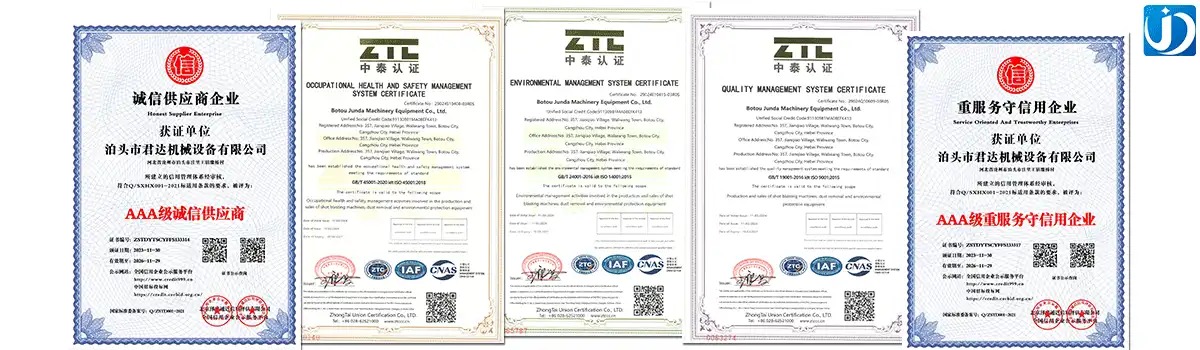
The Junda Machinery Equipment Co., Ltd. is based in Botou, Hebei Province, and has been making shot blasting equipment and matching abrasive media for 20 years. They sell these products to foundries, aluminum companies, and people who finish metal. As part of our ISO 9001 quality system, we check the chemistry and hardness of every batch of cast stainless steel shot we ship. We also do sieve analyzes and keep track of each lot. Because some buyers want to see proof before they place a bulk order, we offer English test reports, custom packaging for OEM/ODM partners, and sample quantities as low as 25 kg for the first round of tests.
What Testing Confirms You Chose the Right Grade Before Scaling Up?
Building a Pre-Production Trial Record
When testing cast stainless steel shot before production, record the initial surface condition, selected shot size and grade, machine settings, exposure time, flow rate, number of passes, part temperature, and the surface appearance and roughness after blasting. This record will be used as a guide the next time someone places an order. This keeps the buyer safe in case the seller sends a different batch with the same product name.
Quality Control Tests That Matter
| Test or inspection | Purpose |
|---|---|
| Chemical analysis (OES) | Confirms chromium and nickel content for corrosion resistance |
| Sieve analysis | Confirms particle-size distribution against spec |
| Hardness testing (Vickers) | Confirms impact behavior and wear life |
| Roundness or shape inspection | Flags excess angular particles or satellites |
| Density and porosity review | Supports consistency and fatigue-life estimates |
| Visual inspection | Detects contamination, rust, or abnormal particles |
Standards Worth Checking Before You Sign Off
Make sure that the most recent version of SAE J444 (SAE International, 2023) fits your stainless steel product. This is because it tells you how to classify and size cast shot and grit. (International Organization for Standardization, 2018) The ISO 11124 series talks about metallic blast-cleaning abrasives and the materials and tests that need to be done on them. Both the buyer and the seller agree on how to use ASTM standards to do sieve analysis (ASTM International, 2016). Any chemical that comes into the EU must follow REACH rules, according to the European Chemicals Agency in 2024. These rules should be read by any OEM that sends goods to Europe. Any U.S. business that uses abrasive blasting must follow the safety rules that OSHA gives on this topic. The Food and Drug Administration (2024). The SSPC/AMPP advice on abrasive media gives more ways to check how well surfaces are prepared (SSPC/AMPP, 2020).
Conclusion
It's hard to pick the right cast stainless steel shot because of four things: the size of the particles, the alloy and hardness, the shape of the part, and the limitations of the machine. Fine S110-class media works best on surfaces that are easy to damage or have a lot of small details. Heavy parts can be cleaned more quickly with medium S230-class and coarse S330-class media, though. Before ordering by the ton, there should be a controlled trial, a real sieve report, a hardness check, and written supplier traceability. This needs to be done before there is a problem on the dock for the customer.
FAQ
What is cast stainless steel shot used for?
For cleaning, deburring, finishing, and controlled peening, cast stainless steel shot is applied to stainless steel, aluminum, and non-ferrous castings. There is less chance of ferrous contamination when carbon steel abrasives are used as a pretreatment in anodizing, passivation, and electroplating.
What do S110, S230, and S330 mean?
There isn't just one number here; instead, there are bands of particle diameters that remind me of SAE rules. Before you place an order, you should compare the exact limits to the most recent version of SAE J444 and the sieve-analysis report from your supplier.
Which stainless steel shot size is best for aluminum castings?
Fine to medium shot is usually the best choice for castings made of aluminum because it cleans up well and doesn't bend as easily. We need smaller particles and less impact energy most of the time for thin walls and detailed cavities.
Is cast stainless steel shot better than cut wire shot?
Cast stainless steel shot has a rounded profile right from the factory, whereas cut wire shot starts out as a cylinder segment and frequently needs to be conditioned to round its edges. Which option works better depends on what you want to achieve, how long the media lasts, and what machine settings you have looked at.
What is the difference between stainless steel shot and stainless steel grit?
It is a round shot that makes repeated, controlled hits that are good for finishing and polishing. Because grit is sharp and cuts faster, the surface is rougher and better for heavy descale jobs.
How do I verify cast stainless steel shot quality before a big order?
It is important to get an analysis certificate, a recent sieve analysis report, hardness test results, and the ability to keep track of a lot of things. The person checking the goods when they come in should match the signed purchase specification to the particle size, level of contamination, and integrity of the packaging.
Does cast stainless steel shot require CE marking?
Most of the time, loose abrasive media doesn't have a CE mark on it like electrical or machine parts do. CE rules usually only cover the blast machine itself, so check the whole set of tools and media to make sure they are in line before assuming they are.
Ready to Match Your Grade to Your Line?
Abrasive media are often contaminated when they are switched without being tested first. Since it began 20 years ago, Junda Machinery has been making cast stainless steel shots and knows how to use both the equipment and the media for shot blasting. Friends who want to put their own labels on the goods before selling them can get 25 kg trial samples, English test reports, and OEM/ODM packaging from them. To help our tech team help you, please send pictures of your part and the current blast settings to junda001@jundablast.com. We'll let you know about a starting size and hardness grade in one business day.
References
SAE International. "SAE J444: Cast Shot and Grit Size Specifications." 2023.
International Organization for Standardization. "ISO 11124 Series: Preparation of Steel Substrates Before Application of Paints and Related Products — Specifications for Metallic Blast-Cleaning Abrasives." 2018.
ASTM International. "ASTM B214-16: Standard Test Method for Sieve Analysis of Metal Powders." 2016.
European Chemicals Agency. "Understanding REACH."
U.S. Occupational Safety and Health Administration. "Abrasive Blasting." 2024.
SSPC/AMPP. "Guidance on Abrasive Blast Cleaning and Surface Preparation Standards." 2020.
About the Author
Michael Wang works as a Shot Blasting Media Specialist with a technical focus on metallic abrasive selection for stainless steel, aluminum, and non-ferrous surface treatment. He has supported trial runs and supplier qualification projects across aluminum extrusion, 3C structural parts, and precision hardware plants in Guangdong and Jiangsu. His work centers on matching particle size, hardness, and alloy chemistry to real production problems, backed by sieve analysis, hardness testing, and documented trial data rather than datasheet claims alone.

USER EVALUATE
Real feedback and practical experience shared by worldwide partners who purchased our machinery and environmental treatment devices.