


_1786959752558.webp)
What parts can be cleaned with steel shot blasting?
If you work in metal fabrication, casting, or structural steel production, surface cleanliness directly affects your bottom line. Paint adhesion failures, coating delamination, and client returns all trace back to inconsistent surface preparation. A steel shot blasting machine solves exactly that problem — delivering repeatable, measurable surface profiles across high-volume production lines.
So, which parts actually benefit from this process? The answer covers more ground than most people expect.
Understanding Steel Shot Blasting and How It Works
The Core Working Principle
A steel shot blasting machine sends steel shot through high-speed rotational blast wheels that usually spin at speeds of 60 to 85 m/s and hit the surface of the subject. Rust, mill scale, and other impurities are stripped off by the kinetic impact, leaving a clean anchor profile that can be coated or processed further.
Machine Types Worth Knowing
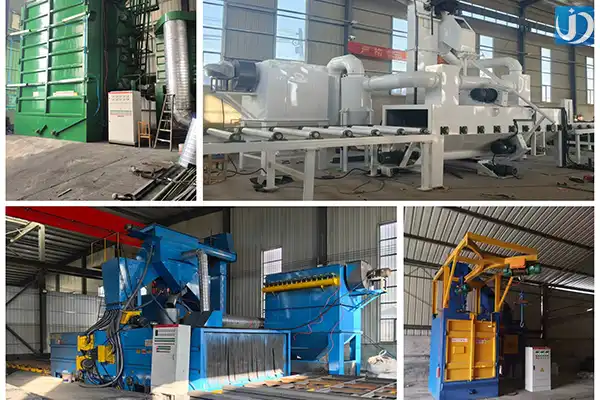
Wheel-blast systems work well for continuous, high-volume production. For complex shapes or smaller batch runs, air-propelled (air-blast) systems give you more control. Long structural features are handled by automated tunnel-type machines, while casts and assembled parts are handled by roller conveyor and hanger-type machines. The first choice that affects output quality is matching the machine type to the part geometry.
Why Surface Consistency Matters
Grades of cleaning from Sa 1 to Sa 3 are set by ISO 8501-1. Most industrial coating standards call for Sa 2.5, which is a metal that is very close to white. This level is rarely reached consistently by hand grinding or chemical pickling. Machine blasting with settings managed by a PLC does, batch after batch.
Key Types of Parts Suitable for Steel Shot Blasting
A lot of different industrial parts can be shot-blasted with steel. The main groups that benefit the most are listed below:
Structural Steel and Fabricated Assemblies
Mill scale and weld spatter on beams, columns, welded frames, and bridge parts make it impossible for paint to stick to them. Tunnel-type steel shot blasting machines keep going over these profiles until they reach Sa 2.5 and a surface roughness of Rz 40–70 µm, which is what most zinc-rich primers and epoxy coats need. Surface preparation is always ranked as the most important factor in coating service life by steel building makers.
Iron and Steel Castings
Every surface of a sand cast item has sand, metal layers, and parting-line flash etched in it. Shot blasting gets rid of all three at the same time. Some examples are engine blocks, pump housings, valve bodies, and hydraulic lines. S330 or S390 steel shot is usually enough to clean gray iron castings without distorting thin-wall sections.
Automotive and Engineering Machinery Components
Gear shafts, connecting rods, brake drums, differential housings, and suspension knuckles can benefit from shot peening, which is a controlled form of blasting that compresses surface layers and increases fatigue life. SAE International research shows that shot peening can make gear fatigue strength 20–30% higher. The same method of pre-paint blasting is used on frames for farm equipment, excavator arm assemblies, and forklift mast parts.
Sheet Metal and Weld Assemblies
Around the welds in sheet metal panels, box sections, and welded subassemblies, heat causes oxidation. These oxides stop the primer from sticking evenly. Hanger-type or spinner-hanger blast machines move these parts around a number of blast wheel positions so that all sides are covered without having to be moved by hand.
Tools, Molds, and Metal Profiles
Scale and carbon build-up on forging dies, injection molds, and press tools. Die service intervals are extended when the cavity surface is cleaned with a blast gun on a regular basis. When metal profiles like tubes, angle iron, and flat bar come out of rolling mills, they still have scale on them that needs to be blasted off before they can be galvanized or powder coated.
All of these types of parts need the same thing: a smooth, clean surface that can hold protective coatings without needing to be reworked.
Why Choose Steel Shot Blasting Over Other Methods?
Comparing Against Sandblasting and Chemical Pickling
IARC lists silica dust made by silica grinding as a Group 1 cancer. Steel shot can be used again and again, 1,000 to 3,000 times. This makes the cost of abrasives per ton of processed steel much lower. Acids are used in chemical pickling, which requires treating wastewater and creates dangerous waste. Blasting gets rid of both the chemical risk and the cost of getting rid of the wastewater.
Consistency That Manual Methods Cannot Match
The speed of the blast wheel, the speed of the hopper, and the flow of grit are all tightly controlled by PLCs in steel shot blasting machines. This means that the 50th part in a batch looks exactly the same as the first part—there is no difference from operator to operator and no quality drift due to tiredness. This must be able to be done again and again for quality managers who keep track of surface roughness data across shifts.
Energy Efficiency and Long-Term Cost Control
Modern blast machines have motors that change the speed of the wheels based on the level of rust on the parts that come in. This cuts down on wear from abrasives that aren't needed and lowers the energy demand during rounds with less work. The closed-loop abrasive recovery and sorting system automatically gets rid of broken shot and fines. This keeps the active media in the right size range and limits the amount of material used per ton.
Maintenance Tips and Safety Considerations
Routine Checks That Protect Output Quality
High-chromium metal blast wheel blades usually last between 500 and 800 hours of use. Checking the wear on the blades once a week keeps the wheels from becoming unbalanced, which can lead to vibration-induced mechanical stress and uneven coverage. Separator screens and air wash separators are examples of abrasive classification systems that need to be checked once a month to make sure that broken media is being taken out of the blast circuit before it goes back in.
Protecting Operators and Meeting Compliance Standards
Using enclosed blast chambers and multi-stage pulse-jet cartridge dust collectors lowers the amount of particulate matter in the air to less than 20 mg/m³, which is below the standard for workplace health. Even if the dust extraction system works well, operators should still wear the right breathing protection when loading and removing. Before an internal check or blade replacement can happen, lockout/tagout steps must be followed.
Troubleshooting Uneven Surface Results
There are two main reasons why cleaning patterns aren't always the same: either the blast wheel control cage (the directional vane that controls the "hot spot" or concentrated blast impact zone) isn't placed correctly, or the part transport speed isn't consistent. Coverage gaps on flat surfaces are usually fixed by adjusting the cage angle by 5 to 10 degrees. For rotating cylinder-shaped parts, making sure the rotation speed is the same gets rid of spiral-pattern problems.
How to Choose the Right Machine for Your Parts
Match Machine Configuration to Part Geometry
Roller conveyor tunnel machines work well with flat structure shapes. Hanger-type or spinner-hanger configurations that turn parts through the blast pattern are needed for irregular castings and assembled parts. Pipes and tubes need special systems with wheels on the outside and lances on the inside to treat the inside. When you skip this step of matching, you get dead zones, which are places where the abrasive stream never gets to.
Evaluate Automation Level Against Your Production Volume
When making more than 5 t/h, fully automatic feed, blast, and discharge systems cut down on the need for labor and keep output steady when experienced workers aren't available. With PLC-based parameter storage, workers can quickly remember pre-set configurations for each part family, so they don't have to make changes by trial and error during changeovers.
Factor in After-Sales Support and Spare Parts Availability
For a steel shot blasting machine that works sixteen hours a day, it needs parts that can be sent out within days, not months. Before you sign the contract, make sure that it includes English-language operation instructions, remote diagnostic help, and a program for keeping extra parts on hand. When a pre-paint blasting line goes down, the finishing and assembly process further down the line stops.
Conclusion
Steel shot blasting machine cleans structural steel, iron castings, car parts, sheet metal assemblies, forging dies, and metal profiles. It can be used for all kinds of industrial metal processes. The process gives a surface standard that can be measured and repeated (Sa 2.5 or better) that can't be matched by chemical or human methods on a large scale. Whether the surface quality is the same on all parts or just most of them depends on the type of machine, the type of grit, and the way the controls are set up.
FAQ
1. What is the difference between steel shot blasting and grit blasting?
Steel shot has a round shape and makes a peened, rounded surface. Steel grit is pointy and makes a more precise anchor pattern. Shot is good for jobs that need to strengthen the surface or hold a modest amount of powder in place. When finishing requirements call for a higher Rz value or when heavy mill scale needs to be removed quickly, grit is the best choice. Shot and grit are often mixed together on production lines to find the right balance between cleaning speed and profile depth.
2. Can delicate or thin-wall parts be processed safely?
Yes, with changes to the parameters. Sheet metal and thin-wall castings can be kept from warping by slowing down the blast wheel and cutting down on the exposure time. A smaller gritty impact energy setting is usually needed for parts with walls that are less than 3 mm thick. Before full production runs, test blasting on sample parts makes sure that the safe parameters are met.
3. How often should blast machines in heavy-duty operations be serviced?
Blade inspection: once a week. Check the abrasive classifier and separator screen once a month. Every 500 hours of use, the wear layer needs to be fully inspected. Pulse-cleaning of the dust collector filter is done automatically every day, and the cartridge is checked by hand every three months. When you stick to this plan, you can expect little to no downtime and stable surface quality.
Get a Customized Blasting Solution from Junda Machinery
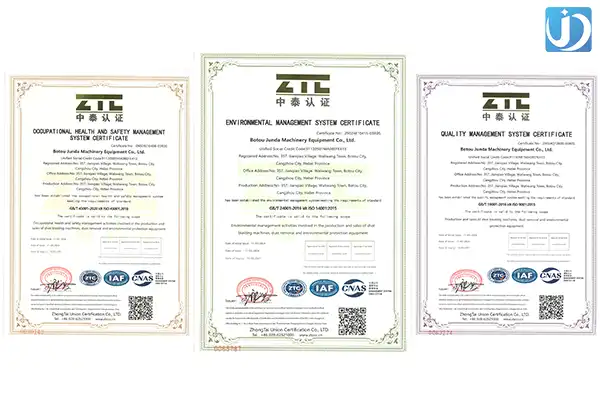
Junda Machinery has been making steel shot blasting machines for 20 years and has ISO 9001 certification. Their machines have intelligent PLC control, variable frequency drives (VFDs), and closed-loop abrasive recovery. Our tech team gets back to you within 6–8 hours, whether you need a normal production line or a system that is set up just the way you want it. For detailed details and free advice, please email us at junda001@jundablast.com.
References
1. ISO 8501-1:2007 — Preparation of Steel Substrates Before Application of Paints and Related Products: Visual Assessment of Surface Cleanliness. International Organization for Standardization, 2007.
2. SAE International. Shot Peening Applications, 8th Edition. SAE International, 2004.
3. IARC Working Group. Silica Dust, Crystalline, in the Form of Quartz or Cristobalite. IARC Monographs on the Evaluation of Carcinogenic Risks to Humans, Vol. 100C. World Health Organization, 2012.
4. Rosaler, Robert C. Standard Handbook of Plant Engineering, 3rd Edition. McGraw-Hill, 2002.
5. Keane, J.D., et al. Surface Profile for Anti-Corrosion Paints. Steel Structures Painting Council (SSPC), 1976.
6. Trengove, S.A. "Optimizing Abrasive Blast Cleaning for Protective Coating Performance." Journal of Protective Coatings & Linings, SSPC, 2009.

USER EVALUATE
Real feedback and practical experience shared by worldwide partners who purchased our machinery and environmental treatment devices.