


_1786959752558.webp)
Industrial Shot Blasting Equipment: Types, Working Principles and Applications
Industrial shot blasting equipment refers to a category of mechanical surface-treatment systems that use high-speed centrifugal wheels to propel steel shot or grit against metal workpieces, removing rust, mill scale, and contaminants while building an anchor profile for coatings. Covering five primary machine types — roller conveyor, hook, tumble belt, overhead chain pass-through, and rotary — these systems serve shipbuilding, automotive, steel construction, foundry, and pressure vessel industries. This guide walks through how each type works, what drives selection decisions, and how Junda Machinery's full product line addresses real production challenges.
Understanding Shot Blasting Equipment: Types and Features
What Sets Shot Blasting Apart from Other Methods
For shot blasting to work, only mechanical force is needed. A high-speed impeller speeds up abrasive media, which is usually steel shot or angular grit, and throws it at the surface of the workpiece. Since compressed air is not needed, less energy is used per kilogram of metal that is cleaned compared to chemical descaling or air blasting. The Steel Structures Painting Council (SSPC) says that wheel blast equipment can clean structural steel several times faster than wire cleaning alone, and it can always hit ISO 8501-1 cleanliness levels of Sa 2.5 to Sa 3.
Five Machine Types and What Each Handles
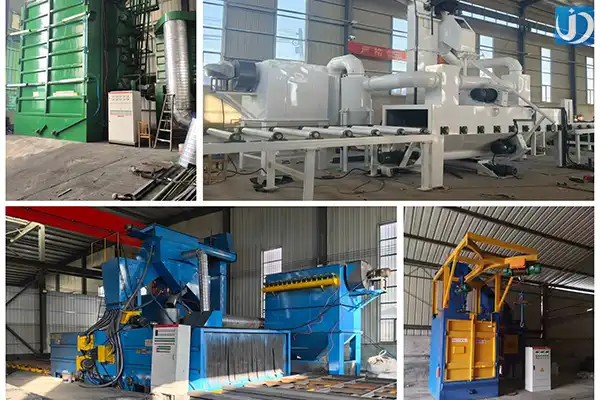
Junda Machinery's product line has five different configurations, and each one is made for a different type of workpiece. It's important to know the differences between the types because choosing the wrong one can cause covering gaps, higher wear rates, and production delays.
Here's how each type is matched with its use:
- Roller conveyor pass-through type: Flat steel plates and section steels such as H-beams travel horizontally through the blast chamber on powered rollers. Multiple blast wheels arranged above, below, and to the sides deliver 360-degree coverage without manual repositioning. This configuration suits high-volume structural steel fabricators processing 1–20 t/h continuously.
- Hook type: Individual castings, forgings, or fabricated assemblies hang from rotating hooks inside a sealed chamber. The hook rotates while blast wheels fire from fixed positions, ensuring all external faces receive equal treatment. It is the standard choice for foundries cleaning engine blocks or gearbox housings.
- Tumble belt type: Hardware items, small castings, and stamped parts load into a rubber belt drum that tumbles parts through the blast zone. The continuous tumbling motion exposes every surface without fixturing, making this type cost-effective for high-mix, low-weight part batches.
- Overhead chain pass-through type: Workpieces hang from a moving overhead conveyor chain and travel through a static blast zone. This layout fits production lines where parts must move continuously — for example, automotive body frames or rail-transit components requiring in-line surface preparation.
- Rotary table type: Heavy or asymmetric parts sit on a rotating turntable while blast wheels fire horizontally. The rotation ensures uniform exposure across irregular profiles, which is why pressure vessel manufacturers and special-shaped structural component processors favor it.
These five configurations cover almost all workpiece shapes used in heavy manufacturing. That's why a seller that offers the whole range has a clear edge over those that only offer one type.
Abrasive Media Selection
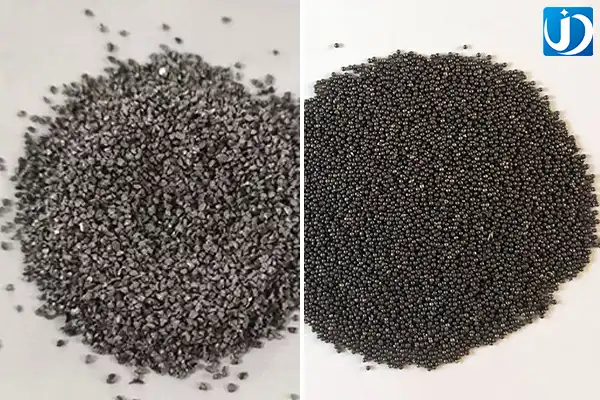
Industrial shot blasting equipment has a round impact shape that works well for cleaning and stress-relieving peening. Steel grit has a shape with sharper angles that coating engineers use when they need the best bonding. The right choice depends on the base hardness and the goal surface roughness (Ra/Rz) value. Junda's engineering team makes this choice during the project's initial scoping.
How Shot Blasting Equipment Works: Process and Principles
The Core Blasting Mechanism
There is a high-speed impeller, a control cage, and a set of alloy blades in each blast wheel. The motor turns the rotor at speeds that usually range from 65 to 110 m/s speeding up the grit. The control cage points the stream of abrasives at a specific "hot spot" on the surface of the workpiece. The abrasive flow rate from Junda's wheels is more than 250 kg/min per wheel, and the PLC controls change the speed of the belt or roller transfer to meet the exposure time needed to reach the goal Sa cleanliness level.
Step-by-Step Process Flow
The process starts when the workpiece goes into the blast chamber. An abrasive hits the surface and removes scale, rust, or other contaminants. Spent abrasive and debris fall to the floor of the sealed chamber. An elevator and screw conveyor return the abrasive mixture to a separator. The separator removes broken particles and dust, sending the right-sized abrasive back to the wheel hopper. Finally, a pulse negative-pressure dust collector collects airborne particles, keeping emissions below 5 mg/m³.
Dust Control as a Compliance Factor
Many places that switched from acid pickling or grinding in the open air to using wheel blast equipment say that the air quality in the workshops got better right away. Junda made its own dust monitoring system that records real-time emission data. This helps with environmental acceptance inspections, which are a common concern for plant engineers and EHS teams in places where particulate regulations are getting stricter.
Benefits and Industrial Applications
Measurable Productivity and Quality Gains
With automated shot blasting, a recorded process can be used over and over again instead of variable human grinding. Every pass makes the surface clean to ISO Sa 2.5 to Sa 3, which gets rid of the need for manual work. With a throughput of 1–20 t/h, the machinery can keep up with most production lines without slowing them down.
The main areas of application and what each one gets are shown below:
- Steel construction and infrastructure: H-beams and bridge girders exit the roller conveyor line with mill scale fully removed, giving protective coatings a consistent anchor profile that extends service life in corrosive marine or industrial shot blasting equipment environments.
- Automotive and foundry: Engine blocks, transmission cases, and complex castings are cleaned in the hook or overhead chain configuration. Burrs are removed, and the surface is prepared for precision coating in a single pass.
- Aerospace shot peening: Turbine blades and landing-gear components require controlled compressive residual stress on their surfaces to resist fatigue cracking under repeated thermal and mechanical loading. Rotary table machines with calibrated wheel speed handle this precision application.
- Shipbuilding and pressure vessels: Large hull sections and vessel shells pass through roller conveyor lines, meeting the Sa 2.5 cleanliness that classification societies require before primer application.
When building ships and pressure vessels, big parts of the hull and the shells of vessels go through roller conveyor lines that meet the Sa 2.5 cleanliness standards that classification societies need before primer is applied.
How to Choose the Right Equipment for Your Facility
Matching Machine Type to Workpiece and Throughput
Workpiece geometry and needed hourly output are the two most important selection factors. For the wheel conveyor type, flat structural steel works almost all of the time. Parts that hang work with either hook or overhead chain types. The tumble belt type is used for small, bulky parts. Junda's engineering team usually suggests a two-machine combination instead of putting every part through a single setup when the mix of workpieces is varied, which happens a lot in job shops or factories that make more than one product.
Total Cost of Ownership Considerations
The price to buy is shown on a single line. The higher numbers are due to energy use, the number of times wear parts need to be replaced, and unplanned downtime. The high-chrome metal blast wheel blades from Junda are HRC 60+ hard and can be used for 400–800 hours in normal circumstances. Chamber liners last longer than 2,000 hours. The one-piece rigid frame doesn't have flex-induced fatigue cracking, which is a common way for welded multi-section frames to break. Also, the fully enclosed design with multi-layer wear-resistant sealing curtains stops shot loss and dust spillage, which raises long-term operating costs.
Customization and Compliance Documentation
In the US, Europe, and Southeast Asia, facilities work with different voltage standards, emission limits, and requirements for importing goods. Junda sets up machines to meet local voltage standards and helps with CE approval. They also offer ISO test results and export paperwork. In real life, this is important because a machine that goes through customs and the local environmental review the first time costs less overall than one that needs to be fixed or re-certified.
Maintenance, Safety, and Equipment Longevity
Routine Inspection Protocol
Most problems are found before they cause downtime by checking the condition of the abrasive separator screen, the sealing curtain, and the blades once a week. Junda offers repair instructions and video lessons in English that cover all inspection points. Customers from other countries can get remote diagnostic help, and when the situation needs direct help, engineers from other countries can be sent to the scene.
Wear-Part Management Strategy
Having a small stock of blades, liners, and separation screens on hand cuts down on wait times of several weeks, which is very important when a wear part needs to be replaced. Junda has fast delivery channels for genuine spare parts and keeps up-to-date production scheduling systems that help customers plan when to replace parts based on actual operating hours instead of calendar time.
Operator Safety and Regulatory Compliance
The fully sealed chamber design keeps dust and grit inside while it's working. Monitoring the sound level makes sure that OSHA noise exposure guidelines are met. Testing for dust emissions shows that the pulse negative-pressure collector keeps output below the limits set by the government. It is becoming more and more important for manufacturing facilities in the US and around the world to pass environmental and occupational safety audits. All of these things help them do that.
Conclusion
Choosing the right industrial shot blasting equipment is as easy as matching the type of product, the amount of work that needs to be done, the need to be environmentally friendly, and the long-term cost of running the equipment. Junda Machinery's five-configuration product line, along with pulse negative-pressure dust control, HRC 60+ wear parts, and full documentation support, meets all the requirements that a serious buyer of capital equipment should look at. From 20 t/h of structural steel to precise aerospace peening, the equipment can handle it all. It comes from a maker with 20 years of experience and current ISO 9001, ISO 14001, and ISO 45001 certification.
FAQ
1. How do I select the correct abrasive for my application?
Steel shot suits general cleaning and peening applications where a smooth, rounded impact profile is acceptable. Steel grit cuts an angular profile that provides the sharp anchor pattern coating engineers specify for high-performance protective coatings. The correct choice depends on substrate hardness, the required surface roughness value (Ra/Rz), and the Sa cleanliness level your coating system specifies.
2. How long do wear parts typically last?
Under standard operating conditions, high-chrome alloy blast wheel blades last 400–800 hours. Chamber liners exceed 2,000 hours. Actual service life varies with abrasive type, throughput rate, and operating speed. Tracking hours against a maintenance log helps predict replacements before failure occurs.
3. Can the equipment be customized for non-standard workpiece sizes?
Yes. Machine dimensions, blast wheel count, conveyor width, and chamber height are all configurable. Junda's engineering team reviews workpiece drawings and proposes a layout during the initial technical consultation.
4. Does the dust collector meet U.S. environmental standards?
The pulse negative-pressure system keeps emissions below 5 mg/m³. Junda provides dust emission test reports and assists with documentation required for local environmental acceptance inspections.
5. What happens if a part has residual oil or grease on it?
Parts should be degreased before entering the blast chamber. Oil contamination degrades the abrasive operating mix, clogs the separator screen, and reduces dust collector efficiency. A pre-cleaning step protects both surface quality and equipment condition.
Get Your Surface Treatment Solution from Junda Machinery
Junda Machinery sells all kinds of shot blasting equipment, from roller conveyor pass-through lines to precise rotary table systems. They have been in business for 20 years, are ISO triple-certified, and offer real global logistics support. Our engineering team gets back to you within 6–8 hours, whether you are looking for an industrial shot blasting equipment manufacturer for a new production line or to expand an existing one. To get a technical consultation and equipment proposal, email us at junda001@jundablast.com right now.
References
1. Society for Protective Coatings (SSPC). Surface Preparation Standards for Painting Steel Structures. SSPC, 2021.
2. International Organization for Standardization. ISO 8501-1: Preparation of Steel Substrates Before Application of Paints and Related Products — Visual Assessment of Surface Cleanliness. ISO, 2007.
3. Occupational Safety and Health Administration (OSHA). OSHA Technical Manual: Abrasive Blasting. U.S. Department of Labor, 2019.
4. Wheelabrator Group. Shot Blasting Technology: Principles and Industrial Applications. Wheelabrator, 2020.
5. American Society for Metals (ASM International). ASM Handbook, Volume 5: Surface Engineering. ASM International, 2019.
6. Nasser, S. et al. "Effect of Shot Peening on the Fatigue Life of High-Strength Steel Components." Journal of Materials Engineering and Performance, Vol. 30, No. 4, 2021.

USER EVALUATE
Real feedback and practical experience shared by worldwide partners who purchased our machinery and environmental treatment devices.