


_1786959752558.webp)
Hook Type Shot Blasting Machine: Types, Applications, and Selection Guide
By Robert Li, Shot Blasting Equipment Engineer, Junda Machinery
A hook type shot blasting machine hangs each workpiece on a rotating hook inside a closed chamber, where blast wheels clean every face without part-to-part contact. It suits large, welded, or irregular steel and castings that cannot tumble. This guide covers the types, the applications, and a step-by-step way to pick the right size. Junda Machinery has built shot blasting equipment for 20 years, and the specs below come from our own machine.
What Is a Hook Type Shot Blasting Machine?
In simple terms, a hook type shot blasting machine is a batch blaster for heavy or delicate parts. A crane or hoist lifts the part onto a hook. The hook carries it into a closed chamber and spins it in the shot stream. Buyers also call it a hanger type, spinner hanger, or hook blast cleaner. Rösler describes hanger machines as a fit for single pieces and batches of somewhat larger parts [2].
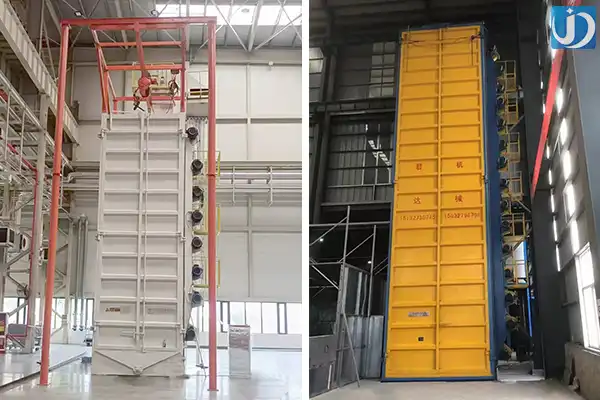
Our hook type shot blasting machine places two blast wheels symmetrically around the hook, so every face takes impact and no dead angle remains. One pass reaches Sa 2.5. Sa 2½ is the ISO 8501-1 grade for very thorough blast cleaning [1]. The frame design needs no foundation pit, which matters in older plants.

How Does a Hook Type Shot Blasting Machine Work?
A hook type shot blasting machine runs a four-step cycle. Crew members hang the part on the hook and close the chamber door. Dual variable-frequency drives lift the hook and spin it. Two wheels throw shot while the part rotates, slowly for large parts and faster for small ones. A bucket elevator, screw conveyor, and air-wash separator then clean the spent shot and return it in a closed loop.
How Does the Hook Rotation Improve Blast Coverage?
Rotation is the key. It lets shot reach inner cavities and weld toes that a fixed part would shadow. Weld spatter and slag must come off before coating [1].
What Is Inside the Blast Chamber?
High-manganese steel plates line the chamber of our hook type shot blasting machine and absorb abrasive wear. Blast wheel blades use high-chromium alloy, and Junda rates their wear life at about twice that of standard blades. The three-stage recovery loop returns usable shot to the wheels. Our monitoring software also tracks dust removal efficiency and maintenance needs.
Single Hook vs Double Hook Blasting Machines Compared
Both versions of a hook type shot blasting machine use the same blasting principle. They differ in how the crane and crew share time with the chamber. The table shows the trade-offs.
Factor | Single hook | Double hook |
Par flow | One part per cycle; the crane waits during blasting | Two hooks alternate, so loading overlaps blasting [6] |
Best for | Large parts and small to medium batches | Higher part counts per shift |
Cost | Lower entry price | Higher price for the added hook system |
Upgrade path | Can move to double hook, heavy-duty hook, or larger chamber | Heavy-duty hook and larger chamber remain options |
When Should You Upgrade the Hook or Chamber?
Upgrade your hook type shot blasting machine when your heaviest part, or the space it needs to rotate, exceeds the standard hook or chamber. Buying a chamber that is too small is a common worry. We confirm chamber size from your drawing before we quote.
Hook Type vs Tumble Belt Shot Blasting: Which to Choose
Rösler lists tumble belt machines as typical batch systems for small parts [2]. Strong Makine advises starting with a hanger machine when the geometry is complex or the part weighs more than 50 kg [3]. A hook type shot blasting machine covers the opposite case. The table compares the two on the points buyers raise most.
Factor | Hook type | Tumble belt |
Part handling | Hung on a hook, no contact | Tumbled together in a drum |
Best parts | Large welded parts, castings, molds | Small, robust bulk parts |
Collision risk | Low, because parts never touch | Higher, because parts strike each other |
Cavities and welds | Rotation exposes hard-to-reach faces | Depends on tumbling action |
Batch size | Single piece to small and medium batches | Bulk loads |
Which Machine Fits Your Parts?
Choose tumble belt for bulk bolts, fasteners, and small castings. Choose a hook type shot blasting machine for thin-wall, welded, or heavy parts that dents would ruin. Scrap from collisions is a real cost, so protect fragile parts before you chase speed.
Which Industries Use Hook Type Shot Blasting Machines?
Any shop that cleans large, irregular parts in single pieces or small batches can use a hook type shot blasting machine. Three use cases stand out for buyers in Vietnam, Malaysia, Indonesia, India, and South Korea.
Pressure Vessels and Welded Fabrications
Vessel makers must clean inner cavities and weld seams. A hook type shot blasting machine replaces slow manual blasting and acid pickling on these parts. Tests on welded joints show that shot peening adds compressive residual stress and improves fatigue strength [5]. Results depend on shot type and coverage, so confirm any stress target with a trial.
Wind Power Castings
GWEC reports a record 165 GW of new wind capacity in 2025. India installed 6.3 GW, nearly double the year before [4]. It projects 969 GW of new capacity from 2026 to 2030 [4]. More turbines mean more castings and welded parts to clean before coating.
Machine Bases and Large Molds
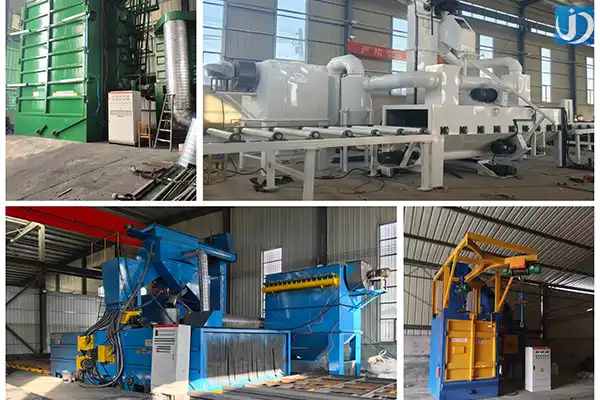
Machine tool bases and large molds are heavy, unique, and made in small numbers. Hanging them avoids dents, and slow rotation gives thorough cleaning on every face. A single hook type shot blasting machine handles most of these jobs.
Workpiece Weight and Size Limits of Hook Machines
Hook tonnage and chamber size set the limits. Market hanger machines cover a wide range. One supplier lists loads from 500 kg to 50,000 kg [6]. Strong Makine’s AK series runs from 0.5 t to 7.5 t of hook capacity [3]. Junda sizes the hook and chamber of each hook type shot blasting machine to your heaviest part. Send a drawing with weight, length, diameter, and hanging points.
Cycle Times and Load Capacity Data for 2026
One supplier reports typical blast cycles of 3 to 15 minutes, depending on the part [6]. Cycle time equals blast time plus crane swap time. Take a 4-minute blast and a 2-minute swap. That gives a 6-minute cycle, or 10 loads per hour. Large parts need slow rotation and longer blast time. The dual drives on our hook type shot blasting machine let you set both per part.
Hook Type Blasting Price Range and Operating Cost
Hanger machines have the widest price band among blaster types, and two machines in one category can differ by more than 300% [3]. Basket size, turbine count and power, manganese liners, and filtration drive the gap [3]. We do not publish a list price, because chamber size, hook tonnage, dust system, and voltage change every hook type shot blasting machine quote. Send drawings and we quote within 6–8 hours.
Operating cost matters more than the sticker price. Strong Makine urges buyers to compare five-year costs and cites 18 to 36 months as a common payback reference [3]. Wear parts, shot loss, and power lead the list. High-manganese liners and high-chromium blades cut wear part swaps on a hook type shot blasting machine, and closed-loop recovery keeps shot working.
Common Hook Machine Faults and Maintenance Tips
Five faults deserve regular checks on any hook type shot blasting machine. Worn blades cause uneven cleaning. A worn seal at the hook slot leaks shot. A clogged separator wastes usable shot. Rotor imbalance causes vibration. Poor rigging makes parts swing. Inspect blades and liners on a set schedule, clean the separator, and rate every sling to the part weight. Our English maintenance videos, remote troubleshooting, and long-term supply of original spare parts keep downtime short.
Step-by-Step Guide to Selecting a Hook Type Machine
A clear checklist helps you pick a hook type shot blasting machine and avoid two mistakes: a small chamber and an unsafe hanging point. Work through the table with your process engineer.
How Should You Match Hook Capacity to Your Workpieces?
Step | Action | What to send or check |
1 | Measure your heaviest part | Weight, length, diameter, and hanging points |
2 | Size the hook and chamber | Leave clearance for rotation; ask Junda to confirm from your drawing |
3 | Choose single or double hook | Parts per shift and crane availability |
4 | Request a trial | Compare the result with ISO 8501-1 photos [1] |
5 | Check local rules | Voltage, dust limits, spare parts, and export papers |
We configure voltage, dust collection, painting, and private labeling to your site. Installing our hook type shot blasting machine needs a crane, power, and a duct route, but no pit. We guide installation remotely, commission the machine, train operators, and send an overseas engineer when required. Distributors get English manuals, FCL, LCL, and oversized shipping support, plus CE documents, test reports, and certificates of origin.
Botou Junda Machinery Equipment Co., Ltd. sits in Botou, Hebei, China’s base for foundry machinery and dust removal equipment. We hold ISO 9001, ISO 14001, and ISO 45001, plus two utility model patents and seven software copyrights. We also keep inventory for fast orders.
Conclusion
A hook type shot blasting machine protects heavy, welded, and fragile parts while it cleans every face to Sa 2.5. Match hook tonnage, chamber size, single or double hook, and dust control to your heaviest part. Then ask for a trial before you commit.
FAQ
What is a hook type shot blasting machine?
A hook type shot blasting machine hangs a part on a rotating hook inside a closed chamber. Blast wheels throw shot at every face, which removes rust, scale, and slag without part-to-part contact.
How is it different from a tumble belt machine?
A tumble belt machine cleans small robust parts in bulk, and the parts touch each other. A hook type shot blasting machine hangs each part, so heavy, thin-wall, or welded pieces avoid dents.
What weight can a hook type shot blasting machine handle?
Weight depends on the hook and chamber. Market machines range from 500 kg to 50,000 kg [6]. Junda sizes the hook to your heaviest part and offers heavy-duty hook and larger chamber upgrades.
Does it need a foundation pit?
No. Our frame-type hook type shot blasting machine needs no pit, so older plants avoid civil work.
Can shot blasting relieve welding stress?
Blasting adds compressive stress at the surface, and tests on welded joints show better fatigue strength [5]. Confirm code requirements before you drop any other stress-relief step.
Ready to Send Your Heaviest Part for a Trial Quote?
Searching for a hook type shot blasting machine for sale that fits your heaviest part and local voltage? Junda Machinery will review your drawings and quote the hook, chamber, and dust system. Email junda001@jundablast.com with weight, size, and site details. Our engineers respond within 6–8 hours. You can also review our full range at jundablast.com.
References
[1] Steel Construction Info (2026). Surface preparation.
[2] Rösler Group (accessed 2026). Shot blasting technology overview.
[3] Strong Makine (2026). 2026 Shot Blasting Machine Prices.
[4] GWEC (2026). Global wind installations rise record 40% as industry charts way out of energy crisis.
[5] International Journal of Steel Structures (2018). Fatigue Strength Improvement of Welded Joints of Existing Steel Bridges by Shot-Peening.
[6] ATHI Group (2026). Spinner hanger shot blasting machine.

USER EVALUATE
Real feedback and practical experience shared by worldwide partners who purchased our machinery and environmental treatment devices.