


_1786959752558.webp)
Pipe Air Blasting Machine for Pipeline Surface Preparation: Applications and Benefits
A pipe air blasting machine removes rust, mill scale, old coatings, and weld residue from steel pipe surfaces before anti-corrosion coating or galvanizing. This tutorial describes how these machines work, compares air blasting to wheel-type shot blasting, and helps you choose one based on pipe diameter, production speed, and Sa2.5 approval criteria. This article provides the technical detail your project team and site inspectors need for pipeline coating or scaffold pipe restoration projects.
What Is a Pipe Air Blasting Machine?
Definition and Operating Scope
A pipe air blasting machine pushes abrasive bits against a pipe using compressed air or a spinning wheel. Impact removes rust, mill scale, paint, and light coating residue, roughening the surface. The anchor design helps the new layer attach to the steel.
Different from airblast and wheel blast. Air blasting employs compressed air pressure (4–8 bar) to drive abrasive through a nozzle. A rotating impeller throws abrasive at high speed during wheel blasting, which uses no compressed air. Project specs often refer to both pipe blast cleaning tools.

Main Machine Components
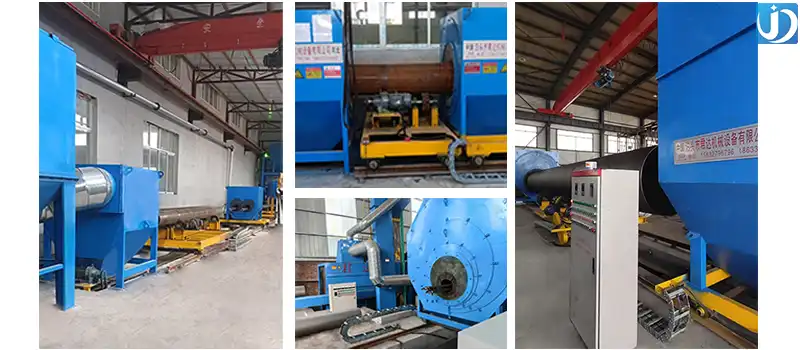
A lot of pipe air blasting machine systems have the same parts, whether they are air-driven or wheel-driven.
Blast pot or wheel housing: Holds and measures abrasive that goes into the air stream or onto the spinning wheel, keeping the flow rate steady while it's working.
Pipe conveying system: V-shaped rotating rollers move the pipe forward while turning it, so the whole circumference goes through the blast zone without having to be moved by hand.
The dust collector and ducting: Pull dust and small particles away from the blast chamber. This keeps the workers safe and the emissions within the allowed range.
Abrasive recovery unit: Sorts, screens, and recycles steel shot or grit that can be used again. This saves a lot of money over time because it cuts down on the need to buy new abrasives.
Control cabinet: Governs rotation speed, travel speed, and safety interlocks, and on newer machines includes remote monitoring software.
Together, these parts make the pipe air blasting machine production line work. If one of them isn't strong enough, like a dust collector that's too small, the whole line can stop. Since Junda Machinery doesn't sell parts separately, they design each part to match the system's rated throughput.
Typical Applications and Use-Case Scenarios
| User type | Typical requirement | Suitable configuration |
|---|---|---|
| Pipe manufacturer | Repeatable prep before coating on standard sizes | Automatic V-roller line with fixed blast wheels |
| Coating contractor | Sa2.5 on mixed pipe sizes for a single project | Adjustable roller spacing, extended 12m frame |
| Scaffold rental company | Low cost per meter on continuous rust removal | Simple wheel design with cheap, easy-to-swap wear parts |
Internal vs External Pipe Blasting Compared
Internal Pipe Blasting
Blasting the inside of pipes cleans them, gets rid of rust, and gets them ready for lining. It is important to think about the pipe's length, nozzle reach, internal thickness, and abrasive buildup. Having shadow patches where the spray angle misses the wall and abrasive that pools where it shouldn't be are the main problems.
External Pipe Blasting
Before painting the pipe, use a pipe air blasting machine to get rid of corrosion, mill scale, and old paint on the outside. Most of the time, wheeled equipment with spinning rollers is used to recondition pipelines and scaffold pipes. So, a pipe that moves under a ring of wheels that stays in place is fully covered and doesn't move.
Comparison Table
| Factor | Internal blasting | External blasting |
|---|---|---|
| Main access requirement | Nozzle or lance enters the bore | Nozzle or wheel reaches the outer surface |
| Typical challenge | Even coverage inside long, narrow pipes | Full 360-degree coverage around the circumference |
| Automation method | Rotating nozzle and/or lance travel | V-roller pipe rotation under fixed blast wheels |
| Inspection method | Bore camera and profile gauge | Direct visual check and profile tape |
| Recovery design | Sealed pipe ends with internal extraction | Enclosed chamber recovery under the rollers |
Which Pipe Materials and Diameters Can Be Cleaned?
Pipe Materials and Surface Conditions
A lot of the time, these lines clean and coat carbon steel pipe. The pipe is weld seams and gets rid of rust and mill scale. To keep stainless steel from getting rust stains, you must sand it without leaving any iron particles behind. It takes less force to hit cast and malleable iron because they chip. When you recoat galvanised pipe, you have to choose whether to leave the zinc layer on or off. Choices have an impact on pressure and grit.
Pipe Diameter and Length Range
Junda's standard pipe air blasting machine lines cover a known range. Any reputable supplier should give you exact numbers instead of a vague "wide range" claim.
| Parameter | Typical documented range |
|---|---|
| Minimum outside diameter | 20 mm |
| Maximum outside diameter | 1200 mm (custom frames available beyond this) |
| Standard maximum pipe length | 6 m to 9 m |
| Extended machine length | 12 m for long oil and gas pipe sections |
| Wall thickness range | 2 mm to 40 mm, media-dependent |
| Compatible geometry | Straight seamless, welded, and galvanized pipe |
Pipe Air Blasting vs Wheel Blasting: Which Technology Fits Your Project?
Process Differences
You may precisely direct pressurised air abrasive blasts through tubes using a pipe air blasting machine. Without an air compressor, wheel blasting throws abrasive from a spinning impeller at high speed. Air-driven tips or lances fit into narrow holes and are best for pipe drilling. Wheel blasting with rotating rollers on pipeline exteriors uses less compressed air and covers more surface area per hour.
Comparison Table
| Criterion | Pipe air blasting | Wheel blasting (Junda V-roller design) |
|---|---|---|
| Internal pipe cleaning | Well suited with rotating nozzle or lance | Limited; not the primary use case |
| External pipe cleaning | Workable but slower on large batches | Strong fit, 360-degree single-pass coverage |
| Compressed-air demand | High, adds compressor operating cost | None for the blast process itself |
| Best fit | Repair work, internal bores, mixed sizes | High-volume oil and gas, structural, scaffold pipe |
| Wear part cost | Nozzle wear, moderate replacement cost | Blade and wheel liner wear, well-documented service life |
Case Study: Cutting Rework Rate on a Southeast Asian Oil and Gas Pipeline Project
The site inspector for a gas transmission pipeline project in northern Vietnam didn't like the work that a painting contractor did. They used a pipe air blasting machine and abrasive lances that they operated by hand on 12-meter sections of pipe and had to do about 20% of the work over again. Because the coating plan got behind, the project was finished two weeks late.
12m frame, V-shaped revolving rollers, dust and chip recovery. Construction included Junda automatic wheel blasting. Steel grit media on 273mm pipe averaged 10 m/h net line speed for three months. Repeat jobs dropped below 4%. Maintaining rotation speed prevented shadow-zone rejects, which caused most of the earlier rework, according to the contractor project engineer. The coating passed dry film thickness testing during the first project-wide inspection.
This is why automated coverage trumps blast pressure. Inspectors frequently say the surface profile is uneven because some spots were missed. A computer that reliably hits every circle point solves this problem.
Conclusion
Better for pipe surfaces: air or wheel blasting? Air-driven nozzles and lances are suitable for interior holes. Wheel-based systems with rotating rollers for 360-degree coverage are excellent for external pipeline, structural, and scaffold pipe surfaces. Before ordering a machine, the standard, usually Sa2.5 under ISO 8501-1, instructs you what grit to use, how many passes to make, and how to keep dust out. You will save more money in the long run if you buy a pipe air blasting machine or a wheel-type equivalent that fits your pipe range, goal grade, and production schedule.
FAQ
Pipe air blasting machines must attain what cleanliness level for pipeline coating?
Under ISO 8501-1, most pipeline coating standards need Sa2.5, which removes most visible rust, mill scale, and old coating, leaving light shadowing. Some projects require Sa3, a full white-metal finish that requires more passes and slower travel.
It one machine handle small scaffold pipe and huge oil and gas pipe?
Rarely does one frame cover both extremes. Oil and gas pipe is 100mm to over 1200mm, while scaffold pipe is 33–60mm. Most operators run separate lines or adjustable roller sets for each diameter range since roller spacing and wheel housing size must match.
Abrasive recovery reduces operating costs how much?
Junda-installed lines exhibit 85–92% abrasive recovery on external pipe blasting systems, reducing fresh grit purchase volume by a similar percentage. That savings covers a lot of the equipment's cost over a year of continuous use.
How do pipe air blasting and wheel blasting machines differ?
For internal bores and repairs, air blasting uses compressed air to drive abrasive via a nozzle with precise direction. Wheel blasting uses a rotating impeller to throw abrasive without compressed air, increasing external pipe surface throughput at reduced cost per metre.
A custom pipe blasting equipment takes how long to build and ship?
Junda Machinery makes standard customised equipment in 15 days, depending on pipe diameter, length, and control system. Larger 12m extended frames or substantially customised dust systems may require additional lead time verified at quotation.
What abrasive for stainless steel pipe?
Stainless steel shouldn't be gritted since iron particles can create surface rust. Garnet or aluminium oxide media is the norm for stainless pipe surface prep because it avoids contamination.
Get a Machine Spec Match for Your Pipe Range and Project Deadline
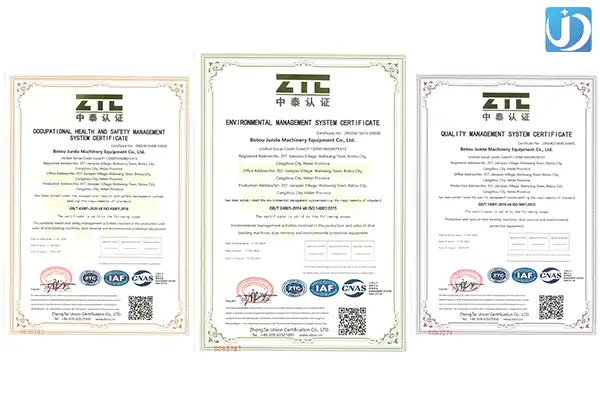
Many companies in Vietnam, Malaysia, Indonesia, and India hire Junda Machinery to make custom pipe air blasting and wheel blasting lines for companies that work with oil and gas, structural, and scaffold pipes. Within 6–8 hours, our engineering team will get back to you with a spec sheet that fits your pipe diameter, goal Sa2.5 grade, and project date. We make pipe air blasting machines and have 20 years of experience using them in the field. We also offer ISO 9001 paperwork and remote commissioning help. To begin your technical review, send an email to junda001@jundablast.com.
References
1. AMPP (Association for Materials Protection and Performance). "Surface Preparation Standards Overview." AMPP, 2024. Used in: Surface Preparation Standards section.
2. ASTM International. "ASTM D4417-20 Standard Test Methods for Field Measurement of Surface Profile of Blast Cleaned Steel." ASTM, 2020. Used in: Surface Preparation Standards section.
3. National Institute for Occupational Safety and Health. "Health Hazard Evaluation: Abrasive Blasting and Silica Exposure." NIOSH, CDC, 2023. Used in: Air Blasting vs Sandblasting Terminology section.
4. Grand View Research. "Surface Preparation Equipment Market Size, Share & Trends Report." Grand View Research, 2024. Used in: Introduction and market context.
About the Author
Robert Chen is a Pipe Surface Treatment Engineer with over 12 years of field experience in pipeline coating preparation and blast cleaning equipment across Southeast Asia and China. He has worked directly with coating contractors and pipe manufacturers to troubleshoot Sa2.5 acceptance issues, dust compliance, and abrasive recovery efficiency on active pipeline projects.

USER EVALUATE
Real feedback and practical experience shared by worldwide partners who purchased our machinery and environmental treatment devices.