


_1786959752558.webp)
Overhead Chain Shot Blaster: Uses, Features, and Benefits
An overhead chain pass-through shot blaster is a continuous cleaning machine that carries workpieces on an overhead monorail through one or more abrasive blast zones without stopping the line. This guide explains how the system works, which features actually matter, and how it compares with batch blasting for automotive frames, engineering machinery parts, and structural steel. I have helped commission lines like this across Asia, and I will share real specification ranges, a documented case study, and a buyer checklist before you request a quote. By the end, you will know whether continuous overhead blasting fits your paint line takt time.
What Is an Overhead Chain Pass-Through Shot Blaster?
Definition and Core Components
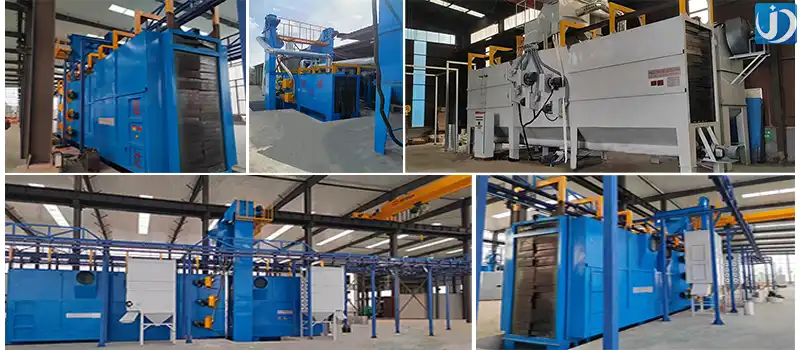
Five parts make up a pass-through chain blaster: a train that hangs from the ceiling, hanging hooks or carriers, blast wheels, an abrasive recovery loop, and a dust collection. There are no breaks in the flow of parts through the blast chamber as they hang from the rail. A steel shot or steel grit is thrown quickly to remove rust, scale, sand, and old paint.
"Shot blasting" means using metal or approved non-metal abrasive that is fired by a wheel that spins. It does not mean using compressed air. For repeat production work, this is important because wheel-driven blasting can handle more material at a lower cost per unit than air blasting. In order to hit its rated output, a overhead chain pass-through shot blaster needs this wheel-driven way.
What the Machine Is—and Is Not
This tool cleans and gets metal surfaces ready to use. It doesn't paint, heat treat, or clean parts chemically. People who are buying it sometimes mix it up with room-type blast cabinets or roller-conveyor systems made for long beams and flat plates.
The pass-through chain design keeps parts moving on a set path the whole cycle, unlike tumble belt or spinning hanger machines. The shape of the part, the orientation of the hooks, the condition of the abrasives, and how the blast wheel is set up still affect the final cleaning results; the machine does not guaranty a certain finish.
Core Specification Fields to Confirm Before Ordering
Check the numbers below with your supplier before you sign a purchase order. Most of the time, integration projects have to redo work during installation because they skip this step.
- Workpiece envelope: maximum length, width, height, and swing clearance inside the tunnel, since nominal chamber size is not the same as usable part size once hooks and fixtures are counted.
- Load rating: maximum weight per hook (commonly 50 kg on standard Junda lines) and total load allowed across the full conveyor loop at any moment.
- Production rate: target hooks per hour, required chain speed, and how that speed lines up with your existing paint booth takt time.
- Blast layout: number of wheels, their position (top, bottom, left, right), motor power, and wheel diameter matched to your part geometry.
- Media and dust systems: abrasive type and size, plus airflow, filter type, and discharge method for the dust collector.
In the rest of this guide, you will use these areas as a starting point for every quote comparison.

Key Features That Define Overhead Chain Shot BlastersContinuous Overhead Conveyor and Dual-Mode Operation
The motor is what holds the whole system together. Most Junda lines have a stepless variable-frequency drive that lets the chain speed range from 0.5 to 3 meters per minute. This lets workers change the exposure time without having to change motors.
The plants can be used in two different ways. Continuous mode works best for standard parts that are run in big groups and move steadily through the tube. Step mode stops for a short time at each blast zone. This works well for parts that are big or wonky, like machinery arms or long frame sections that need more stay time on one face.
Blast Wheel Layout and Abrasive Recovery
Overhead chain pass-through shot blaster with four wheels on top, bottom, left, and right, it can cover all four sides without having to go around again. For parts that are boxed or channel-shaped, this plan is most important because a two-wheel machine often leaves dark strips along the bottom.
A screw conveyor and an elevator loop move the recovered abrasive back to the wheels. Long-distance screw recovery keeps steel shot moving, even in large rooms. This means that a plant doesn't have to buy as much new media every month. The structure is protected from the abrasive stream by wear liners, metal blast wheel housings, and replacement wheel blades. These parts should be shown on the equipment drawing along with the material grade.
Dust Collection, Controls, and Safety Interlocks
Fine dust is sucked out of the blast chamber by a cartridge or baghouse dust collection, which also makes the work area airy. At the entrance and exit, flexible multi-layer sealing curtains stop shot and dust from escaping the tunnel while parts pass through. This is one of the most common places where cheaper machines break down.
From one panel, the PLC and HMI controls set the speed of the conveyor, the order in which the wheels start, and the door interlocks. The safety package also includes emergency stops, switches for the access door, and overload protection for the chain motor. Before you pay the last dollar, not after. Ask for the electrical schematic and risk assessment.
How an Overhead Chain Blasting Line Works
Loading and Workpiece Positioning
Parts are hung on hooks, bins, or fittings that are made to fit the shape of the part. Based on the part's rotation and the distance between the hooks, the abrasive stream can reach a certain amount of the surface. Parts that overlap or are close together make shade areas that a wheel can't reach.
It takes more care than it sounds to get this step right. When different part sizes are used on the same device design, cleaning is often not even between batches because parts that are bigger or not balanced right swing around while they are being moved.
Abrasive Blasting and Surface Cleaning
Once the part is inside the tunnel, blast wheels throw abrasive at it at a controlled speed. The metal gets rid of scale, rust, foundry sand, old coating, and small burrs when it hits something. The effect of the cleaning rests on a number of factors working together.
- Wheel speed and abrasive flow rate set the energy delivered per second, and a mismatch between the two — high speed with low flow — wastes power without improving the finish.
- Conveyor speed and blast angle decide how long each surface stays inside the abrasive stream and from which direction it gets hit.
- Media size, hardness, and part orientation determine whether deep pockets or ribbed sections get fully cleaned or only partly touched during a single pass.
When plants keep track of these factors for each batch, they can find the setting that caused a bad finish instead of having to guess across the whole line.
Separation, Recovery, and Discharge
Dough and used abrasive fall into the recovery hopper below the chamber through a grate. An air-wash divider gets rid of dust, broken shot, and other impurities. It then sends clean media back to the storage bin so it can be used again. Compared to blasting ways that only use steel shot once, this loop keeps the amount used low.
Parts come out of the tube, get one last look over, and then either go straight to unloading or a paint room. During this stage, dust collection keeps going because small particles keep settling for a short time after the blast wheels stop.
Overhead Chain vs Batch-Type Blasting: A Practical Comparison
| Criterion | Overhead chain pass-through | Tumble belt | Spinner hanger |
|---|---|---|---|
| Production mode | Continuous | Batch | Batch |
| Workpiece handling | Hanging conveyor | Tumbling load | Individual hanging |
| Complex shapes | Strong fit | Risk of impact damage | Strong fit |
| Fragile or cosmetic parts | Needs controlled fixturing | Often unsuitable | Good control |
| Labor after loading | Low, once automated | Batch load/unload cycles | Higher fixture handling |
| Volume | High and repeatable | Medium to high batch | Low to medium batch |
| Best fit | Repeat production lines | Durable small/medium parts | Delicate or varied parts |
When Overhead Chain Equipment Is the Better Choice
When parts are made over and over again and the sizes stay the same, continuous overhead chain pass-through shot blaster pays for itself the fastest. Most of the time, I've seen this happen on three different types of lines.
- Automotive frame and chassis plants running the same handful of part numbers daily, where a fixed hook design pays for itself within months through steady throughput.
- Foundry and forging operations cleaning repeated batches of castings that need sand and scale removal before machining or coating.
- Contract fabricators and paint line integrators serving several customers with parts close enough in size to share one fixture family.
In auto frame and chassis companies that make the same few part numbers every day, a fixed hook design pays for itself in a few months of steady output.
Automatic Versus Manual Loading
When the output is low, manual hook filling works fine, but it stops at whatever speed a user can safely keep up. When you use robotic or gantry lifting, that limit goes away, and the repeat accuracy between hooks gets better.
The cost up front is the trade-off. Although automated filling costs more, it saves time and money because workers don't have to lift heavy things over and over again near a blast chamber.
Which Industries Use Overhead Chain Shot Blasters?Automotive, Foundry, and Forging Applications
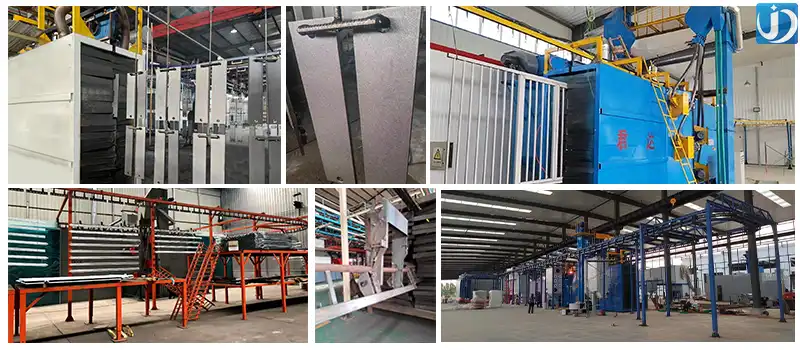
Before they are coated, engine blocks, suspension arms, brake carriers, and transmission housings all go through this machine. Parts that are cast or made have sand or heat scale that needs to be cleaned off carefully so that the part's size doesn't change.
When making an overhead chain pass-through shot blaster for auto parts, the mounting control has to be tighter than when working with steel. This is because brake and suspension parts often have tolerance limits that scale removal has to follow.
Structural Steel, Weldments, and General Fabrication
Hanging exposure is better for beams, brackets, welded frames, and manufactured brackets because the hook lets the blast wheels reach seams and sides that a floor-mounted process would miss. A roller-conveyor blast machine is usually needed instead of a chain hook design for very long structural members.
Case Study: Korean Chassis Plant Switches to Continuous Blasting
In South Korea, a medium-sized chassis builder used a spinning spinner hanger machine to feed its paint line. Because of the 12-minute break between blasting sets, the paint booth had to be empty twice a shift.
It worked perfectly when the plant switched to a four-wheeled overhead chain pass-through shot blaster that was the right size for its longest frame member. The blast output was then directly matched to the speed of the paint booth intake. Based on the plant's internal production log that was shared with our engineering team during startup, after three months of operation, there was a 31% drop in paint booth idle time and a measured drop in rework due to uneven scale removal. In continuous mode, the chain speed was set at 1.8 meters per minute. Step mode was only used twice a week for large cross-member groups.
Workpiece Size and Weight Limits Buyers Need to Know
Key Dimensional and Loading Limits
Before they give you a quote on a fitting design, ask any seller for exact numbers on the limits listed below. With these numbers, you can tell if your heaviest part fits the line or just the average part.
- Maximum part dimensions and weight including length, width, height, diagonal clearance through the tunnel, and the single heaviest workpiece expected on any hook.
- Hook spacing and conveyor pitch which set how close parts can travel without touching, along with the maximum allowed center-of-gravity offset for stable hanging.
- Hourly load capacity covering total production weight per hour, not just part count, since a mix of light and heavy parts changes real throughput.
Part Geometry, Shadowing, and Coverage
Abrasive has a hard time getting to shadow areas that are made up of holes, deep ribs, and closed off sections. When compared to a fixed two-wheel setup, rotating hooks and a four-wheel plan cut down on shadowing. However, internal openings on boxed parts may still need a separate cleaning step.
Sample-part trials are still the only safe way to make sure that a new part family is covered before committing to making the tools for mass production.
Capacity Validation and Acceptance Testing
A quick test in the workplace keeps everyone safe. Before the machine is built, send sample parts to show what kind of abrasive will be used and how hard it should be. Once the machine is running, compare the cleaning result to a standard that everyone agreed on.
While the test is going on, write down the cycle time, media consumption, and dust performance. Also, keep pictures and measurements on file in case there is a disagreement during site acceptance.
Main Benefits: Output, Labor, and Surface Quality
Throughput and Production-Line Integration
When a machine is moving continuously, an overhead chain pass-through shot blaster can plan its output in terms of parts per hour instead of parts per batch cycle. That number is directly set by the speed of the conveyor and the pitch of the hooks. This makes capacity planning easier for production schedulers who connect blasting to coating or inspection further down the line.
Labor, Ergonomics, and Operating Efficiency
When operators don't have to manually load and unload as often, they are exposed to less abrasive dust. The conveyor and blast wheel motors have variable-frequency drives that lower the power draw when the loads are smaller. Also, demand-controlled dust collection keeps the fan from running at full speed when the room is empty between batches.
Surface Quality and Process Consistency
Keeping the blast settings the same from batch to batch is important for getting rid of sand, scale, and coating leftovers evenly across a whole production run. To make sure the surface is clean, it is compared to visual standards like ISO 8501-1 (International Organization for Standardization, 2007). To make sure the coating sticks well, the surface profile depth is compared to ISO 8503. The blasting parameters should always be checked against the next process in the line, whether it's welding, coating, or machining.
Overhead Chain Blaster Cost and Payback Period
Main Cost Components
A clear quote breaks down the cost into groups instead of giving one big number. Before you compare bids, this table tells you what to ask any supplier.
| Cost category | Items to identify |
|---|---|
| Base machine | Blast chamber, conveyor, blast wheels, controls |
| Dust collection | Collector, ducting, filters, fan, discharge |
| Automation | Loading, unloading, sensors, PLC integration |
| Installation | Freight, rigging, assembly, commissioning, training |
| Consumables | Steel shot, filters, liners, hooks, wheel blades |
| Compliance | Testing, documentation, electrical adaptation, guarding |
| Logistics | Packaging, inland transport, ocean freight, duties |
Payback and Total Cost of Ownership Model
You don't need a finance team to get a good idea of the payback period with this easy formula:
Every year, it saves money on labor, raises output, and cuts down on rework, which adds to the annual operating cost.
Time it takes to get your money back = total investment ÷ annual net gain
On the cost side, you should include power, rough use, filter replacement, and maintenance work. Before you decide if the extra automation is worth the money you'll have to pay up front, compare that total to the amount of work you already do by hand or in batches. The exact price of an overhead chain pass-through shot blaster relies on the chamber size, the number of wheels, and the compliance scope. Any flat number given should only be used as a starting point for negotiations, not as the final price.
Procurement Terms to Request
Before you sign, you should ask for a written quote that spells out the scope and what it doesn't cover, as well as the manufacturing wait time and payment milestones. Ask what the Incoterm is (EXW, FOB, CIF, or DAP), how long the guarantee lasts, and whether spare parts and training for the user are part of the base price or charged extra. These terms, not just the price of the machine, determine your final landing cost.
Common Operating Issues and Practical Solutions
Uneven Cleaning or Shadowed Areas
Most shadowed strips are caused by the way the hooks are positioned, parts that meet, or a worn wheel blade that stops the flow of sharp material. To fix most of these problems without having to rebuild the whole thing, you can do a coverage trial with real production parts and change the fixture spacing or wheel angle.
Excessive Abrasive Consumption or Dust
It's likely that a broken chamber seal, an air-wash separation that isn't set right, or too many fines building up in the abrasive loop are to blame for rising media costs or noticeable dust leaks. This can be caught before it leads to a bigger repair bill by regularly checking the differential pressure of the dust collector and the seals.
Conveyor, Hook, and Blast-Wheel Failures
Most unexpected downtime on chain-driven blast lines is caused by parts that aren't balanced, hooks that are too full, or lining replacements that are late. A vital parts list for chains, liners, and bearings and a preventive maintenance program that is tied to working hours make sure that unexpected stops don't happen very often.
Safety, Compliance, and Environmental Risks
Guarding, interlocks, lockout and tagout procedures, and controls for dust exposure all need to be in line with the rules where they will be installed, not just where they were made. The European Commission (2024) says that buyers in the EU should ask for up-to-date CE compatibility documents and a machinery risk assessment. (Occupational Safety and Health Administration, 2024) US buyers should make sure that the finished installation meets OSHA's standards for machine safety and dust exposure.
Selection Checklist for Overhead Chain Blasting Buyers
Technical Selection Checklist
Go through this list before asking any of the suppliers on your choice for a final quote.
- Confirm workpiece dimensions, maximum weight, and center-of-gravity limits against the machine's rated hook capacity and tunnel clearance.
- Calculate required parts-per-hour output and match it against chain speed range and hook spacing on the proposed design.
- Supply part drawings and photos so the supplier can flag shadow-risk geometry before fixture design begins.
- Define the cleaning standard and acceptance method in writing, referencing a visual or profile standard where one applies.
- Review dust collector airflow, filter type, and emissions target against your site's environmental permit requirements.
Supplier Capability and Evaluation
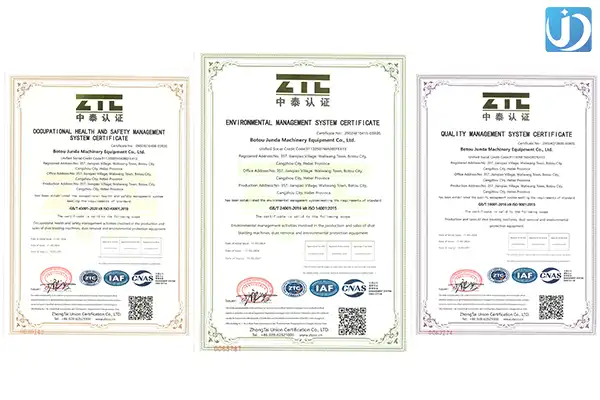
At this point, proof is more important than sales boasts. Before you compare prices, make sure you get general arrangement plans, references for similar installations, and a copy of the supplier's quality guarantee. If your seller has ISO 9001 certification and written plant acceptance test records, you can use these as proof if there is a disagreement in the future. Junda Machinery is certified by ISO 9001, ISO 14001, and ISO 45001, and they include full test results and export paperwork with every order. This cuts down on the verification step for buyers from other countries who have to make a choice in 12 to 20 weeks.
Quality Verification and Final Decision
Ask for a technical specification that has been signed off on and a list of changes that have been made, along with material certificates for the chain, hooks, and wear liners. Not after the machine has been shipped, but before it leaves. Look over the wiring plans and spar parts code list. A weighted scorecard that includes technical fit, total cost, wait time, and after-sales help from at least three suppliers is a better way to make a choice than price alone.
Conclusion
When making the same thing over and over, the part sizes stay within a known range, and the plant needs to blast at the same speed as the paint line behind it, an overhead chain pass-through shot blaster is the best choice. The best choice is based on tried-and-true part tests, hook capacity, dust control, and the total cost of the equipment over its lifetime, not on the price that is shown on the first quote. If buyers check these details early on, they can avoid the extra work and wait time that slow down a good machine purchase.
FAQ
What is an overhead chain pass-through shot blaster?
It is an ongoing blast-cleaning machine with an overhead rail that moves workpieces through one or more sharp blast zones. It is used in plants to make repeated amounts of castings, forgings, car parts, and weldments.
How does an overhead conveyor shot blaster work?
An overhead railroad moves parts along by hooking them up. As the parts move by, blast wheels hit them with abrasive. The contact time is controlled by the speed of the conveyor, and used media is automatically sorted and sent back to the wheels.
Is an overhead chain shot blaster better than a tumble belt machine?
It works better for parts that shouldn't fall on top of each other and to make things that are mass-produced. Small, durable parts that are run in flexible, low-volume batches work best on a tumble belt machine.
How much does an overhead chain shot blasting machine cost?
How much something costs is based on its chamber size, conveyor length, wheel power, level of automation, and compliance scope. Along with the base machine price, a fair comparison should take into account things like grit, filters, energy, upkeep, and freight.
Which abrasive media works best in overhead shot blasters?
To clean and lightly peen something, steel shot works well. For heavy scale, steel grit makes a more violent angular cut. The choice of media should match the surface of the part and the finishing process that will come after.
What standards apply to an overhead shot blasting machine?
Standards are usually in place for machine safety, electrical safety, and surface cleanliness. Buyers in the EU should check the CE paperwork, and buyers in the US should see if their place meets OSHA's standards for guarding and dust exposure.
Get a Technical Review Before You Commit to a Supplier
In Vietnam, Malaysia, Indonesia, India, and South Korea, Junda Machinery plans and builds overhead chain pass-through shot blaster systems for paint line integrators, engineering machinery makers, and auto frame plants. Plants that want to buy an overhead chain pass-through shot blaster with the right hook capacity, chain speed, and full CE paperwork support can talk to our team. To junda001@jundablast.com, send your part drawings and the result you want to achieve. Within a few business days, our engineers will send you back a rough layout and interface review.
References
International Organization for Standardization. ISO 8501-1:2007 — Preparation of steel substrates before application of paints and related products. Cited in the surface quality section.
International Organization for Standardization. ISO 11124-1:2018 — Specifications for metallic blast-cleaning abrasives. Cited in the media selection discussion.
Occupational Safety and Health Administration. Abrasive Blasting. Cited in the safety and compliance section.
National Institute for Occupational Safety and Health. Blasting. Cited in the dust exposure discussion.
European Commission. Machinery — Mechanical Engineering. Cited in the CE compliance section.
ASTM International. Standards and Publications. Cited in the material and testing references throughout.
About the Author: David Zhang is a senior shot blasting equipment engineer with over 15 years of experience designing continuous and batch abrasive cleaning systems for automotive, foundry, and structural steel producers. He has led equipment commissioning projects across South Korea, India, and Southeast Asia, and works directly with plant engineering teams at Junda Machinery to match blast line design to paint line and production takt requirements.

USER EVALUATE
Real feedback and practical experience shared by worldwide partners who purchased our machinery and environmental treatment devices.