


_1786959752558.webp)
Hook Pass-Through Shot Blaster: Working Principle, Components and Applications
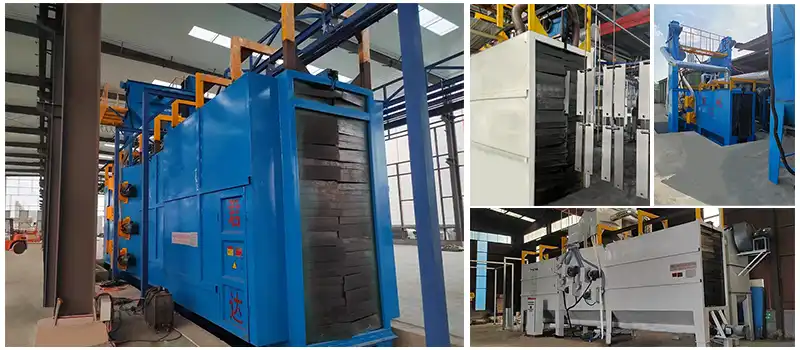
A hook pass-through shot blaster is a suspended, monorail-driven surface treatment machine that propels high-velocity steel shot at workpieces hanging from overhead hooks. Unlike stationary batch machines, workpieces travel continuously through the blast chamber, so loading, blasting, and unloading happen in alternating cycles on the same rail. This pass-through design converts idle setup time into productive output time — a direct answer to the single-station bottleneck that slows down fabricators handling large castings, truck frames, and construction machinery parts every day.
How a Hook Pass-Through Shot Blaster Works
The Pass-Through Cycle
A single train hangs above the machine and powers it. The operator puts the next piece of work on a second hook outside while the first hook goes into the blast chamber. When the blasting is done, the cleaning part comes out of the other side, and the filled hook goes in right away. Because the rhythm changes, neither the blast wheel nor the production line has to wait for a part.
Variable-Frequ
ency Hook Rotation
A variable-frequency inverter makes each hook spin at 2–4 r/min. The user changes the spinning speed and hook pass-through shot blaster lift speed based on the shape, weight, and amount of rust on the workpiece. Without any help from a person, the right exposure time is set for both a 500 kg casting and a 10,000 kg truck frame. One machine can clean a lot of different kinds of parts to Sa 2.5 level because it has variable control.
Blast Wheel Mechanics
High-efficiency blast turbines use centrifugal force to speed up steel shot and shoot it at the suspended workpiece from multiple angles at the same time. There are no shadow zones because the part spins 360° and shots come from all directions. Every surface, cavity, and weld seam gets full abrasive coverage. The main technical advantage over belt or wheel conveyor tools is that it can clean surfaces regardless of their shape.
Key Components and Their Functions
Each part of a spinner hanger shot blasting machine does a specific job. Knowing what each part does helps buyers figure out how much it will cost to run in the long term, especially when it comes to replacing worn-out parts.
Blast Chamber Lining
High-manganese steel armor plates made of Mn13 are all around the inside of the chamber. Manganese steel work-hardens when it is hit, which makes it last a lot longer than mild steel. For the same reason, the blast turbine blades are made from a high-alloy material that doesn't break down easily. These decisions about materials are the single most important factor in figuring out the three-year running cost in a continuous production setting.
Abrasive Recovery System
Shot doesn't get thrown away after just one use. In this machine, used abrasive is moved from the floor bin to the top of the machine by a bucket lifter. The separator takes out the dust and broken pieces of shot, then sends the cleaned, usable shot back to the blast wheel. This closed-loop recycling system, which includes a bucket elevator, a screw conveyor, and an air classifier, keeps the amount of abrasive used low and the quality of the surface the same from shift to shift.
Dust Collection and Environmental Compliance
A pulse-cartridge dust collector pulls dust from both the blast chamber and the separation at the same time. When systems are properly set up, they keep pollution levels well below 5 mg/m³, which helps them pass environmental inspections. For companies in places with strict rules about air quality, the dust collection specs should be checked before the purchase, not after the installation.
PLC Control System
A Siemens or similar PLC controls the speed of the hook's movement, the frequency of its rotation, the order in which the blast wheels start and stop, and the operation of the dust collector from a single panel. Normally, there are alarms for motor overload, grit level, and filter pressure drop. Junda Machinery's Q48 series can be monitored remotely, which lets maintenance teams record information about the status of machines to plan ahead for when they need to be serviced.
Typical Industrial Applications
The spinner hanger shot blaster can work on things that a tumble blast machine can't touch without breaking them. In these main production situations, this type of machine is the most useful:
- Construction machinery components — boom arms, bucket teeth, track frames, and hydraulic cylinder bodies all benefit from Sa 2.5 surface prep before painting or thermal spray coating.
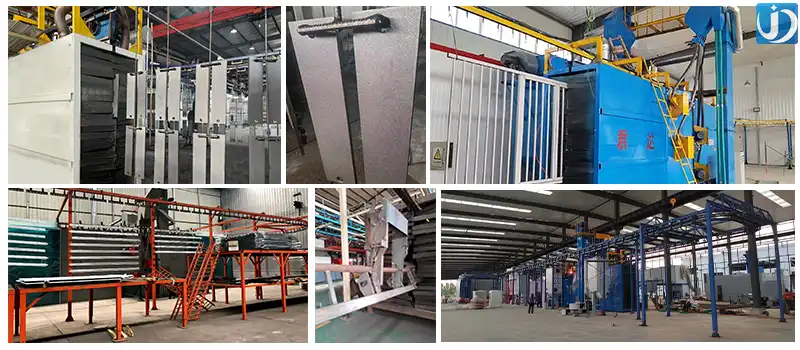
- Truck body and chassis fabrication — long, asymmetric steel structures hang cleanly from a single hook pass-through shot blaster, and rotate through the blast zone without contacting each other or the chamber walls.
- Large iron and steel castings — single-hook capacity up to 10,000 kg covers gate valves, pump housings, and bearing pedestals that no batch machine can accept.
- Structural steel and complex weldments — irregular geometries that defeat flat-bed roller conveyors are handled naturally in a suspended, rotating orientation.
All of these uses need surfaces that are clean all the way through and don't get damaged when parts hit each other. The overhead suspension design meets both requirements, which is why foundries and big makers choose this kind of equipment for their main production lines.
Maintenance, Safety, and TroubleshootingScheduled Wear-Part Inspection
Every 80 to 120 hours of use, the blast turbine blades should be checked and changed as a set to keep the shot velocity even. Because chamber liner plates can be rotated, installers can flip them over when one face starts to wear thin. This makes them last twice as long. By keeping a written check log, you can avoid sudden blade failures that would stop work in the middle of the shift.
Operator Safety Requirements
Operators must wear steel-toed shoes, impact-resistant eye protection, and hearing protection (blast noise at the operator station usually hits 85 to 95 dB). At both the load station and the unload station, there must be emergency stop buttons. The turbine motors must be locked out and tagged before any repair worker can enter the blast room. This is a must, no matter how small the job seems.
Common Fault Patterns and Fixes
Most of the unexpected downtime is caused by three faults. First, abrasive bridging in the hopper outlet, which can be fixed with a vibrator or a breakup rod that you move by hand. Second, rubble buildup on the drive pulley caused the elevator belt to slip. This problem could be fixed by checking the tension of the belt once a week and cleaning the pulley. Third, cleaning the surface unevenly, which typically means that the blast pattern control cage is worn or not lined up right, not the turbine blades. Figuring out the right root cause cuts down on testing time by a large amount.
How to Select the Right Monorail Shot Blasting Machine
Buyers should start with two numbers: the largest cross-section dimension and the weight of the heaviest single piece of work. The minimum hook capacity and the needed blast chamber opening are set by these two numbers. These limits determine everything else, like the number of turbines, the rate of abrasive flow, and the length of the rails.
If you make mid-range castings and structural parts, Junda Machinery's Q37 and Q38 models are perfect for you. They can handle hook loads from 500 kg to 3,000 kg. Heavy-duty foundries and building sites can use the Q48 line, which can handle up to 10,000 kg per hook. Standard production lead time is about 15 days from the time an order is confirmed. For international buyers, English-language remote installation instructions are available.
Conclusion
When a machine stops to swap parts, it wastes time and money that could be used to make more things. A hook pass-through shot blaster fixes this problem. At the hardware level, it turns setup times into throughput by separating loading from blasting. The machine is reliable enough to work in demanding environments with multiple shifts thanks to its high-manganese liners, variable-frequency hook control, and closed abrasive recovery loop. If buyers match the hook capacity to their biggest piece of work and make sure they know the chamber dimensions before placing their order, this type of equipment will be one of the easiest purchases they can make in surface preparation.
FAQ
1. What is the difference between a hook pass-through shot blaster and a tumble blast machine?
A tumble blast machine is good for small parts that can take a hit and still roll around without breaking. Each piece of work is suspended separately in a hook pass-through machine. This keeps parts from running into each other and lets large, fragile, or precisely made parts be processed. It can also handle odd forms that a tumble barrel would damage or get stuck on.
2. What surface cleanliness standard can this machine achieve?
As long as the abrasive media is chosen correctly and the blast exposure time is long enough, the standard output is Sa 2.5 (near-white metal) according to ISO 8501-1.
3. How long does installation typically take?
Installation and start-up usually take three to five days for a standard factory layout with an existing overhead crane rail. For custom train layouts, you may need to do more civil planning. For foreign projects, Junda Machinery offers remote installation help and English-language instructions.
4. What abrasive media is recommended?
Standard S280 to S330 steel shot is used to clean steel parts of rust and mill scale. Steel grit in grades GL or GH is used when heavy-duty coatings need a deeper anchor profile.
Ready to Spec Your Next Hook Pass-Through Shot Blaster? Contact Junda Machinery
Tell us the largest part size and weight of your heaviest piece of work, and we'll send you a layout proposal for the right model from our Q37, Q38, or Q48 series. Junda Machinery has been making direct hook pass-through shot blasters for 20 years, is ISO 9001/14001 certified, and has a normal wait time of 15 days. They can give you a clear, technical answer quickly. You can email us at junda001@jundablast.com to send us your question right now.

References
1. Wheelabrator Group — Shot Blast Technology Reference Manual, Wheelabrator, 2019.
2. Surface Preparation Standards for Painting Steel Structures, ISO 8501-1:2007, International Organization for Standardization, 2007.
3. Abrasive Blasting Operations — Engineering Control and Work Practices Manual, NIOSH Publication No. 84-116, National Institute for Occupational Safety and Health, 1984.
4. Casting Engineer's Handbook, Steel Founders' Society of America, 2018.
5. Industrial Surface Treatment: Blasting Techniques and Equipment Selection, Finishing Publications Ltd., 2020.
6. Occupational Noise Exposure: Revised Criteria, NIOSH Current Intelligence Bulletin 58, National Institute for Occupational Safety and Health, 1998.

USER EVALUATE
Real feedback and practical experience shared by worldwide partners who purchased our machinery and environmental treatment devices.