_1786959752558.webp)
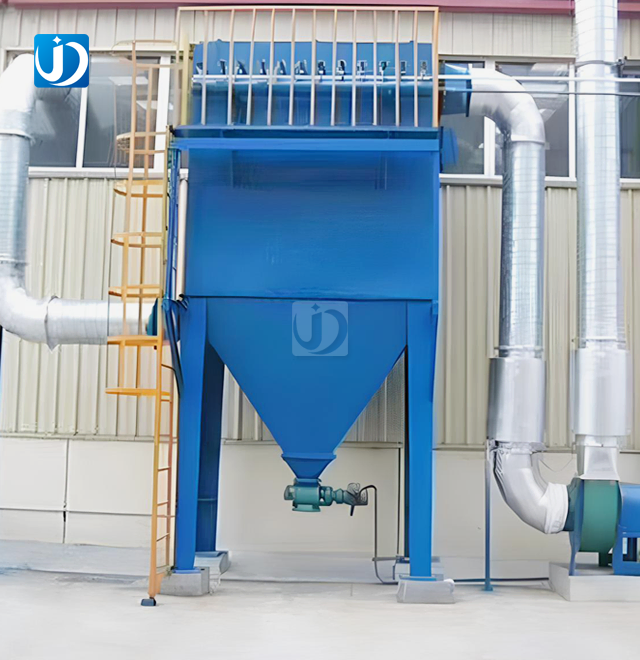
industrial dust extraction
Suction ports are arranged at dust generation zones to capture airborne metal dust, improving
workshop environment and protecting operator health.
Optional multi-stage purification realizes abrasive recovery and compliant emission
Cyclone separators can be equipped for high dust concentration to recover reusable steel shots.
Secondary filters trap fine dust, lowering media cost while exhaust meets environmental regulations.
Modular integrated design for new production lines and workshop retrofits
Standardized ducts, dust collectors and fans support flexible layout. Suitable for brand-new shot
blasting workshops and renovation of existing dust control systems.
Automatic pulse cleaning enables non-stop production
Dual-mode pulse jet cleaning (timer & differential pressure) removes dust from filters automatically
and maintains stable airflow for long-hour blasting operations.
- Product Description
Industrial Dust Extraction System for Clean‑Workshop Operations|Junda Machinery Advanced Filtration Solutions
Botou Junda Machinery Equipment Co., Ltd. provides enterprise‑grade industrial dust extraction systems specially designed for high‑efficiency particle capture in surface‑treatment and metal‑processing operations. With a 3,000‑square‑meter production plant and over 20 years of foundry‑equipment experience, our negative‑pressure dust collector achieves filtration efficiency ≥99.5 % for metallic dust, welding fumes and abrasive particles. Custom configurations can be manufactured in approximately 15 days, supported by an ISO9001, ISO14001 and ISO45001‑certified quality‑management system, while standard equipment ships from stock.

What Makes Our Industrial Dust Extraction System Effective
Dust removal is the cornerstone of compliant workshop air‑quality management. Our industrial dust extraction system generates powerful negative pressure at dust‑generating zones (blast cabinets, grinding stations and welding benches), drawing airborne contaminants directly into multi‑stage filtration units before particles reach operators’ breathing zones.
Its working principle combines high‑velocity suction with composite filtration technology. Dust‑laden air enters via strategically positioned capture hoods, travels through sealed ductwork into the purification chamber and passes through progressive filtration stages. Clean exhaust gas meets environmental emission standards, while collected particulate matter falls into sealed ash hoppers for safe disposal.

Technical Specifications
| Parameter | Specification |
|---|---|
| Product Name | Dust‑collection equipment |
| Applicable Industries | Shot‑blasting, sandblasting, grinding, polishing, welding and cutting operations |
| Working Principle | High‑negative‑pressure suction, multi‑stage composite filtration |
| Filtration Efficiency | ≥99.5 % for fine particulate matter |
| Configuration Options | Air volume and pressure adjustable according to workshop requirements |
| Cleaning Method | Automatic pulse‑jet system (timer and differential‑pressure modes) |
| Voltage Standard | Customizable to regional specifications |
| Energy Consumption | Low air resistance, optimized for continuous operation |
| Installation Type | Modular integrated design for new builds and retrofits |
Core Features to Solve Workshop Challenges
Source Capture Prevents Dust Diffusion
Suction inlets mounted directly on dust‑generating equipment intercept airborne metallic particles before dispersion. This negative‑pressure approach improves workshop visibility and protects operators’ respiratory health during long shifts.
Multi‑Stage Purification with Abrasive Recovery
For high‑concentration applications, an optional cyclone separator recovers reusable steel shot and grit, cutting media costs by 30‑40 %. Secondary filter cartridges capture fine particles down to sub‑micron sizes, ensuring emissions satisfy strict environmental‑audit requirements.
Modular Design for Flexible Integration
Standardized duct sections, collection hoods and exhaust fans adapt to a wide range of workshop layouts. Whether you are installing a new shot‑blasting line or upgrading existing dust‑control infrastructure, components integrate smoothly without extensive facility modifications.
Non‑Stop Production via Automatic Cleaning
Dual‑mode pulse‑jet cleaning automatically removes accumulated dust from filter surfaces. Timer‑based intervals handle predictable loads, while differential‑pressure sensors trigger cleaning when resistance rises during heavy‑duty operations, maintaining consistent airflow throughout production runs.
Full Sealing Eliminates Secondary Emissions
Gaskets seal all duct flange and access‑panel joints. Rotary airlock valves at ash‑discharge points prevent dust re‑entrainment during hopper emptying, preserving performance gains delivered by your industrial dust extraction system.
Intelligent Interlock Control Simplifies Operation
The extraction system synchronizes with blasting machines and conveyor lines via a programmable logic controller. Differential‑pressure alarms and motor‑overload warnings enable centralized monitoring, reducing manual inspections and simplifying maintenance schedules.
Multiple Models for Different Capacities
Our product portfolio covers compact standalone units for single workstations, medium‑capacity systems serving multiple grinding booths, and large central industrial dust extraction networks handling entire workshop areas. Compatible equipment includes cabinet‑type blast machines, rotary hanger machines, roller‑conveyor systems and tunnel‑type continuous shot‑blasting production lines.

Frequently Asked Questions
Q: What main types of dust‑collection equipment are available?
A: These systems capture industrial dust and fumes while maintaining negative pressure inside machinery to prevent leakage. They purify exhaust gas to meet emission standards and protect operators. For shot‑blasting and sandblasting production lines, cyclone separators recover steel shot and grit to substantially reduce abrasive costs.
Q: What are the key requirements for dust collectors used in shot‑blasting and sandblasting?
A: Hard metallic dust demands wear‑resistant construction. Pulse baghouse dust collectors are preferred. Pre‑cyclone separators are recommended for steel‑shot and grit recovery. Sufficient air volume is critical to sustain negative pressure, avoid dust leakage and achieve emission compliance.
Q: What causes poor suction performance?
A: Common issues include air leakage and duct clogging, damaged or blinded filter bags / cartridges, insufficient fan air volume and pressure, malfunctioning pulse‑cleaning systems, poorly‑sealed access doors, over‑filled ash hoppers, and excessive elbows increasing airflow resistance.
Q: What routine maintenance keeps the system operating reliably?
A: Regularly inspect filter bags and cartridges. Ensure pulse‑jet cleaning works properly. Check sealing of ductwork and cabinets. Empty hopper dust as scheduled. Maintain exhaust fans. Repair and replace worn components in a timely manner for long‑term stable operation.
Why Choose Junda Machinery for Your Dust‑Control Needs
Our 20‑year experience in foundry‑equipment manufacturing translates into practical system designs. We maintain sufficient stock for fast delivery, while providing professional ODM/OEM customization adapted to your voltage standards, environmental regulations and installation conditions.
Technical support covers remote installation guidance, commissioning assistance, troubleshooting, operator training, English‑language operation manuals and maintenance videos. Our customer‑service team replies to inquiries within 6‑8 hours to keep projects on track.
Long‑term cooperation with major logistics companies delivers stable sea‑freight resources for FCL, LCL and out‑of‑gauge cargo. We handle export packaging, equipment fixing, fumigation requirements and customs procedures to lower transportation risks.



Get Your Custom Dust‑Extraction Solution
Contact our engineering team via junda001@jundablast.com to discuss your workshop industrial dust extraction requirements. We will recommend the optimal system configuration for your application.

USER EVALUATE
Real feedback and practical experience shared by worldwide partners who purchased our machinery and environmental treatment devices.