


_1786959752558.webp)
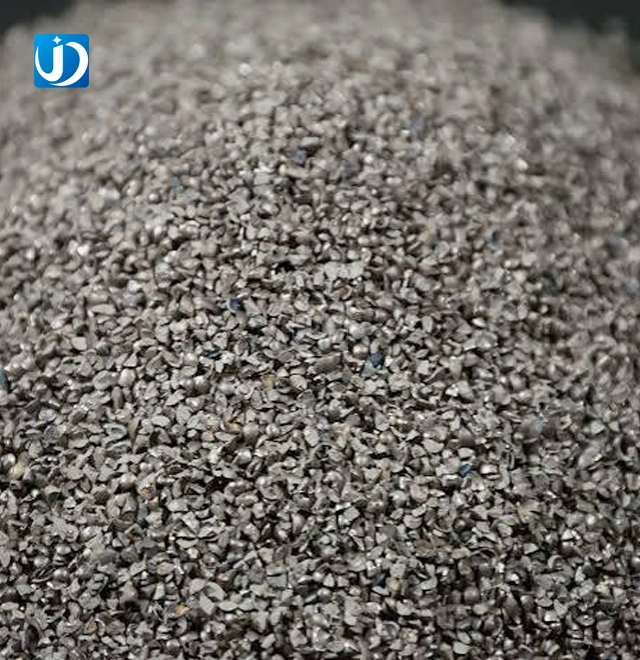
best blasting media for steel
With rational particle shape, it efficiently removes surface rust, mill scale and welding residues on steel,
while preventing excessive substrate erosion. No deep grooves are formed on workpieces, balancing
processing speed and base material integrity.
Adjustable Anchor Profile for Diverse Coating Schemes
Spherical or angular abrasives can be selected according to technical requirements to produce anchor
profiles of different depths, compatible with primers, intermediate paints, high-build anti-corrosion
coatings and meet surface acceptance standards of various projects.
Stable Cyclic Consumption Suitable for Medium & Long-Term Mass Production
Outstanding anti-fatigue property ensures steady fragmentation rate and controllable fine dust output
during continuous blasting.
- Product Description
Best Blasting Media for Steel: High‑Efficiency Carbon‑Steel Shot & Grit Solutions for Industrial Surface Treatment
Steel surface treatment requires specialized abrasive materials to balance cleaning capacity and substrate protection. Botou Junda Machinery Equipment Co., Ltd. provides the best blasting media for steel, manufactured from high‑carbon steel shot and steel grit with hardness ranging from 420‑800 HV and bulk density above 7.8 g/cm³. Backed by over 20 years of manufacturing expertise and a 3,000‑square‑meter production facility, we supply customizable particle sizes from 0.2 mm to 6.0 mm, achieving Sa2.5 cleanliness standard while delivering consistent anchor profiles. Compared with disposable media, our recyclable abrasive solutions cut consumption costs by up to 70 %, making them ideal for shipbuilding, steel‑structure fabrication and heavy‑duty machinery manufacturing.
Our professional team replies to inquiries within 6‑8 hours. Standard products are available for immediate shipment, and custom configurations can be completed in approximately 15 days.

Why Choose Carbon‑Steel Shot and Grit as Blasting Media
Carbon‑steel abrasives effectively remove mill scale, rust layers and welding residues without compromising substrate integrity. Spherical shot delivers powerful impact cleaning, while angular grit generates uniform surface roughness to enhance coating adhesion.
When paired with suitable recovery systems, these abrasives maintain stable performance through multiple recycling cycles. Facilities processing large volumes of steel benefit from reduced dust emissions and predictable breakage rates during continuous operation.
Adjustable hardness ranges accommodate different steel grades and coating requirements. Lower‑hardness grades suit thin‑walled components, whereas high‑hardness grades are intended for heavily‑corroded structures and aged‑paint removal.

Technical Specifications for best blasting media for steel
| Parameter | Specification |
|---|---|
| Product Series | Premium High‑Efficiency Steel Blasting Abrasives |
| Material Grade | High‑Carbon Steel Shot / Steel Grit / Alloy‑Steel Abrasives |
| Particle‑Size Range | 0.2 mm‑6.0 mm (Customizable) |
| Hardness | 420‑800 HV |
| Bulk Density | ≥7.8 g/cm³ |
| Recyclability | Upwards of 200 cycles with recovery equipment |
| Dust Output | Low‑level controlled fine particulate matter |
| Surface Profile | Adjustable anchor depth: 1.5‑4.5 mils |
Performance Advantages for Higher Productivity
Balanced Cleaning Without Substrate Damage
Well‑proportioned particle geometry removes contaminants efficiently while preventing deep groove formation. Your steel workpieces retain dimensional accuracy and surface smoothness, which is critical for precision applications.
Customizable Surface Profiles for Any Coating System
You may select spherical shot, angular grit or custom blends to satisfy your specific coating requirements. This flexibility covers everything from thin primers to high‑build anti‑corrosion systems across diverse project specifications.
Extended Service Life Reduces Operating Costs
Excellent fatigue‑resistance guarantees consistent performance over hundreds of recycling cycles. Compared with disposable alternatives, your facility experiences lower consumable replacement frequency and less material throughput.
Multi‑Application Compatibility
The best blasting media for steel works efficiently in shot‑blasting machines, pressure blast cabinets and enclosed blast‑chamber systems. Consistent results can be achieved when processing components ranging from small mechanical parts to large structural assemblies.
Main Application Scenarios
Steel‑structure manufacturers use these abrasives to remove corrosion and prepare surfaces prior to welding or painting. Controlled impact force prevents deformation of beam sections and steel plates.
Shipyard operations benefit from low‑dust properties during hull preparation. The media efficiently removes marine growth and old coatings while generating optimal profiles for marine‑grade protective systems.
Foundries and forging plants deploy the abrasives to eliminate mill scale and surface defects on cast and forged parts. The process improves component appearance and prepares surfaces for machining operations.
Pressure‑vessel manufacturers rely on consistent performance for internal and external surface treatment. The media helps meet cleanliness standards required for high‑integrity welding and coating adhesion.

Selecting the Right Media Configuration
Your rust condition and roughness requirements determine optimal abrasive selection. Minor surface oxidation responds well to spherical shot, whereas heavy corrosion and thick coatings demand the cutting action of angular grit.
Thin‑walled components benefit from lower‑hardness grades to minimize surface deformation. Heavy‑duty structural steel tolerates higher‑hardness media for faster material removal rates.
Blended ratios between shot and grit offer intermediate solutions. A 50/50 blend combines impact cleaning with profile creation, suitable for general‑purpose steel‑preparation applications.
Particle‑size selection influences cleaning speed and surface texture. Smaller particles produce finer profiles suited for thin coatings, while larger particles create deeper anchors for high‑film‑build systems.
Maximize Media Utilization Efficiency
Install proper recovery and screening systems to continuously separate fractured particles and dust. This preserves consistent abrasive quality and extends effective service life.
Match your grain‑size selection to actual workpiece conditions. Oversized media wastes energy, while undersized particles reduce cleaning efficiency and raise consumption rates.
Maintain stable blasting pressure within equipment specifications. Excessively high pressure accelerates media degradation, while insufficient pressure lowers cleaning effectiveness.
Ensure proper equipment sealing to prevent media loss during operation. Recycled abrasives deliver direct cost savings when maintained within closed‑loop systems.
Quality Assurance Standards
Our manufacturing procedures comply with ISO9001 quality‑management‑system requirements. Every production batch undergoes hardness testing, particle‑size‑distribution analysis and density verification.
ISO14001 environmental‑management‑system and ISO45001 occupational‑health‑and‑safety certifications are available upon request. Export documentation includes material‑safety data sheets and international‑shipping compliance certificates.
CE‑certification assistance is provided for customers requiring European‑market access. Our technical team prepares necessary documentation and test files to support your certification applications.

Frequently Asked Questions
Q: What is the most cost‑effective preferred abrasive for carbon‑steel blasting?
A: Blended carbon‑steel shot and steel grit is the first choice. Steel shot removes rust by impact force, while angular steel grit produces uniform surface roughness. It achieves Sa2.5 cleanliness standard in one pass and is well‑suited for pretreatment of steel structures, steel plates and pipelines.
Q: When should pure steel shot be adopted for steel shot‑blasting?
A: Pure steel shot is selected for thin‑walled workpieces to avoid deep scratches; it is mainly used to remove loose rust and mill scale where moderate roughness is required. It is also applied for shot peening to release welding internal stress.
Q: When should steel grit be used alone for steel blasting?
A: Carbon‑steel grit is preferred for projects featuring heavy rust, aged coatings and high‑roughness requirements to guarantee long‑term coating adhesion, such as refurbishment and heavy‑duty rust removal for ships, storage tanks and large‑sized steel structures.
Q: What key measures improve utilization efficiency of steel‑blasting abrasives?
A: Equip abrasive recovery and screening systems to continuously separate fractured particles and dust. Match particle sizes according to rust conditions. Stabilize blasting pressure to reduce abrasive fragmentation. Seal equipment properly to prevent abrasive loss.
Q: How does media hardness influence steel‑substrate protection?
A: Higher‑hardness media removes contaminants faster yet may indent softer steel grades. Select hardness suitable for your substrate to prevent surface damage while preserving cleaning efficiency throughout blasting cycles.
Start Optimizing Your Surface‑Treatment Process
Contact Botou Junda Machinery Equipment Co., Ltd. via junda001@jundablast.com for technical and customized recommendations for the best blasting media for steel matching your steel‑specification requirements. Our team will respond within 6‑8 hours and deliver solutions aligned with your steel‑processing demands.



USER EVALUATE
Real feedback and practical experience shared by worldwide partners who purchased our machinery and environmental treatment devices.